
Sign up to save your podcasts
Or

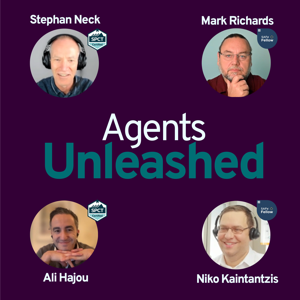

Does AI make Solution Intent obsolete—or finally give it the living, breathing life it was always meant to have? Four practitioners who've never seen anyone "install" a solution intent explore whether AI creates dangerous rigidity or unprecedented opportunity.
Stephan anchors a conversation that begins with confession: Ali has rarely seen solution intent used as intended. Mark reframes it entirely—not as something to install, but as "a map, a mesh, and a mindset." Niko brings his alternative name: "product memory"—the bus factor savior. Together they navigate Stephan's opening paradox: AI can accelerate solution intent's creation while threatening to make it obsolete or dangerously rigid.
From Automation to Augmentation
The conversation pivots on Mark's sharp distinction: AI as sparring partner versus AI as document generator. "If you let AI generate 80% of your solution intent, the only person accountable for that much rubbish is you." The hosts explore using AI to challenge thinking—"point out the three biggest flaws," "what assumptions should I test?"—rather than producing voluminous output nobody reads.
Intent as the New Source of Truth
Mark surfaces a paradigm shift: "We're moving from code is the source of truth to intent is the source of truth." Citing Llewellyn Falco's hackathon where the team would have chosen specs over code, the conversation explores what happens when specifications become more valuable than what they produce.
Optimizing the Wrong Percentage
Are we optimizing the 8-12% of the value stream where AI writes code, while missing where solution intent actually lives? Mark argues its natural home is the beginning (exploring options) and the end (tracing what was built against intent). Niko is blunt: "We are optimizing the wrong percent."
The Monster Network
Niko offers a memorable framing: Is your solution intent a Jurassic Park monster—one terrifying monolith? Or Monster Inc.—a network of smaller, friendlier creatures you can navigate? The latter is what AI might help create: an entry point where some elements are augmented while others remain human-crafted.
Highlight Moments:
On accountability, Ali cuts to the heart: "There is a need for a single, ringable neck." Delegation to AI doesn't eliminate accountability—it concentrates it.
Niko's warning lands hard: "We have to be careful if we outsource everything to AI to not lose the skills of critical thinking."
The prison jiggle produces unexpected depth—and Niko's meta-observation that AI couldn't have produced these culturally-contextual answers proves his point about what machines still can't do.
Closing:
Stephan closes with a haiku: "AI writes so fast, yet wisdom needs time to grow. Keep options open." The takeaway isn't whether AI should power solution intent—it's that the intent must live and breathe. Producing more documentation nobody reads? That's not solution intent. That's just rubbish with your name on it.
 View all episodes
 By Stephan Neck, Niko Kaintantzis, Ali Hajou, Mark Richards
Does AI make Solution Intent obsolete—or finally give it the living, breathing life it was always meant to have? Four practitioners who've never seen anyone "install" a solution intent explore whether AI creates dangerous rigidity or unprecedented opportunity.
Stephan anchors a conversation that begins with confession: Ali has rarely seen solution intent used as intended. Mark reframes it entirely—not as something to install, but as "a map, a mesh, and a mindset." Niko brings his alternative name: "product memory"—the bus factor savior. Together they navigate Stephan's opening paradox: AI can accelerate solution intent's creation while threatening to make it obsolete or dangerously rigid.
From Automation to Augmentation
The conversation pivots on Mark's sharp distinction: AI as sparring partner versus AI as document generator. "If you let AI generate 80% of your solution intent, the only person accountable for that much rubbish is you." The hosts explore using AI to challenge thinking—"point out the three biggest flaws," "what assumptions should I test?"—rather than producing voluminous output nobody reads.
Intent as the New Source of Truth
Mark surfaces a paradigm shift: "We're moving from code is the source of truth to intent is the source of truth." Citing Llewellyn Falco's hackathon where the team would have chosen specs over code, the conversation explores what happens when specifications become more valuable than what they produce.
Optimizing the Wrong Percentage
Are we optimizing the 8-12% of the value stream where AI writes code, while missing where solution intent actually lives? Mark argues its natural home is the beginning (exploring options) and the end (tracing what was built against intent). Niko is blunt: "We are optimizing the wrong percent."
The Monster Network
Niko offers a memorable framing: Is your solution intent a Jurassic Park monster—one terrifying monolith? Or Monster Inc.—a network of smaller, friendlier creatures you can navigate? The latter is what AI might help create: an entry point where some elements are augmented while others remain human-crafted.
Highlight Moments:
On accountability, Ali cuts to the heart: "There is a need for a single, ringable neck." Delegation to AI doesn't eliminate accountability—it concentrates it.
Niko's warning lands hard: "We have to be careful if we outsource everything to AI to not lose the skills of critical thinking."
The prison jiggle produces unexpected depth—and Niko's meta-observation that AI couldn't have produced these culturally-contextual answers proves his point about what machines still can't do.
Closing:
Stephan closes with a haiku: "AI writes so fast, yet wisdom needs time to grow. Keep options open." The takeaway isn't whether AI should power solution intent—it's that the intent must live and breathe. Producing more documentation nobody reads? That's not solution intent. That's just rubbish with your name on it.