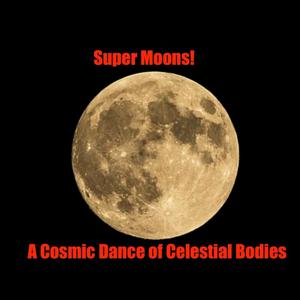
In the vast ocean of space, on the shore of the cosmic sea, we find ourselves gazing up at the night sky, witnesses to a celestial spectacle that has captivated humanity for millennia. Among the countless stars and wandering planets, one object stands out, closer and more familiar than any other celestial body – our Moon. And sometimes, this constant companion appears to us larger and brighter than usual, a phenomenon we've come to call a Super Moon. To understand the Super Moon, we must first embark on a journey through space and time, to comprehend the intricate dance of celestial bodies that governs our universe. We are but tiny motes of dust in the grand cosmic arena, yet through our curiosity and ingenuity, we've unraveled many of the mysteries that surround us. Our story begins with the birth of the Moon itself. About 4.5 billion years ago, when our planet was still young, a Mars-sized body collided with the proto-Earth. From this violent collision, debris was thrown into orbit around our planet. Over time, this debris coalesced, forming the Moon we see today. This cosmic creation story ties us inextricably to our lunar companion – in a very real sense, the Moon is a part of Earth, torn away and reformed in the sky. As the Moon formed, it began its eternal orbit around our planet. But this orbit, like many things in nature, is not a perfect circle. Instead, the Moon follows an elliptical path, sometimes closer to Earth, sometimes farther away. This elliptical orbit is the key to understanding the Super Moon phenomenon. At its closest approach to Earth, the Moon reaches a point we call perigee. At its furthest, it reaches apogee. The difference between these two points is substantial – about 50,000 kilometers, or more than three times the diameter of Earth itself. When a full Moon coincides with, or occurs near, perigee, we experience what we now call a Super Moon. But why "super"? To our eyes, a Super Moon appears up to 14% larger and 30% brighter than a full Moon at apogee. While these numbers might seem small, the effect can be striking, especially when the Moon is near the horizon. The Moon Illusion, a quirk of human perception that makes the Moon appear larger when it's low in the sky, enhances the impact of a Super Moon, creating a truly awe-inspiring sight. The term "Super Moon" itself is relatively new, coined in 1979 by astrologer Richard Nolle. However, the phenomenon has been observed and recorded by various cultures throughout history. Ancient astronomers, lacking our modern understanding of orbital mechanics, often attributed special significance to these unusually large and bright full Moons. In reality, Super Moons are not as rare as one might think. They occur, on average, three to four times a year. Yet each one is a reminder of the dynamic nature of our cosmic environment, a visible manifestation of the gravitational forces that shape our solar system. To truly appreciate the Super Moon, we must consider the forces at play.
This content was created in partnership and with the help of Artificial Intelligence AI.



 View all episodes
