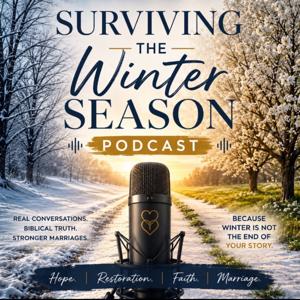
Surviving the Winter Season

Surviving the Winter Season

By Marty and Stephanie ParkerReligion & SpiritualityChristianity
Download on the App Store

Surviving the Winter Season episodes

  • Episode 7: Are You Giving Your Spouse the Leftovers?

    After giving your best energy to work, ministry, parenting, responsibilities, and everyone who needs something from you, what remains for your spouse?

    In this episode of Surviving the Winter Season, Marty and Stephanie discuss how couples can unintentionally give each other the leftovers of their time, attention, patience, and affection. This pattern rarely begins with a deliberate choice to neglect a marriage. It develops gradually as exhaustion, busy schedules, distractions, and competing priorities take over.

    Being in the same room does not necessarily mean a couple is connected. Spouses can spend hours together while scrolling on their phones, discussing schedules, managing responsibilities, or barely speaking. Quantity of time cannot replace the intentional conversations and undivided attention that build emotional connection.

    Marty and Stephanie examine why people sometimes offer greater patience and kindness to coworkers, friends, and strangers than to those they love most. They discuss setting healthy boundaries, communicating exhaustion without becoming unkind, creating meaningful moments without expensive dates, and giving a marriage attention before it reaches a crisis.

    They also introduce a seven-day challenge: give your spouse 15 minutes of undivided attention each day—without phones or television. Ask how they are really doing, listen without trying to fix everything, and share something you appreciate about them.

    Your spouse should receive more than what remains after everyone else has received your best.


    Chapter markers
    • 00:00 — A conversation about leftovers
    • 01:07 — Giving your spouse what remains after a long day
    • 01:42 — Welcome to Episode 7
    • 07:01 — Have you ever received leftovers from your spouse?
    • 09:20 — Burnout and its effect on marriage
    • 09:26 — Creating healthier boundaries
    • 11:58 — Present but not connected
    • 15:55 — Quantity time versus quality time
    • 18:58 — Work, children, television, and phone distractions
    • 20:25 — Disconnection creates tension and impatience
    • 21:41 — Why strangers sometimes receive our best behavior
    • 24:07 — Exhaustion does not excuse unkindness
    • 24:30 — Being kind, tenderhearted, and forgiving
    • 28:54 — Communicating exhaustion without hurting your spouse
    • 33:20 — Give your marriage attention before a crisis
    • 33:25 — Why small moments of connection matter
    • 35:14 — Preventing the “roommate” relationship
    • 37:00 — Rearranging priorities instead of waiting for spare time
    • 38:06 — Considering your spouse’s interests
    • 40:41 — Making room for what matters
    • 41:06 — The seven-day connection challenge
    • 44:03 — What difference could seven days make?
    • 44:28 — Growth, grace, repentance, and beginning again
    • 45:56 — A prayer for disconnected couples
    • 47:30 — Holding on to hope for restoration
    • Key takeaways
      • Neglect often develops gradually rather than through an intentional decision.
      • Physical presence does not guarantee emotional connection.
      • Conversations about schedules and responsibilities cannot replace meaningful connection.
      • Work, ministry, parenting, television, and phones can all become distractions.
      • Your spouse should not consistently receive what remains after everyone else receives your best.
      • Being tired does not excuse treating your spouse unkindly.
      • Healthy boundaries protect marriages from burnout.
      • Small, inexpensive moments of attention can matter more than elaborate dates.
      • A healthy marriage needs attention before it reaches a crisis.
      • Couples must schedule connection instead of waiting for spare time.
      • Listening without fixing communicates care and emotional presence.
      • Consistent, intentional attention can begin rebuilding a disconnected marriage.
      • Scriptures mentioned
        • Ephesians 4:32 — Be kind and tenderhearted, forgiving one another.
        • Philippians 2:3–4 — Avoid selfishness and consider the interests of others.
        • 49 min
        • Episode 6: For Better or Worse — What Commitment Really Means

          What does commitment look like after the wedding day—especially when marriage no longer feels easy or romantic?

          In this episode of Surviving the Winter Season, Marty and Stephanie discuss the meaning of “for better or for worse” after more than 30 years of marriage. Feelings can change from day to day and season to season, but commitment is a covenant continually lived out through ordinary choices.

          They reflect on seasons involving depression, grief, emotional distance, parenting, changing responsibilities, and other pressures that tested their relationship. During the hardest moments, prayer, Scripture, forgiveness, and their relationships with God helped them continue choosing one another—even when they didn’t feel especially close.

          Marty and Stephanie also discuss removing divorce threats from disagreements, rebuilding trust through honesty, continuing to date and pursue one another, protecting friendship, and seeking counseling or coaching before small problems become overwhelming.

          Biblical commitment includes truth, faithfulness, love, grace, and perseverance. However, commitment never requires someone to remain in an abusive, threatening, or dangerous situation. Safety and qualified outside help matter.

          Marriage will move through changing seasons. Commitment means continuing to show up, pursue one another, seek God together, and say through both words and actions, “I still choose you.”


          Chapter markers
          • 00:00 — What does commitment mean?
          • 03:15 — Welcome to Episode 6
          • 03:28 — Commitment cannot be based entirely on feelings
          • 05:19 — What does “for worse” actually look like?
          • 07:32 — A difficult season is different from deciding it’s over
          • 08:59 — Choosing your spouse every day
          • 10:12 — Prayer, Scripture, and depending on God
          • 11:00 — Choosing love when you don’t feel in love
          • 12:14 — How difficult seasons test commitment
          • 13:10 — Depression, grief, and emotional distance
          • 14:45 — Remembering that hardship is a season
          • 15:25 — How children and life changes affect marriage
          • 16:37 — Why married couples should continue dating
          • 17:00 — How faith helped Stephanie keep choosing
          • 18:24 — Removing divorce from the vocabulary
          • 19:56 — Creating security during disagreements
          • 21:44 — Commitment in ordinary things
          • 23:10 — Continuing to communicate and pursue each other
          • 24:26 — Protecting friendship in marriage
          • 25:21 — Everyday actions that create security
          • 27:36 — Why commitment requires forgiveness
          • 30:23 — When couples should seek outside help
          • 33:11 — Fighting for what God has joined together
          • 33:45 — Love perseveres through every circumstance
          • 35:55 — Continuing to pursue and choose one another
          • 36:14 — Commitment never requires remaining unsafe
          • 36:47 — Practical steps for this week
          • 37:23 — “One reason I would choose you again…”
          • 38:21 — Turning commitment into action
          • 39:03 — Choosing each other through every season
          • Key takeaways
            • Commitment is more than a wedding-day promise; it is lived out continually.
            • Feelings matter, but they are not a stable foundation for lifelong commitment.
            • A difficult season does not automatically mean a marriage is finished.
            • Prayer and spiritual growth can help spouses choose love during hard seasons.
            • Threatening divorce during arguments can damage trust and security.
            • Trust grows through faithfulness, honesty, and keeping your word.
            • Commitment appears in ordinary actions: showing up, communicating, serving, forgiving, and remaining friends.
            • Counseling or coaching is a sign of wisdom, not weakness.
            • Grace and forgiveness make restoration possible.
            • Healthy commitment never requires someone to remain in abuse, danger, or an unsafe situation.
            • Love should be expressed through practical action, not words alone.
            • Scriptures mentioned
              • Mark 10:9 — What God has joined together, no one should separate.
              • 1 Corinthians 13:7 — Love never gives up, never loses faith, remains hopeful, and endures through every circumstance.
              • 40 min
              • Episode 5: Stop Trying to Win the Argument

                Have you ever started with a small disagreement and ended up in a major argument—without even remembering how it began?

                In this episode of Surviving the Winter Season, Marty and Stephanie discuss the difference between solving a problem and trying to win an argument. They honestly examine their own conflict habits, including becoming defensive, interrupting, raising their voices, shutting down, revisiting old issues, and listening only long enough to prepare a response.

                Many arguments aren’t really about the issue on the surface. Underneath them may be feelings of being unheard, unappreciated, rejected, unimportant, or disconnected. When spouses treat each other like opposing attorneys, they can lose sight of an essential truth: your spouse is not the problem. The problem is the problem, and you are supposed to face it together.

                Marty and Stephanie share practical ways to disagree more constructively, including taking a healthy timeout, returning to unfinished conversations, listening before responding, apologizing without adding a defense, and asking whether the issue will still matter next week, next month, or next year.

                They also introduce a simple two-minute exercise that gives each spouse uninterrupted time to explain what they feel and need. The goal is not necessarily agreement—it is understanding.

                You don’t have to win against the person you’re supposed to be winning with.


                Chapter markers
                • 00:00 — When a small disagreement becomes a major argument
                • 02:31 — Welcome to Episode 5
                • 03:13 — Entering “defense lawyer” mode
                • 05:19 — Who becomes defensive?
                • 06:23 — Resolving conflict immediately versus taking time to process
                • 09:23 — Raising voices, shutting down, and revisiting old issues
                • 10:04 — What makes communication harder during disagreements?
                • 13:34 — The argument may not be about the real issue
                • 14:06 — Feeling unheard, unappreciated, or disconnected
                • 16:08 — What has changed after 30 years of marriage?
                • 17:52 — Remembering that you’re on the same side
                • 18:09 — Why accusations make listening difficult
                • 20:32 — Quick to listen and slow to become angry
                • 23:48 — The problem is the problem—not your spouse
                • 27:00 — Healthy timeouts versus the silent treatment
                • 29:19 — Reassuring your spouse during a difficult conversation
                • 29:36 — Apologizing without adding “but”
                • 34:41 — Not every issue deserves the same emotional energy
                • 35:39 — Will this still matter next week?
                • 35:53 — This week’s marriage challenge
                • 36:26 — The two-minute listening exercise
                • 37:29 — Repeating what you heard
                • 38:18 — Understanding matters more than agreement
                • 38:37 — Winning with your spouse instead of against them
                • Key takeaways
                  • Solving a problem and winning an argument are not the same thing.
                  • Defensiveness can turn spouses into opposing attorneys.
                  • The surface disagreement may conceal feelings of rejection or disconnection.
                  • Your spouse is not the enemy; the problem is the problem.
                  • Listening does not require agreeing with everything your spouse says.
                  • A healthy timeout includes a commitment to return to the conversation.
                  • The silent treatment uses distance as punishment and is not a healthy timeout.
                  • A sincere apology takes responsibility without adding an excuse or defense.
                  • Not every preference deserves the same emotional energy.
                  • The goal of conflict should be understanding and connection—not victory.
                  • 40 min
                  • Episode 4: “You Should Have Known” — Unspoken Expectations in Marriage

                    Every person enters marriage with expectations—some clearly understood and others hidden beneath the surface. We develop ideas about affection, money, conflict, family traditions, responsibilities, and what a husband or wife should be by watching the relationships around us. Problems arise when those unspoken expectations become tests our spouses don’t even know they’re taking.

                    In this episode of Surviving the Winter Season, Marty and Stephanie explore how different family backgrounds and communication styles shaped their expectations of marriage. They discuss the frustration behind the phrase “You should have known” and why even couples who have been together for decades cannot expect one another to read minds.

                    They also examine the pressure created when we expect a spouse to provide all our happiness, security, value, and fulfillment. Our spouses can love us deeply, but they cannot take the place that belongs to God.

                    Through honest conversation, biblical encouragement, and plenty of laughter, Marty and Stephanie explain how to replace accusations with invitations, communicate needs clearly, listen without immediately hearing criticism, and offer grace while continuing to grow.

                    Unmet expectations do not have to become resentment. Healthy marriages are built when couples replace assumptions with honest conversations and continue choosing grace, growth, and one another.


                    Chapter markers
                    • 00:00 — Expectations versus the person you actually married
                    • 01:57 — Welcome to Episode 4
                    • 02:09 — Nobody enters marriage with a blank slate
                    • 06:15 — Bringing two different family backgrounds together
                    • 10:59 — When different expectations collide
                    • 12:40 — The danger of unspoken expectations
                    • 13:33 — Giving your spouse an unfair test
                    • 15:02 — The phrase “You should have known”
                    • 16:17 — Why spouses cannot read each other’s minds
                    • 19:11 — Your spouse cannot be your everything
                    • 19:55 — Finding hope and fulfillment in God
                    • 21:39 — Replacing accusations with invitations
                    • 22:22 — “Can I tell you what I need?”
                    • 22:56 — Hearing a request without assuming criticism
                    • 25:49 — What Marty and Stephanie need in their current season
                    • 30:59 — Healthy expectations in marriage
                    • 31:46 — Grace provides room to grow
                    • 32:49 — Becoming more like Jesus
                    • 33:16 — This week’s marriage challenge
                    • 36:35 — Why the small things matter
                    • 37:07 — Closing encouragement
                    • Key takeaways
                      • Everyone brings expectations into marriage from family, culture, and past experiences.
                      • Different expectations can look like conflict even when neither spouse intends harm.
                      • An expectation that was never communicated can become an unfair test.
                      • Being married for many years does not make spouses mind readers.
                      • “Can I tell you what I need?” creates a healthier conversation than “You should have known.”
                      • A request for connection should not automatically be interpreted as criticism.
                      • No spouse can provide all another person’s happiness, security, value, and fulfillment.
                      • Grace does not provide permission to stop growing; it provides room to grow.
                      • Healthy expectations include faithfulness, honesty, respect, commitment, kindness, and continued growth.
                      • Disappointment does not have to become resentment when couples communicate honestly.
                      • Scripture mentioned

                        Psalm 62:5 — Wait quietly before God, because our hope ultimately comes from Him.

                        38 min
                      • Episode 3: Are You Listening? Reconnecting Through Better Communication

                        Talking and communicating are not always the same thing.

                        In this episode of Surviving the Winter Season, Marty and Stephanie explore what happens when marriage becomes all business. Couples may spend the entire day discussing children, schedules, work, bills, appointments, and responsibilities—yet never genuinely connect with each other.

                        They discuss the difference between hearing and listening, why a spouse may need understanding instead of a solution, and how responding to someone’s pain by defending your intentions can leave them feeling dismissed. They also examine how phones, television, work, ministry, and even parenting can consume the attention that a marriage needs.

                        With honesty, biblical encouragement, and plenty of humor, Marty and Stephanie share practical ways to make conversations safer and more meaningful. They encourage couples to consider their timing, tone, and choice of words; listen to understand instead of preparing a defense; and remember that winning an argument is never worth losing connection with your spouse.

                        This week’s challenge is simple: set aside 15 distraction-free minutes, ask your spouse, “How are you really doing?”—and listen without interrupting, defending, or trying to fix everything.

                        One honest conversation can become a new beginning.


                        Chapter markers
                        • 00:00 — Hearing versus genuinely listening
                        • 02:41 — Welcome to Episode 3
                        • 03:11 — When marriage becomes all business
                        • 05:23 — “Do you want me to listen or fix it?”
                        • 07:05 — Intentions versus emotional impact
                        • 08:54 — How phones and other distractions affect communication
                        • 10:18 — Giving loved ones the leftovers of our attention
                        • 10:59 — Why spouses eventually stop talking
                        • 12:05 — A quiet marriage isn’t necessarily a healthy marriage
                        • 13:05 — Listening to understand or listening to defend?
                        • 14:39 — Why timing, tone, and words matter
                        • 16:24 — Winning the argument but losing the connection
                        • 17:20 — Being quick to listen: James 1:19
                        • 18:00 — Using words to build one another up
                        • 19:38 — When Marty and Stephanie feel most connected
                        • 21:00 — Understanding Marty’s “fix-it” response
                        • 26:17 — The 15-minute communication challenge
                        • 28:02 — Rebuilding one conversation at a time
                        • 28:36 — One conversation can become a new beginning
                        • 29:03 — Closing encouragement
                        • Key takeaways
                          • Couples can exchange information all day without emotionally connecting.
                          • Hearing someone and listening to understand them are different.
                          • Ask whether your spouse wants support or help finding a solution.
                          • A person’s intentions do not erase the emotional impact of their actions.
                          • Eye contact and undivided attention communicate that your spouse matters.
                          • Constant defensiveness can eventually make a spouse stop trying to talk.
                          • The absence of arguments does not necessarily indicate a healthy marriage.
                          • Timing, tone, and word choice shape difficult conversations.
                          • Your spouse is not the enemy; the problem is the problem.
                          • Strong communication is built one honest conversation at a time.
                          • Scriptures mentioned
                            • James 1:19 — Be quick to listen, slow to speak, and slow to become angry.
                            • Ephesians 4 — Use your words to build others up.
                            • 30 min
                            • Episode 2: When Little Things Become Big Things in Marriage

                              Small frustrations don’t always stay small. When hurt is ignored, conversations are avoided, and offenses are quietly collected, minor irritations can gradually become resentment and emotional distance.

                              In this episode of Surviving the Winter Season, Marty and Stephanie discuss how unresolved issues affect the way spouses see and respond to one another. Using the picture of a pebble in your shoe, they explain that the original problem may not grow—but the irritation surrounding it can.

                              They also share a personal story about grief, misplaced anger, and the resentment that affected their marriage for years. Through honesty, biblical encouragement, and their usual humor, Marty and Stephanie offer practical ways to address hurt before it becomes a deeper wound: talk about it early, create a safe space for conversation, listen without becoming defensive, take responsibility, and apologize without making excuses.

                              They also remind couples that accumulation can work in a positive direction. Small expressions of kindness, attention, prayer, gratitude, and affection can steadily rebuild connection.

                              Don’t let little hurts become big wounds—and never underestimate the power of small acts of love.

                              Chapter markers
                              • 00:00 — Welcome and introduction
                              • 00:48 — How little things become big things
                              • 03:12 — When “always” and “never” enter an argument
                              • 05:13 — The pebble-in-your-shoe illustration
                              • 07:32 — Today’s conflict may expose yesterday’s pain
                              • 10:43 — Letting something go versus stuffing it
                              • 12:37 — What does “nothing’s wrong” really mean?
                              • 15:28 — Making difficult conversations feel safe
                              • 16:07 — Anger, Scripture, and giving arguments a bedtime
                              • 17:33 — How resentment changes your view of your spouse
                              • 20:15 — Marty’s story of grief and misplaced resentment
                              • 25:23 — Moving from identifying problems to practical action
                              • 25:56 — Talk early, listen carefully, and apologize without excuses
                              • 29:17 — How small acts of love rebuild connection
                              • 32:06 — This week’s marriage challenge
                              • 34:05 — Marriages are built through everyday choices
                              • Key takeaways
                                • Many large conflicts begin with small hurts that were never addressed.
                                • A new disagreement may expose an older, unresolved wound.
                                • Letting go is different from suppressing anger.
                                • Difficult conversations need to feel emotionally safe.
                                • Resting during an argument can be healthy if the couple returns to the issue.
                                • Listening to understand is more valuable than immediately defending your intentions.
                                • A sincere apology takes responsibility without adding “but.”
                                • Small, consistent acts of love can rebuild closeness.
                                • Healthy marriages are formed through everyday choices to listen, forgive, show kindness, and choose each other.
                                • 35 min
                                • Episode 1: Meet the Parkers

                                  Welcome to the first episode of Surviving the Winter Season.

                                  Marty and Stephanie Parker introduce themselves, share how their relationship began, and reflect on more than 30 years of marriage. Through honest stories, playful disagreements, and plenty of laughter, they discuss how their relationship has changed through dating, marriage, parenting five children, and the unexpected challenges of life.

                                  They also introduce the central message of the podcast: every marriage experiences different seasons. Some bring growth, closeness, and new beginnings, while others bring conflict, financial pressure, parenting stress, loss, disconnection, or unmet expectations. A winter season may feel lifeless, but it does not have to be the end of the story.

                                  Grounded in their faith in Jesus, Marty and Stephanie explain how grace, forgiveness, friendship, and continuing to choose one another helped them survive their hardest seasons. Their marriage is not perfect, but it is still growing—and they want other couples to know that hope remains.

                                  Winter seasons don’t last forever.


                                  Chapter markers
                                  • 00:00 — Welcome and meet Marty and Stephanie
                                  • 02:38 — How they first met
                                  • 06:30 — Dating, falling in love, and getting married young
                                  • 10:00 — Expectations versus the reality of marriage
                                  • 12:30 — A lighthearted look at their personalities and habits
                                  • 18:52 — How raising five children changed their lives
                                  • 25:25 — The different seasons of marriage
                                  • 29:18 — Why a winter season is not the end
                                  • 32:16 — Faith, forgiveness, grace, and choosing each other
                                  • 35:00 — Keeping laughter alive
                                  • 38:49 — Topics coming in future episodes
                                  • 40:59 — Quick-fire questions and closing encouragement
                                  • Key topics

                                    Marriage, Christian faith, relationships, parenting, communication, forgiveness, difficult seasons, emotional connection, hope, and humor.


                                    46 min

                                  About Surviving the Winter Season

                                  From the publisher's feed

                                  Every marriage moves through seasons. Some are filled with growth, connection, and joy. Others bring conflict, financial pressure, parenting challenges, loss, unmet expectations, or painful distance. But a difficult season does not have to become the end of your story.