
Sign up to save your podcasts
Or

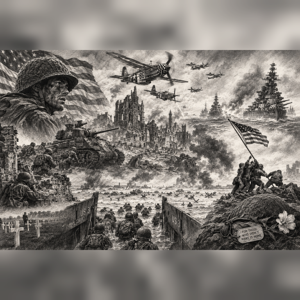


In early 1945 the tiny volcanic island of Iwo Jima became a brutal focal point of the Pacific war: a strategic waypoint for bombers, turned into a fortress by General Tadamichi Kuribayashi’s miles-long tunnel network. American Marines landed on February 19 amid ash-black sand, hidden defenses, and relentless close combat that turned every yard into a desperate fight.
The famous flag-raising on Mount Suribachi on February 23 offered a symbolic moment, but the battle raged on with massive casualties and costly tactics. Iwo Jima remains both a strategic case study and a human crucible—an iconic image that can never fully capture the months of sacrifice, confusion, and the lingering debate over the price of victory.
An intense World War II naval manhunt: after Bismarck sinks HMS Hood, the Royal Navy races across the Atlantic through storms, intelligence gaps, and split-second choices to stop the German battleship from breaking out into the convoy lanes.
Damaged and leaking fuel, Bismarck is finally crippled by carrier-launched torpedoes that jam her rudder, allowing British battleships to close in. The final battle—heavy bombardment, chaos, and contested accounts of scuttling—ends the threat and reshapes how sea power is fought.
June 6, 1944: a colossal, risky invasion unfolds as Allied forces launch a coordinated assault by land, sea, and air to open a Western front in Europe. This episode walks through the planning, deception that fooled German commanders, the brutal airborne drops, and the desperate, varied fights on Utah, Omaha, Gold, Juno, and Sword.
It also highlights the logistical feats—Mulberry harbors, supply lines—and the human cost: small-unit leadership, scattered paratroopers, and civilians caught in between. D-Day wasn’t inevitable; it combined preparation, bravery, bad weather, and luck to change the course of the war.
Need camo and outdoor gear without the hassle? Quikcamo.com offers a solid selection of camouflage and outdoor products to help you gear up quickly for hunting, seasonal prep, or kit upgrades — and you can save 25% right now.
Use the promo code at checkout to get 25% off your order. Shop Quikcamo.com, save big, and get back outside.🛒 QuikCamo - 3D Leafy Camo Suits, Hat/Masks & Gloves 💰 Get 25% OFF | Promo Code: 65489 https://promocode.to/quikcamo/65489-669
Osowiec was a late‑19th‑century fortress in the marshes of the Eastern Front where, in 1915, a German chlorine gas attack seemed to finish off the Russian defenders—until a small, gas‑poisoned group rose and charged back, halting the assault in a moment forever called the "Attack of the Dead Men."
This episode unpacks the terrain, engineering, and desperate improvisations that shaped the fight, explains why the counterattack worked despite horrific casualties, and places the legend in its wider strategic context: a local, brutal victory set against the larger Russian retreat and the grim human cost of chemical warfare.
The Tiger I was Germany’s answer to tougher battlefield threats — a heavily armored tank armed with the feared 8.8 cm gun that could engage enemies at long range and dominate many one-on-one encounters.
But its power came with costs: extreme weight, mechanical complexity, high fuel use, and demanding logistics that limited production and strategic impact. This episode explains how the Tiger became both a tactical terror and a logistical liability, shaping legend and reality alike.
Welcome in. Today we’re doing something surprisingly fun and very loud, at least in theory: we’re talking about artillery pieces. Not just “big guns go boom,” but what artillery really is, the different kinds of artillery pieces, how they’re used, and why they still matter in modern warfare.
If you’ve ever wondered about terms like howitzer, mortar, or multiple rocket launcher, this episode breaks down the differences, how targeting and fire direction work, the variety of ammunition, and how modern tech—drones, guided rounds, and fast-moving platforms—changes the game. Artillery isn’t just hardware; it’s a whole system of observation, calculation, logistics, and tactics that controls space and time on the battlefield.
My deals and discounts: - QuikCamo (25% Off) 🔗 Get them at: https://MyDeals.Page/1rek 🎁 Code: 65489Go behind the headlines and into the shipyard to follow the construction of the Japanese battleship Yamato: the dry docks, cranes, secrecy, and the massive engineering compromises required to carry the world’s largest guns. This episode explains why Japan chose overwhelming individual power, how armor, propulsion, and turret installation shaped the hull, and the logistical and human effort needed to turn steel into a warship.
From internal compartmentalization and fire-control systems to fitting-out and sea trials, the episode shows Yamato as both an industrial masterpiece and a strategic bet—one forged under wartime urgency while naval warfare was rapidly changing.
Welcome to the show: a practical tour of World War Two tactics that focuses on squads, platoons, companies, and battalions—how infantry, artillery, armor, aircraft, and ships coordinated to win or lose minute by minute.
We explore combined-arms methods, mission command, reconnaissance, artillery and air support, terrain-specific adaptations (desert, hedgerow, urban, island), and the core lesson: wars are won by systems that communicate, support, and adapt faster than the enemy.
From the publisher's feed