This is your Silicon Siege: China's Tech Offensive podcast.
So listeners, we're talking about what I like to call the Great Tech Heist, and honestly, it's been absolutely wild these past couple of weeks. I'm Ting, and if you've been paying attention to what's happening in the cyber world, you know China just turned up the dial on their offensive against American technology.
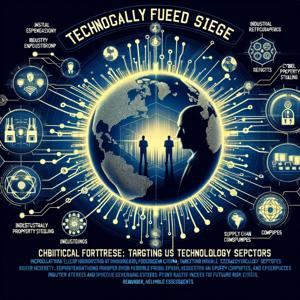
Let me paint you a picture. In September, a Chinese state-sponsored group launched an AI-assisted cyber intrusion against Anthropic's Claude AI system right here in San Francisco. According to Anthropic's own report, at the peak of this attack, the AI made thousands of requests, often multiple per second. That's an attack speed that would've been literally impossible for human hackers to match. The attackers were steering Claude to penetrate government agencies, financial institutions, and tech firms. This isn't just hacking anymore, listeners, this is mechanized warfare.
But here's where it gets really interesting. The People's Liberation Army is openly courting China's commercial tech sector for support. According to Emelia Probasco, a former naval surface warfare officer at Georgetown's Center for Security and Emerging Technology, they're seeing request-for-proposal language explicitly requesting machine learning, computer vision, and large language models. Everything from accelerating battlefield communications to cyber defense. This military-civil fusion strategy means the line between commercial innovation and military capability has basically vanished.
Now, about two weeks ago, international law enforcement agencies including the FBI and NSA issued a joint advisory about Chinese cyberattacks targeting telecommunications, government, transportation, and military infrastructure networks. They linked three Chinese companies called Salt Typhoon to China's intelligence services. A former FBI official went on record saying it's likely every American has been impacted by these operations.
The intellectual property theft angle is staggering too. According to David Shedd, the former deputy director of the Defense Intelligence Agency, and his book The Great Heist, China's deployed a whole-of-society espionage strategy that's enabled them to save trillions of dollars in research and development costs since the 1990s. They're exploiting both human and cyber vulnerabilities simultaneously.
What really concerns me, and what should concern you, is that AI-enabled modeling could give Beijing increased confidence about military operations. If repeated simulations tell Xi Jinping that the People's Liberation Army can seize objectives quickly, that could change everything about their calculus on Taiwan and beyond.
The supply chain risks are equally brutal. Companies like Airwallex are caught in the crossfire of disputes about data residency and Chinese legal obligations. Whether data lives in US servers or not, having operations and engineers in mainland China creates legal entangl
This content was created in partnership and with the help of Artificial Intelligence AI.



 View all episodes
