
Sign up to save your podcasts
Or

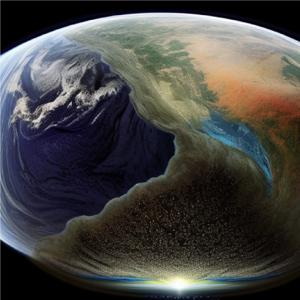

The Earth formed about 4.54 billion years ago, approximately one-third the age of the universe, by accretion from the solar nebula. The solar nebula was a cloud of dust and gas that collapsed under its own gravity. As the cloud collapsed, it spun faster and faster, forming a disk of material. The material in the disk became increasingly hot, and eventually the first stars and planets formed.
The Earth formed from a region of the solar nebula that was rich in heavy elements. These elements were likely delivered to the solar nebula by comets and asteroids that collided with the early Earth. The Earth's core formed first, as the heaviest elements sank to the center of the planet. The mantle and crust formed later, as the lighter elements rose to the surface.
The early Earth was a very hot and violent place. The surface was covered in molten lava, and there was no atmosphere to protect the planet from the harsh radiation from the Sun. However, over time, the Earth cooled and the atmosphere began to form. Volcanic outgassing released water vapor, carbon dioxide, and other gases into the atmosphere. These gases eventually condensed to form the oceans, and the Earth began to resemble the planet we know today.
The formation of the Earth was a complex and chaotic process, but it ultimately led to the creation of a planet that is home to life. The Earth is a unique planet in the solar system, and it is likely that the conditions that allowed for the formation of life are not present on any other planet. We are still learning about the early history of the Earth, but the more we learn, the more we realize just how special our planet is.
 View all episodes
 By Robert G. Kraushaar
The Earth formed about 4.54 billion years ago, approximately one-third the age of the universe, by accretion from the solar nebula. The solar nebula was a cloud of dust and gas that collapsed under its own gravity. As the cloud collapsed, it spun faster and faster, forming a disk of material. The material in the disk became increasingly hot, and eventually the first stars and planets formed.
The Earth formed from a region of the solar nebula that was rich in heavy elements. These elements were likely delivered to the solar nebula by comets and asteroids that collided with the early Earth. The Earth's core formed first, as the heaviest elements sank to the center of the planet. The mantle and crust formed later, as the lighter elements rose to the surface.
The early Earth was a very hot and violent place. The surface was covered in molten lava, and there was no atmosphere to protect the planet from the harsh radiation from the Sun. However, over time, the Earth cooled and the atmosphere began to form. Volcanic outgassing released water vapor, carbon dioxide, and other gases into the atmosphere. These gases eventually condensed to form the oceans, and the Earth began to resemble the planet we know today.
The formation of the Earth was a complex and chaotic process, but it ultimately led to the creation of a planet that is home to life. The Earth is a unique planet in the solar system, and it is likely that the conditions that allowed for the formation of life are not present on any other planet. We are still learning about the early history of the Earth, but the more we learn, the more we realize just how special our planet is.