
Sign up to save your podcasts
Or


Venerable Shoushan picked up his “bamboo comb” and said to the assembly, "You people of various ranks, if you call out ‘bamboo comb’ you butt your head into the norm. Not calling out ‘bamboo comb’ you turn your back to the norm. You various people, just say what do you call out?”
Free radicals are best known as those things that are often vilified in pop science media for causing all kinds of problems in your body and needing to be defended against by anti-oxidants and bright colored fruits and vegetables and resveratrol and stuff.
Here's a quick synopsis of what a free radical is in terms of chemistry:
> [A] radical, also known as a free radical, is an atom, molecule, or ion that has at least one unpaired valence electron. With some exceptions, these unpaired electrons make radicals highly chemically reactive. Many radicals spontaneously dimerize. Most organic radicals have short lifetimes.
Ripping "free radicals" out of chemistry and depositing them into the realm of ideas, it seems to me that the free-radicalization of meaning - that is the liberation of meaning from its normative constraints in order to maximize its creative reactivity - is critical to being able to freely express yourself appropriately under any and all circumstances.
Take the christian Bible, for instance. In terms of meaning repletion, it's got to be a top .01% document, no matter which edit you use. It's also a fantastic example of the way bound meaning constrains rather than liberates. If you hew to a particular interpretation of some portion or portions of the document - as defined by the dogma of a given church, or a given priest, or a given pastor - then you become bound to that singular interpretation. But if you don't hew to any particular dogma, the Bible is full of robust imagery and evocative language that can be put to all kinds of expressive uses, just as the need arises.
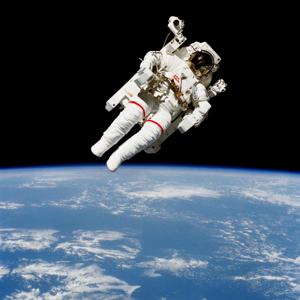
As a more down to earth (reverse pun intended) example, consider Apollo 13. A handful of astronauts stuck in space on a broken space ship slowly running out of breathable air suddenly find themselves in need of a carbon dioxide scrubber. If they don’t get one set up ASAP, their spacecraft will turn into the world’s most expensive and physically distant coffin. In order to solve this problem, NASA engineers famously had to come up with an ad hoc design to “fit a square peg into a round hole.” The picture at the top of this essay is what they came up with.
There’s no handbook design for this device. It is an amalgam of other objects intended for other uses in other places - an assortment of materials never intended for this specific purpose - materials which NASA engineers, driven by necessity, successfully liberated from their normative framework of meaning, thereby liberating their metaphorical power and allowing them to be reconfigured into something entirely new and perfectly adapted to conditions as they arose.
Zen Master Shoushan may not be presenting any judgment in his case above. It’s two true statements - normality is calling the comb a comb, and calling it anything else denies normality. But then, the “hard” part, he insists that people call it something.
The natural inclination is to search for the correct answer - as though there is one in particular Shoushan intends to elicit. But thinking about what the correct answer is doesn’t work - and in fact, it seems to me that “correct answer” thinking is exactly what the shackles of normative meaning consist of. It could even be said that “correct answer” thinking here, somewhat ironically, turns the comb into an impassable mountain. Perhaps giving up on the correct answer allows for the right answer? But then, what’s the difference and how would you know?
I think when you’re no longer bound in any way to the norm - but also not blind to the norm - that all meaning becomes free radicalized and reactions of the mind abound, and nuclear pulse explosions of meaning spontaneously erupt and propel you in all directions, just as circumstances demands.
The dilemma is that the “shackles” include all kinds of things we explicitly or implicitly prize.
But who ever said freedom was free?
Intelleclectic is a reader-supported publication. To receive new posts and support my work, consider becoming a free or paid subscriber.
 View all episodes
 By Intelleclectic
Venerable Shoushan picked up his “bamboo comb” and said to the assembly, "You people of various ranks, if you call out ‘bamboo comb’ you butt your head into the norm. Not calling out ‘bamboo comb’ you turn your back to the norm. You various people, just say what do you call out?”
Free radicals are best known as those things that are often vilified in pop science media for causing all kinds of problems in your body and needing to be defended against by anti-oxidants and bright colored fruits and vegetables and resveratrol and stuff.
Here's a quick synopsis of what a free radical is in terms of chemistry:
> [A] radical, also known as a free radical, is an atom, molecule, or ion that has at least one unpaired valence electron. With some exceptions, these unpaired electrons make radicals highly chemically reactive. Many radicals spontaneously dimerize. Most organic radicals have short lifetimes.
Ripping "free radicals" out of chemistry and depositing them into the realm of ideas, it seems to me that the free-radicalization of meaning - that is the liberation of meaning from its normative constraints in order to maximize its creative reactivity - is critical to being able to freely express yourself appropriately under any and all circumstances.
Take the christian Bible, for instance. In terms of meaning repletion, it's got to be a top .01% document, no matter which edit you use. It's also a fantastic example of the way bound meaning constrains rather than liberates. If you hew to a particular interpretation of some portion or portions of the document - as defined by the dogma of a given church, or a given priest, or a given pastor - then you become bound to that singular interpretation. But if you don't hew to any particular dogma, the Bible is full of robust imagery and evocative language that can be put to all kinds of expressive uses, just as the need arises.
As a more down to earth (reverse pun intended) example, consider Apollo 13. A handful of astronauts stuck in space on a broken space ship slowly running out of breathable air suddenly find themselves in need of a carbon dioxide scrubber. If they don’t get one set up ASAP, their spacecraft will turn into the world’s most expensive and physically distant coffin. In order to solve this problem, NASA engineers famously had to come up with an ad hoc design to “fit a square peg into a round hole.” The picture at the top of this essay is what they came up with.
There’s no handbook design for this device. It is an amalgam of other objects intended for other uses in other places - an assortment of materials never intended for this specific purpose - materials which NASA engineers, driven by necessity, successfully liberated from their normative framework of meaning, thereby liberating their metaphorical power and allowing them to be reconfigured into something entirely new and perfectly adapted to conditions as they arose.
Zen Master Shoushan may not be presenting any judgment in his case above. It’s two true statements - normality is calling the comb a comb, and calling it anything else denies normality. But then, the “hard” part, he insists that people call it something.
The natural inclination is to search for the correct answer - as though there is one in particular Shoushan intends to elicit. But thinking about what the correct answer is doesn’t work - and in fact, it seems to me that “correct answer” thinking is exactly what the shackles of normative meaning consist of. It could even be said that “correct answer” thinking here, somewhat ironically, turns the comb into an impassable mountain. Perhaps giving up on the correct answer allows for the right answer? But then, what’s the difference and how would you know?
I think when you’re no longer bound in any way to the norm - but also not blind to the norm - that all meaning becomes free radicalized and reactions of the mind abound, and nuclear pulse explosions of meaning spontaneously erupt and propel you in all directions, just as circumstances demands.
The dilemma is that the “shackles” include all kinds of things we explicitly or implicitly prize.
But who ever said freedom was free?
Intelleclectic is a reader-supported publication. To receive new posts and support my work, consider becoming a free or paid subscriber.