
Sign up to save your podcasts
Or

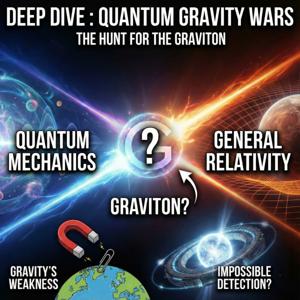

For half a century, the "Quantization Dogma" has ruled physics: the belief that gravity, like all other forces, must be quantum. But after decades of silence from String Theory and Loop Quantum Gravity, a crisis of confidence has taken hold. In this episode, we explore the rise of the "heretics"—a new wave of physicists asking the forbidden question: What if gravity is actually classical?
Join us as we unpack Jonathan Oppenheim’s radical "Post-Quantum" theory, which suggests spacetime is not a quiet stage but a noisy, "jiggling" mess of stochastic diffusion. We’ll discuss the 5000:1 bet that has divided the physics community, the race to "weigh the vacuum" using table-top experiments, and the stunning 2024 discovery of "Chiral Graviton Modes" in a semiconductor chip that might finally let us play the music of the cosmos in a lab
--------------------------------------------------------------------------------Key Themes Covered:
The Crisis: The failure of String Theory and Loop Quantum Gravity to produce experimental predictions.
The Heresy: Oppenheim's theory that gravity remains classical and interacts with quantum matter via stochastic (random) fluctuations.
The Evidence: The search for "spacetime diffusion" (the wobble) and the discovery of Chiral Graviton Modes (CGM) in condensed matter physics.
 View all episodes
 By Graviton Space Facts
For half a century, the "Quantization Dogma" has ruled physics: the belief that gravity, like all other forces, must be quantum. But after decades of silence from String Theory and Loop Quantum Gravity, a crisis of confidence has taken hold. In this episode, we explore the rise of the "heretics"—a new wave of physicists asking the forbidden question: What if gravity is actually classical?
Join us as we unpack Jonathan Oppenheim’s radical "Post-Quantum" theory, which suggests spacetime is not a quiet stage but a noisy, "jiggling" mess of stochastic diffusion. We’ll discuss the 5000:1 bet that has divided the physics community, the race to "weigh the vacuum" using table-top experiments, and the stunning 2024 discovery of "Chiral Graviton Modes" in a semiconductor chip that might finally let us play the music of the cosmos in a lab
--------------------------------------------------------------------------------Key Themes Covered:
The Crisis: The failure of String Theory and Loop Quantum Gravity to produce experimental predictions.
The Heresy: Oppenheim's theory that gravity remains classical and interacts with quantum matter via stochastic (random) fluctuations.
The Evidence: The search for "spacetime diffusion" (the wobble) and the discovery of Chiral Graviton Modes (CGM) in condensed matter physics.