
Sign up to save your podcasts
Or


Send us a text
Who was Ragnar Lothbrok? The name echoes through history as the quintessential Viking warrior—a dragon-slayer, king, raider, and father of conquerors. But when we search for the flesh-and-blood man behind the legend, he seems to vanish into the mists of time.
The saga tells us of a hero who crafted strange, hairy armor to slay a venomous serpent, winning the hand of a princess. It speaks of his marriage to a woman of extraordinary wisdom who bore him sons destined for greatness. And it recounts his defiant death in a pit of snakes, laughing at his tormentors and promising vengeance through his offspring. "How the little pigs would grunt if they knew how the old boar suffers," he supposedly proclaimed as venom coursed through his veins.
Yet contemporary historical records tell a different story—or rather, they tell no story at all. No 9th-century chronicle mentions a Ragnar Lothbrok. Instead, we find fragments: a Viking chieftain who besieged Paris, a Danish king named Reginfrid caught in dynastic struggles, and most significantly, the very real "Great Heathen Army" that invaded England in 865, led by commanders named Ivar the Boneless, Bjorn Ironside, and Halfdan—the very sons attributed to the legendary Ragnar.
This revelation doesn't diminish Ragnar's importance; it transforms our understanding of how myths function in society. The legend of Ragnar wasn't just an adventure tale but a powerful origin story that gave meaning and divine purpose to the very real conquests of his sons. He became the perfect Viking archetype—clever as well as strong, respectful of female wisdom, devoted to his children's legacy, and unflinchingly brave in the face of death.
Whether watching modern interpretations like the TV series "Vikings" or reading the ancient sagas, we're participating in a tradition of storytelling that spans over a thousand years. Ragnar may not have existed as a single historical figure, but the power of his myth has shaped our understanding of the Viking Age in ways that mere historical facts never could.
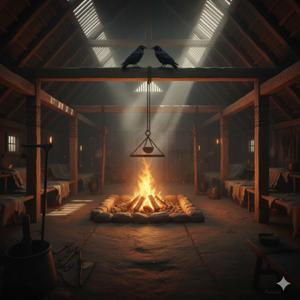
Join us by the fire at the Heathen's Hearth as we unravel one of history's most enduring legends and discover how sometimes, the sons create the father rather than the other way around.
Support the show
 View all episodes
 By The Heathen's Hearth
Send us a text
Who was Ragnar Lothbrok? The name echoes through history as the quintessential Viking warrior—a dragon-slayer, king, raider, and father of conquerors. But when we search for the flesh-and-blood man behind the legend, he seems to vanish into the mists of time.
The saga tells us of a hero who crafted strange, hairy armor to slay a venomous serpent, winning the hand of a princess. It speaks of his marriage to a woman of extraordinary wisdom who bore him sons destined for greatness. And it recounts his defiant death in a pit of snakes, laughing at his tormentors and promising vengeance through his offspring. "How the little pigs would grunt if they knew how the old boar suffers," he supposedly proclaimed as venom coursed through his veins.
Yet contemporary historical records tell a different story—or rather, they tell no story at all. No 9th-century chronicle mentions a Ragnar Lothbrok. Instead, we find fragments: a Viking chieftain who besieged Paris, a Danish king named Reginfrid caught in dynastic struggles, and most significantly, the very real "Great Heathen Army" that invaded England in 865, led by commanders named Ivar the Boneless, Bjorn Ironside, and Halfdan—the very sons attributed to the legendary Ragnar.
This revelation doesn't diminish Ragnar's importance; it transforms our understanding of how myths function in society. The legend of Ragnar wasn't just an adventure tale but a powerful origin story that gave meaning and divine purpose to the very real conquests of his sons. He became the perfect Viking archetype—clever as well as strong, respectful of female wisdom, devoted to his children's legacy, and unflinchingly brave in the face of death.
Whether watching modern interpretations like the TV series "Vikings" or reading the ancient sagas, we're participating in a tradition of storytelling that spans over a thousand years. Ragnar may not have existed as a single historical figure, but the power of his myth has shaped our understanding of the Viking Age in ways that mere historical facts never could.
Join us by the fire at the Heathen's Hearth as we unravel one of history's most enduring legends and discover how sometimes, the sons create the father rather than the other way around.
Support the show