
Sign up to save your podcasts
Or

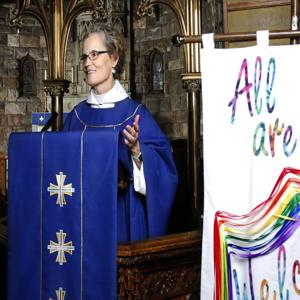

September 7, 2025: May God’s words be spoken, may God’s words be heard. Amen.
It is so good to be back here with all of you. I loved being on vacation, but this is wonderful to return to.
One part of my vacation had me in Maine for a day or two. I had the chance to go over to the Portland Head Light at Cape Elizabeth. There is a beautiful lighthouse on the rocky coast, with walking paths that seem to go on for miles. I spent hours there – walking, sitting, reflecting, and renewing, and oh how that was needed.
PHOTO: The Rev. Diana L. Wilcox
As individuals, we take vacations, sabbaticals, days off to give ourselves a chance to rest and renew. Church does this for us too – it is our sabbath practice. Here we are restored for another week. That is why it is important to come here, because it is here, particularly in-person, where we step aside from the world, and truly focus on allowing God to work in us and re-work us for our lives.
I was thinking about all of that when I read the passage from Jeremiah for today. Now, to be clear, this passage is about reforming entire nations, not individuals. Still, it is something God does do with us too, though not the whole smashing on a potter’s wheel bit – yikes. If you don’t know what I mean, listen to the first part of it again:
“The word that came to Jeremiah from the Lord: “Come, go down to the potter’s house, and there I will let you hear my words.” So I went down to the potter’s house, and there he was working at his wheel. The vessel he was making of clay was spoiled in the potter’s hand, and he reworked it into another vessel, as seemed good to him. Then the word of the Lord came to me: Can I not do with you, O house of Israel, just as this potter has done? says the Lord. Just like the clay in the potter’s hand, so are you in my hand, O house of Israel.”
Of course, God certainly doesn’t work with us by first destroying us to be re-created, though in a very real sense, that is what baptism does. In baptism, we die to all that holds us back from our lives in Christ, and are resurrected for new life in him. That aside, the larger working of God – with nations – is important too. And, as we see from the prophets, including Jeremiah, God works this renewal of nations through those prophetic witnesses God chooses for mission and ministry. One of those chosen was Jeremiah, of course, but another was St. Paul, and we heard from him in the letter to Philemon this morning.
Now, this letter is well known to many, but not for a good reason. It was used, particularly in this country, to justify slavery. But had those folks actually bothered to really reflect on what St. Paul was saying here, they would have understood that their use of this letter as a means of supporting the forced labor of any child of God was absurd. So, let’s take a deeper look…
First, here are the players: St. Paul – who is writing from prison. Onesimus, a slave who has runaway from the house of Philemon, and has ended up with Paul. Philemon, Apphia, and Archippus – leaders of the church established by St. Paul in Colossae, and likely meeting in the house of Philemon.
As for the historical context, slavery was a pervasive part of the Greco-Roman world. Slavery was not a racial construct, but a societal one of economic status. People of any race could be a slave. Scholars estimate anywhere from 10-20% of the Roman Empire’s population were enslaved.[1]
And now, the letter itself. Paul sends Onesimus with this letter to deliver to Philemon, Apphia, and Archippus. That he sends the letter to all three, and not just to Philemon, is important. The fact that he is sending Onesimus with it is dangerous to this runaway slave, as his former master could kill him. It is also why misguided people used this as a way to justify slavery. They said that Paul was sending the slave back to his master, therefore Paul was saying that slavery is just.
But that would be like looking at that meme of a cow on it’s back in a meadow, legs up in the air, with the words “Really, I’m fine!” and saying “See, everything is okey-dokey.” St. Paul is doing something radical and unexpected here, and those who took the actions apart from the words to justify their own evil in enslaving others missed the point entirely. The words matter here, so let’s take a look at them.
First, he commends Philemon on his ministry in the name of Jesus Christ, referring to him as a brother. Next, he says that he could command Philemon to do something, but he is appealing to him brother to brother (meaning – as brothers in Christ). The rest, you should hear directly from St. Paul, and listen carefully to what he is doing in his words:
“I am appealing to you for my child, Onesimus, whose father I have become during my imprisonment. Formerly he was useless to you, but now he is indeed useful both to you and to me. I am sending him, that is, my own heart, back to you. I wanted to keep him with me, so that he might be of service to me in your place during my imprisonment for the gospel; but I preferred to do nothing without your consent, in order that your good deed might be voluntary and not something forced. Perhaps this is the reason he was separated from you for a while, so that you might have him back forever, no longer as a slave but more than a slave, a beloved brother– especially to me but how much more to you, both in the flesh and in the Lord.
So if you consider me your partner, welcome him as you would welcome me. If he has wronged you in any way, or owes you anything, charge that to my account. I, Paul, am writing this with my own hand: I will repay it. I say nothing about your owing me even your own self. Yes, brother, let me have this benefit from you in the Lord! Refresh my heart in Christ. Confident of your obedience, I am writing to you, knowing that you will do even more than I say.”
Basically St. Paul is putting Philemon in a corner by claiming family relationship in Christ to Onesimus, and doing so in his own hand, so there can be no charge that this was written by anyone else. As he notes, he could have told Philemon to do it, but he chose to invite him to the act of grace on his own. St. Paul understood what we all know too – that it is better to get someone to do the right thing themselves through invitation toward the right path. Anyone who ever had a parent say to us “Well, it is your choice,” knows that is parent speak for “If you want to be an idiot, go right ahead, but know that I will be deeply disappointed in you.” Way more effective than a command.
If that were not enough – He equates the role that Onesimus would play if he stayed with St. Paul to that of the role Philemon played when he worked alongside him in the spreading of the gospel. And finally, St. Paul copies two others in the letter – Apphia, and Archippus, so everybody will be watching to see what Philemon does here.
This is no ordinary letter. This is a challenge to Philemon, and to us. It calls us to discern what is right as followers of Jesus vs. what is normative for society. This is not really an easy thing for us because it requires us to let go of how we do things – to not only do good deeds for others, but to transform the relationships we have with them. St. Paul is asking Philemon to reject what he understands to be his privilege and right – to own Onesimus.
For us today, it would require us to overturn unjust systems, even when we ourselves benefit from them. More than that, it pushes us to embrace as family those who we keep at a distance, because St. Paul reminds us that we are all children of God, siblings with one another, and bound in that common web of life. It means we must cross boundaries we may, consciously or not, actually prefer remain – between us and those who look, think, act, love, speak, or vote differently. That is not an easy thing.
This is a call to radical transformation that can reshape nations, like God’s potter and his wheel, one small act at a time. And in this moment in our own nation, we must not waste any opportunity to get our hands dirty in the clay – working ceaselessly to destroy that which enslaves any child of God, and build relationships of love, grace, hope, and peace in its place.
We may not feel up to the task. Lord knows, things are difficult for us these days. We have more time challenges than we know how to manage anymore.
We are wearied by the constant drumbeat of cruelty by our nation’s leaders against the least of these.
We are fearful that this democratic dream we call the United State may soon turn into an autocratic nightmare.
We mourn the senseless loss of lives to gun violence in our schools, houses of worship, theatres, grocery stores – everywhere.
And we see people perverting the gospel in the rise of Christian Nationalism that is often aligned with racist White Supremacy.
No, with all that is going on, if we are smart, we probably don’t feel up to the task, and the truth is – on our own – we aren’t! And – we don’t need to be. I mean, look at St. Paul. The guy was sitting in a prison cell for crying out loud. Yet, just with words on parchment, he changed countless lives in the course of a single letter. That is the power of the transformation possible by Christ in our lives.
I remember during the pandemic, the diocesan clergy were gifted with several presentations and talks to help us serve in those trying days, when we felt so weary and so inadequate to the task. One that really struck me was by the former bishop of Maine, the Rt. Rev. Chilton Knudsen. She spoke to us about an Orthodox understanding of Christification – a growth in holiness through the power of the Spirit.
She told us that Christ, through the Spirit, is changing us – God willing for the better. Yes – we will have troubles, but we are being transformed. Like potter and clay – the potter throws the clay around, and she knows where to find all of our clay. Referring to the disappointments, challenges, hardships in our lives, the potter folds those sharp corners into the new creation – little bits of us becoming more Christ like.
In other words, even in the most difficult of times, each of us are being continually reshaped by God for the work we are called to do. We don’t need to have anything other than an open heart, and a willingness to pause our busyness and allow the Spirit to renew us.
Remember that St. Paul was an early persecutor of the followers of Christ. Then he was literally thrown off his horse by Jesus, like a potter smashes down clay on a wheel, and he was re-shaped to be a leader in the spread of the gospel.
Even Jeremiah was called when he was only a boy – yet God was able to shape him for prophetic witness.
Each of you are also being worked by God to be agents of radical transformation in a world so desperately in need of it. Or as God would put it “Can I not do with you what I have done with so many more before you?” Well, of course God can.
As the late bishop, the Rt. Rev. Barbara Harris, once said “God doesn’t call those who are worthy. God makes worthy those whom God would call.”
So, as we head into this new program year in the church, let us hear again these words of St. Paul from the close of his letter, and think of them as being addressed to each and every one of us – the saints of the church today – the ones called to be prophets, the ones called to break the chains of oppression in our time:
St. Paul writes, “When I remember you in my prayers, I always thank my God because I hear of your love for all the saints and your faith toward the Lord Jesus. I pray that the sharing of your faith may become effective when you perceive all the good that we may do for Christ.”
Indeed there is much good we can, and need to do, for Christ today in our own communities.
May we open ourselves to be reshaped by God in our time and in our context, becoming more Christ-like each and every day, that we may be transformative agents of change through grace and love, relationship building and invitation – freeing ourselves as we free others – reworking our world into God’s dream of peace and wholeness for all.
Amen.
For the audio, click below, or subscribe to our iTunes Sermon Podcast by clicking here (also available on Audible):
Sermon Podcast
[1] British Museum.
The Rev. Diana L. Wilcox
Christ Church in Bloomfield & Glen Ridge
September 7, 2025
Pentecost 13 – Year C – Proper 18 – Track 1
1st Reading – Jeremiah 18:1-11
Psalm 139:1-5, 12-17
Gospel – Luke 14:25-33
The post “The Potter, Philemon, & You” appeared first on Christ Episcopal Church.
 View all episodes
 By The Rev. Diana L. Wilcox
5
88 ratings
September 7, 2025: May God’s words be spoken, may God’s words be heard. Amen.
It is so good to be back here with all of you. I loved being on vacation, but this is wonderful to return to.
One part of my vacation had me in Maine for a day or two. I had the chance to go over to the Portland Head Light at Cape Elizabeth. There is a beautiful lighthouse on the rocky coast, with walking paths that seem to go on for miles. I spent hours there – walking, sitting, reflecting, and renewing, and oh how that was needed.
PHOTO: The Rev. Diana L. Wilcox
As individuals, we take vacations, sabbaticals, days off to give ourselves a chance to rest and renew. Church does this for us too – it is our sabbath practice. Here we are restored for another week. That is why it is important to come here, because it is here, particularly in-person, where we step aside from the world, and truly focus on allowing God to work in us and re-work us for our lives.
I was thinking about all of that when I read the passage from Jeremiah for today. Now, to be clear, this passage is about reforming entire nations, not individuals. Still, it is something God does do with us too, though not the whole smashing on a potter’s wheel bit – yikes. If you don’t know what I mean, listen to the first part of it again:
“The word that came to Jeremiah from the Lord: “Come, go down to the potter’s house, and there I will let you hear my words.” So I went down to the potter’s house, and there he was working at his wheel. The vessel he was making of clay was spoiled in the potter’s hand, and he reworked it into another vessel, as seemed good to him. Then the word of the Lord came to me: Can I not do with you, O house of Israel, just as this potter has done? says the Lord. Just like the clay in the potter’s hand, so are you in my hand, O house of Israel.”
Of course, God certainly doesn’t work with us by first destroying us to be re-created, though in a very real sense, that is what baptism does. In baptism, we die to all that holds us back from our lives in Christ, and are resurrected for new life in him. That aside, the larger working of God – with nations – is important too. And, as we see from the prophets, including Jeremiah, God works this renewal of nations through those prophetic witnesses God chooses for mission and ministry. One of those chosen was Jeremiah, of course, but another was St. Paul, and we heard from him in the letter to Philemon this morning.
Now, this letter is well known to many, but not for a good reason. It was used, particularly in this country, to justify slavery. But had those folks actually bothered to really reflect on what St. Paul was saying here, they would have understood that their use of this letter as a means of supporting the forced labor of any child of God was absurd. So, let’s take a deeper look…
First, here are the players: St. Paul – who is writing from prison. Onesimus, a slave who has runaway from the house of Philemon, and has ended up with Paul. Philemon, Apphia, and Archippus – leaders of the church established by St. Paul in Colossae, and likely meeting in the house of Philemon.
As for the historical context, slavery was a pervasive part of the Greco-Roman world. Slavery was not a racial construct, but a societal one of economic status. People of any race could be a slave. Scholars estimate anywhere from 10-20% of the Roman Empire’s population were enslaved.[1]
And now, the letter itself. Paul sends Onesimus with this letter to deliver to Philemon, Apphia, and Archippus. That he sends the letter to all three, and not just to Philemon, is important. The fact that he is sending Onesimus with it is dangerous to this runaway slave, as his former master could kill him. It is also why misguided people used this as a way to justify slavery. They said that Paul was sending the slave back to his master, therefore Paul was saying that slavery is just.
But that would be like looking at that meme of a cow on it’s back in a meadow, legs up in the air, with the words “Really, I’m fine!” and saying “See, everything is okey-dokey.” St. Paul is doing something radical and unexpected here, and those who took the actions apart from the words to justify their own evil in enslaving others missed the point entirely. The words matter here, so let’s take a look at them.
First, he commends Philemon on his ministry in the name of Jesus Christ, referring to him as a brother. Next, he says that he could command Philemon to do something, but he is appealing to him brother to brother (meaning – as brothers in Christ). The rest, you should hear directly from St. Paul, and listen carefully to what he is doing in his words:
“I am appealing to you for my child, Onesimus, whose father I have become during my imprisonment. Formerly he was useless to you, but now he is indeed useful both to you and to me. I am sending him, that is, my own heart, back to you. I wanted to keep him with me, so that he might be of service to me in your place during my imprisonment for the gospel; but I preferred to do nothing without your consent, in order that your good deed might be voluntary and not something forced. Perhaps this is the reason he was separated from you for a while, so that you might have him back forever, no longer as a slave but more than a slave, a beloved brother– especially to me but how much more to you, both in the flesh and in the Lord.
So if you consider me your partner, welcome him as you would welcome me. If he has wronged you in any way, or owes you anything, charge that to my account. I, Paul, am writing this with my own hand: I will repay it. I say nothing about your owing me even your own self. Yes, brother, let me have this benefit from you in the Lord! Refresh my heart in Christ. Confident of your obedience, I am writing to you, knowing that you will do even more than I say.”
Basically St. Paul is putting Philemon in a corner by claiming family relationship in Christ to Onesimus, and doing so in his own hand, so there can be no charge that this was written by anyone else. As he notes, he could have told Philemon to do it, but he chose to invite him to the act of grace on his own. St. Paul understood what we all know too – that it is better to get someone to do the right thing themselves through invitation toward the right path. Anyone who ever had a parent say to us “Well, it is your choice,” knows that is parent speak for “If you want to be an idiot, go right ahead, but know that I will be deeply disappointed in you.” Way more effective than a command.
If that were not enough – He equates the role that Onesimus would play if he stayed with St. Paul to that of the role Philemon played when he worked alongside him in the spreading of the gospel. And finally, St. Paul copies two others in the letter – Apphia, and Archippus, so everybody will be watching to see what Philemon does here.
This is no ordinary letter. This is a challenge to Philemon, and to us. It calls us to discern what is right as followers of Jesus vs. what is normative for society. This is not really an easy thing for us because it requires us to let go of how we do things – to not only do good deeds for others, but to transform the relationships we have with them. St. Paul is asking Philemon to reject what he understands to be his privilege and right – to own Onesimus.
For us today, it would require us to overturn unjust systems, even when we ourselves benefit from them. More than that, it pushes us to embrace as family those who we keep at a distance, because St. Paul reminds us that we are all children of God, siblings with one another, and bound in that common web of life. It means we must cross boundaries we may, consciously or not, actually prefer remain – between us and those who look, think, act, love, speak, or vote differently. That is not an easy thing.
This is a call to radical transformation that can reshape nations, like God’s potter and his wheel, one small act at a time. And in this moment in our own nation, we must not waste any opportunity to get our hands dirty in the clay – working ceaselessly to destroy that which enslaves any child of God, and build relationships of love, grace, hope, and peace in its place.
We may not feel up to the task. Lord knows, things are difficult for us these days. We have more time challenges than we know how to manage anymore.
We are wearied by the constant drumbeat of cruelty by our nation’s leaders against the least of these.
We are fearful that this democratic dream we call the United State may soon turn into an autocratic nightmare.
We mourn the senseless loss of lives to gun violence in our schools, houses of worship, theatres, grocery stores – everywhere.
And we see people perverting the gospel in the rise of Christian Nationalism that is often aligned with racist White Supremacy.
No, with all that is going on, if we are smart, we probably don’t feel up to the task, and the truth is – on our own – we aren’t! And – we don’t need to be. I mean, look at St. Paul. The guy was sitting in a prison cell for crying out loud. Yet, just with words on parchment, he changed countless lives in the course of a single letter. That is the power of the transformation possible by Christ in our lives.
I remember during the pandemic, the diocesan clergy were gifted with several presentations and talks to help us serve in those trying days, when we felt so weary and so inadequate to the task. One that really struck me was by the former bishop of Maine, the Rt. Rev. Chilton Knudsen. She spoke to us about an Orthodox understanding of Christification – a growth in holiness through the power of the Spirit.
She told us that Christ, through the Spirit, is changing us – God willing for the better. Yes – we will have troubles, but we are being transformed. Like potter and clay – the potter throws the clay around, and she knows where to find all of our clay. Referring to the disappointments, challenges, hardships in our lives, the potter folds those sharp corners into the new creation – little bits of us becoming more Christ like.
In other words, even in the most difficult of times, each of us are being continually reshaped by God for the work we are called to do. We don’t need to have anything other than an open heart, and a willingness to pause our busyness and allow the Spirit to renew us.
Remember that St. Paul was an early persecutor of the followers of Christ. Then he was literally thrown off his horse by Jesus, like a potter smashes down clay on a wheel, and he was re-shaped to be a leader in the spread of the gospel.
Even Jeremiah was called when he was only a boy – yet God was able to shape him for prophetic witness.
Each of you are also being worked by God to be agents of radical transformation in a world so desperately in need of it. Or as God would put it “Can I not do with you what I have done with so many more before you?” Well, of course God can.
As the late bishop, the Rt. Rev. Barbara Harris, once said “God doesn’t call those who are worthy. God makes worthy those whom God would call.”
So, as we head into this new program year in the church, let us hear again these words of St. Paul from the close of his letter, and think of them as being addressed to each and every one of us – the saints of the church today – the ones called to be prophets, the ones called to break the chains of oppression in our time:
St. Paul writes, “When I remember you in my prayers, I always thank my God because I hear of your love for all the saints and your faith toward the Lord Jesus. I pray that the sharing of your faith may become effective when you perceive all the good that we may do for Christ.”
Indeed there is much good we can, and need to do, for Christ today in our own communities.
May we open ourselves to be reshaped by God in our time and in our context, becoming more Christ-like each and every day, that we may be transformative agents of change through grace and love, relationship building and invitation – freeing ourselves as we free others – reworking our world into God’s dream of peace and wholeness for all.
Amen.
For the audio, click below, or subscribe to our iTunes Sermon Podcast by clicking here (also available on Audible):
Sermon Podcast
[1] British Museum.
The Rev. Diana L. Wilcox
Christ Church in Bloomfield & Glen Ridge
September 7, 2025
Pentecost 13 – Year C – Proper 18 – Track 1
1st Reading – Jeremiah 18:1-11
Psalm 139:1-5, 12-17
Gospel – Luke 14:25-33
The post “The Potter, Philemon, & You” appeared first on Christ Episcopal Church.