
Sign up to save your podcasts
Or

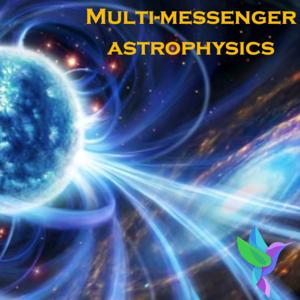

In this episode, we venture into the high-energy universe to tackle one of astrophysics' enduring mysteries: the origin of "super-knee" cosmic rays. We explore new research suggesting that Interacting Supernovae (ISNe)—specifically Type IIn—are the "PeVatrons" responsible for accelerating particles to mind-boggling energies between $10^{15}$ and $10^{17}$ eV.
Join us as we break down how shockwaves crashing into dense circumstellar material act as massive particle accelerators. We also discuss why this new model aligns with recent data from the LHAASO observatory, offering a compelling explanation for why these high-energy cosmic rays appear to be composed of heavy nuclei like iron rather than just protons.
Reference:
Ekanger, N., Kimura, S. S., & Kashiyama, K. (2026). *Super-knee cosmic rays from interacting supernovae*. arXiv preprint arXiv:2602.06410v1.
Acknowledements: Podcast prepared with Google/NotebookLM. Illustration credits: IXPE, Evan Gough (Universe Today)
 View all episodes
 By Astro-COLIBRI
In this episode, we venture into the high-energy universe to tackle one of astrophysics' enduring mysteries: the origin of "super-knee" cosmic rays. We explore new research suggesting that Interacting Supernovae (ISNe)—specifically Type IIn—are the "PeVatrons" responsible for accelerating particles to mind-boggling energies between $10^{15}$ and $10^{17}$ eV.
Join us as we break down how shockwaves crashing into dense circumstellar material act as massive particle accelerators. We also discuss why this new model aligns with recent data from the LHAASO observatory, offering a compelling explanation for why these high-energy cosmic rays appear to be composed of heavy nuclei like iron rather than just protons.
Reference:
Ekanger, N., Kimura, S. S., & Kashiyama, K. (2026). *Super-knee cosmic rays from interacting supernovae*. arXiv preprint arXiv:2602.06410v1.
Acknowledements: Podcast prepared with Google/NotebookLM. Illustration credits: IXPE, Evan Gough (Universe Today)