
Sign up to save your podcasts
Or

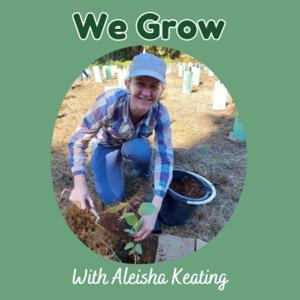


In this episode, host Aleisha Keating speaks with Kadi Warner, one of the founding board directors of We Grow Community.
With decades of experience across Asia, Sub-Saharan Africa, the Pacific and now the Sunshine Coast in Queensland, Kadi brings incredible wisdom with practical knowledge to the We Grow Community Board. In this episode, we discuss what actually works when communities, governments and conservation goals intersect. Kadi shares how ecological anthropology shaped her view of natural resource management, why communities usually know their local ecosystems bettter than anyone else and what it takes to turn local knowledge into policy that lasts.
With fascinating examples from around the world, this conversation is rich with insights and inspiration as to how local communities can protect ecosystems and create lasting environmental change.
Podcast Rebrand! We have rebranded the podcast to be called the We Grow Community Podcast.
In this episode, host Aleisha Keating shares the vision of We Grow Community, a start up charity focusing on community-based nature restoration dedicated to long-term stewardship of land through active community involvement.
Hear about the organisation's mission, how they plan to create a community of advocates that care for nature and why they are different to other organisations. Be inspired as Aleisha explains how the simple action of planting a tree can create ripple effects throughout communities and ecosystems today and into the future.
We Grow Community website: https://wegrowcommunity.org/about-us
In this episode, host Aleisha Keating discusses why long-term thinking is the secret to transforming native ecosystems. Sharing insights about some of the native species in South East Queensland, Aleisha describes how different species play different roles in ecosystem restoration, growing at varying speeds and living to different ages. You'll hear about the stages of ecosystem recovery, from the rapid growth of pioneer plants, to the slow emergence of mature trees that provide vital habitat and ecosystem resilience. Discover why the work we do today echoes through time; when you plant a tree, you are planting for future generations and for the future of the earth. You are choosing a biodiverse, thriving future over a degraded, uninhabitatable one.
In this episode, host Aleisha Keating discusses a disturbing trend of declining water quality in one of her local river catchments. You'll learn about the vital role catchments play in water quality as Aleisha chats about:
Discover how everything we do in a catchment is connected, from the mountains and hills, to rural and urban areas and ultimately to the sea. Flowing water connects these areas, linking landuse with downstream and coastal water quality.
Read about the Healthy Land and Water report card for the Maroochy and Mooloolah Rivers: https://www.sunshinecoastnews.com.au/2026/04/09/condition-of-water-catchment-sinks-to-record-low/
In this episode, host Aleisha Keating chats to Dr. Chris Johnson, a transport ecologist. Chris shares is experiences from working in the industry, research and being involved in community projects. With over fifteen years in community-based environmental leadership, Chris works at the nexus of ecological restoration, infrastructure planning and environmental management.
You'll hear about:
🦅Chris's journey from volunteering in landcare as a youngster to being inspired to study ecology and zoology through to taking an active role in community leadership.
🦅 The sobering stats of how many wildlife are killed on roads each year and the positive impact that well-designed roads can have on the ecology around roads
🦅 How Chris is helping to bridge the gap between research and practitioners, ensuring that decision makers are informed about the latest research outcomes
🦅 His involvement in Intrepid Landcare and other community groups
Articles
Illaweena Overpass Case Study
Compton Road Wildlife Overpass Summary
How well do wildlife crossing structures help animals across roads? (summary of research by Kylie Sloans)
Do wildlife crossing structures mitigate the barrier effect of roads on animal movement? A global assessment (original article by Kylie Sloans)
Connect with Chris
Instagram - @thetransportecologist
Linkedin - Dr. Chris Johnson
Intrepid Landcare
In Episode 17, host Aleisha Keating discusses why private properties are so important to enhancing connectivity across the landscape.
You'll hear about:
Tune in to discover why this matters, why private landholders are so critical to help support many threatened species to thrive.
Read more about private properties here.
Host Aleisha Keating chats with Angelica Choppin, a sustainability and systems strategist who works at the intersection of finance, business operations and circular economy thinking. She is talented at bringing a commercially balanced perspective to sustainability, helping businesses understand how environmental outcomes connect to cashflow, efficiency and long-term resilience.
In this episode you'll learn about some simple cost-effective strategies to make your business more sustainable and resilient in the long term, saving you not only money, but also time and resources. Angelica shares about how she supports businesses through her business Resona Verde to optimise processes and systems through streamlining operations and making smarter decisions that align with your business goals.
We also discuss what it means to be living and doing business in the Sunshine Coast Biosphere and how you can get involved in local community and environmental initiatives.
👉 Connect with Angelica:
Resona Verde: www.resonaverde.au
Linkedin: @angelica-choppin
Blog: resonaverde.au/blog
Email: [email protected]
👉 Learn about the Sunshine Coast Biosphere:
Website: www.sunshinecoast.qld.gov.au/council/planning-and-projects/major-regional-projects/sunshine-coast-biosphere
Projects and Initiatives: current-projects-and-initiatives
In this episode, Aleisha chats about tackling invasive weeds and how this process offers surprising lessons for organisational success. Drawing from her hands on experience working on managing a 55-hectare property in Queensland, Aleisha shares how clearing invasive species like lantana mirror common organisational challenges. Just as weeds overwhelm native plants, outdated systems and processes and misaligned resources can reduce an organisation's effectiveness and growth.
Aleisha shares practical strategies for overcoming these challenges, emphasising the power of small, consistent actions. Drawing several parallels between the act of weeding to promote healthy, resilient native ecosystems and addressing 'weeds' from your organisation, she explores several ways to nurture thriving ecosystems and organisations.
Whether you're leading a not for profit, running a business or managing a community project, this episode provides essential insights into creating healthier, more resilient systems by inviting you to see weeds not just as nuisances, but as catalysts for growth.
👉 Share your experience with landscape restoration and optimising organisational impact in the comments below.
👉 Share this episode with someone in your community.
Welcome to 2026! In this episode of the We Grow podcast, host Aleisha Keating kicks off 2026 with a fresh perspective on biodiversity, community and nature restoration. Aleisha shares insights from her recent career transition and reflects on the podcast's journey over the past year.
She considers what perspectives and ideas the podcast could share this coming year and what we need to learn as a community to improve outcomes for biodiversity, native ecosystems and our community.
👉 Do you have an important perspective to share?
Contact Aleisha at [email protected] if you'd like to join the We Grow podcast conversation in 2026.
👉 Who do you want to hear from on the We Grow podcast in 2026? Take our poll below!
In Episode 13, host Aleisha Keating explores why "less is more" in the environmental sector. She examines the challenges of large-scale environmental projects and the benefits of focusing on smaller, high-quality initiatives. Through insightful examples, she highlights how sustainable, manageable efforts can lead to greater long-term impact and keep the passionate individuals in the sector motivated and healthy. Discover how you can apply these lessons to your own projects and life.
From the publisher's feed