
Sign up to save your podcasts
Or

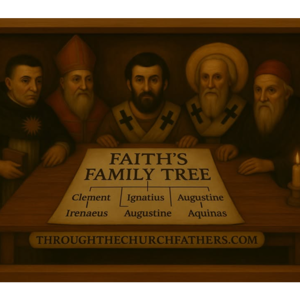

True beauty, true strength, and true order—these are the threads uniting today’s readings.
Clement of Alexandria rebukes the vanity of men who seek beauty in mirrors instead of in virtue. He reminds us that to be human is to bear the image of God, not the cosmetics of culture. Man’s adornment, he says, is reason and righteousness, not gold or perfume.
Augustine, writing to Italica as Rome collapses, calls believers to find their peace not in the city of man but in the city of God. The fall of earthly glory, he teaches, is not the ruin of the Church but the refining of its faith. Sorrow shared in Christ becomes strength; loss reveals where our true treasure lies.
Then Thomas Aquinas takes us deeper into the soul itself. Each power of the soul, he explains, has its own habit—wisdom for the intellect, charity for the will, temperance for desire. The harmony of these powers forms virtue, and virtue itself is the beauty of the soul rightly ordered under grace.
All three Fathers lead us to the same truth: holiness is not a surface glow but the inner symmetry of a life shaped by God—where the body, the mind, and the heart are adorned not with gold or youth, but with goodness. (1 Peter 3:3–4; Romans 12:1–2)
Readings: Clement of Alexandria, The Instructor, Book 3, Chapter 3 — Against Men Who Embellish Themselves
Augustine of Hippo, Letter 99 — To Italica (On Shared Suffering and the Fall of Rome)
Thomas Aquinas, Summa Theologica, Part 1–2, Question 54 (Combined articles—Of the Distinction of Habits)
Explore the Project:
Through the Church Fathers – https://www.throughthechurchfathers.com
Patreon – https://www.patreon.com/cmichaelpatton
Credo Courses – https://www.credocourses.com
Credo Ministries – https://www.credoministries.org
#ClementOfAlexandria #Augustine #Aquinas #Virtue #ChurchFathers #HistoricalTheology
 View all episodes
 By C. Michael Patton
True beauty, true strength, and true order—these are the threads uniting today’s readings.
Clement of Alexandria rebukes the vanity of men who seek beauty in mirrors instead of in virtue. He reminds us that to be human is to bear the image of God, not the cosmetics of culture. Man’s adornment, he says, is reason and righteousness, not gold or perfume.
Augustine, writing to Italica as Rome collapses, calls believers to find their peace not in the city of man but in the city of God. The fall of earthly glory, he teaches, is not the ruin of the Church but the refining of its faith. Sorrow shared in Christ becomes strength; loss reveals where our true treasure lies.
Then Thomas Aquinas takes us deeper into the soul itself. Each power of the soul, he explains, has its own habit—wisdom for the intellect, charity for the will, temperance for desire. The harmony of these powers forms virtue, and virtue itself is the beauty of the soul rightly ordered under grace.
All three Fathers lead us to the same truth: holiness is not a surface glow but the inner symmetry of a life shaped by God—where the body, the mind, and the heart are adorned not with gold or youth, but with goodness. (1 Peter 3:3–4; Romans 12:1–2)
Readings: Clement of Alexandria, The Instructor, Book 3, Chapter 3 — Against Men Who Embellish Themselves
Augustine of Hippo, Letter 99 — To Italica (On Shared Suffering and the Fall of Rome)
Thomas Aquinas, Summa Theologica, Part 1–2, Question 54 (Combined articles—Of the Distinction of Habits)
Explore the Project:
Through the Church Fathers – https://www.throughthechurchfathers.com
Patreon – https://www.patreon.com/cmichaelpatton
Credo Courses – https://www.credocourses.com
Credo Ministries – https://www.credoministries.org
#ClementOfAlexandria #Augustine #Aquinas #Virtue #ChurchFathers #HistoricalTheology