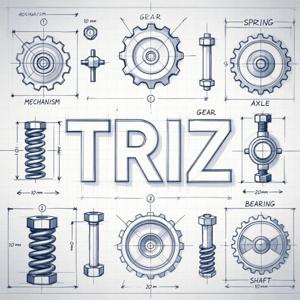
In the vast landscape of engineering and innovation, few methodologies stand out as profoundly systematic and transformative as TRIZ, the Theory of Inventive Problem Solving. Originating from the Russian acronym "Teoriya Resheniya Izobretatelskikh Zadach," TRIZ represents a structured approach to creativity, turning invention from an art reliant on intuition into a science grounded in patterns and principles. Developed in the mid-20th century, TRIZ has evolved into a cornerstone for engineers, inventors, and problem-solvers worldwide, offering tools to overcome technical contradictions and foster breakthrough innovations. This essay explores the origins, core principles, key tools, applications, and future potential of TRIZ, demonstrating how it demystifies the inventive process and empowers engineering minds to push boundaries. The genesis of TRIZ can be traced back to the Soviet Union during the post-World War II era, a time when rapid industrialization demanded efficient problem-solving. Genrich Altshuller, a patent examiner and inventor, spearheaded its creation. Frustrated by the inefficiency of trial-and-error methods in invention, Altshuller analyzed over 40,000 patents in the 1940s and 1950s. He discovered recurring patterns: inventive solutions often resolved contradictions without compromise, and these patterns transcended specific industries. For instance, patents from aviation might inspire solutions in chemical engineering. Altshuller's work, initially conducted in secrecy due to Soviet censorship, led to the formalization of TRIZ in 1946. Despite facing imprisonment for his ideas, he continued refining the theory through correspondence with collaborators. By the 1970s, TRIZ had gained traction in Soviet engineering education, and after the fall of the Iron Curtain in the 1990s, it spread globally, influencing companies like Samsung, Intel, and General Electric. Today, TRIZ is taught in universities and integrated into software tools, evolving with additions like TRIZ-based forecasting and integration with lean manufacturing. At its heart, TRIZ is built on the premise that invention is not random but follows evolutionary laws. Altshuller identified that systems evolve toward ideality—a state where benefits are maximized while costs and harms are minimized. This "ideal final result" (IFR) serves as a guiding star, encouraging engineers to envision a perfect solution before backtracking to feasible implementations. Central to TRIZ is the concept of contradictions: problems arise when improving one parameter worsens another. Traditional engineering often seeks trade-offs, but TRIZ demands separation—resolving contradictions in time, space, or condition. For example, a drill bit needs to be hard for cutting but flexible to avoid breaking; TRIZ might suggest a design where hardness varies by location or under different loads. TRIZ's toolkit is extensive, comprising 40 inventive principles, contradiction matrices, and patterns of evolution. The 40 principles are distilled from patent analyses, offering reusable strategies like segmentation (breaking an object into parts), asymmetry (changing shapes unevenly), or periodicity (introducing vibrations). The contradiction matrix, a 39x39 grid, maps improving features against worsening ones, recommending principles that have historically resolved similar conflicts. If strength improves but weight increases, the matrix might point to principle 35: transformation of properties, such as using foams that change density. Beyond these, TRIZ includes eight trends of technical evolution, like transitioning from mechanical to field-based systems (e.g., from gears to magnetic levitation). Other tools encompass substance-field analysis (Su-Field), which models problems as interactions between substances and fields, and ARIZ (Algorithm for Inventive Problem Solving), a step-by-step algorithm for complex issues. ARIZ guides users through problem formulation, resource identification, and solution generation, ensuring thoroughness. In practice, TRIZ has revolutionized engineering across domains. In aerospace, Boeing applied TRIZ to redesign aircraft components, reducing weight while maintaining structural integrity by using composite materials that separate contradictions in tension and compression. In consumer electronics, Samsung credits TRIZ for over 10,000 patents, including innovations in flexible displays where bending (improving portability) doesn't compromise durability—resolved via principle 10: preliminary action, pre-stressing materials. Automotive giants like Ford use TRIZ for eco-friendly designs, such as engines that boost efficiency without sacrificing power, drawing on evolution trends toward dynamization (making rigid parts movable). In biomedical engineering, TRIZ aids in developing prosthetics that adapt to user needs, resolving contradictions between comfort and functionality through smart materials that change properties with body heat. One compelling case study is Procter & Gamble's use of TRIZ in product development. Facing a contradiction in diaper design—absorbency versus thinness—they applied principle 31: porous materials, leading to super-absorbent polymers that swell on contact, achieving both goals. This not only improved the product but also exemplified TRIZ's economic impact: faster innovation cycles reduce R&D costs by up to 50%, according to studies from the European TRIZ Association. In software engineering, though less traditional, TRIZ adapts well; for instance, resolving algorithmic contradictions in AI, where speed conflicts with accuracy, by separating in scale—using approximations for broad searches and precision for refinements. Critics argue TRIZ's rigidity stifles pure creativity, as its patterns might overlook novel disruptions. However, proponents counter that it complements intuition, providing a scaffold for ideas. Integration with other methodologies, like Design Thinking or Six Sigma, addresses this, creating hybrid approaches. For example, TRIZ+Lean eliminates waste while innovating, as seen in Toyota's production systems. Looking ahead, TRIZ's future is intertwined with emerging technologies. AI-enhanced TRIZ tools, like those from Invention Machine or Ideation International, automate patent searches and principle suggestions, making it accessible to non-experts. In sustainability engineering, TRIZ tackles global challenges: resolving energy contradictions in renewables, such as solar panels that maximize capture without environmental harm, via biomimicry principles (e.g., copying lotus leaves for self-cleaning). In the era of Industry 4.0, TRIZ evolves to handle cyber-physical systems, predicting evolutions toward integration and autonomy. Ultimately, TRIZ demystifies invention, proving it's a learnable science rather than an innate gift. By codifying patterns from human ingenuity, it empowers engineers to solve problems systematically, fostering a world where innovation is democratized. As Altshuller envisioned, TRIZ bridges the gap between current limitations and ideal solutions, driving progress in engineering and beyond. In an age of rapid change, embracing TRIZ ensures that invention remains not just reactive, but proactive—a true science of creation.
This episode includes AI-generated content.



 View all episodes
