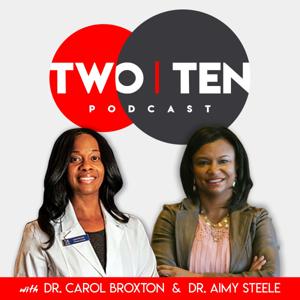
Two | Ten Podcast

Two | Ten Podcast

Download on the App Store

All Two | Ten Podcast episodes

  • Two Ten Mom Interview: Business Owner, Diva Sherkica Miller-McIntyre

    Join Aimy and Carol as they interview a dynamic business owner, mom of 4 amazing children, and wife to Gary--Sherkica Miller-McIntyre. She is quite a spectacular woman who is poised to help women grow in the areas of casting their visions for their lives, entering the realm of homeownership, and financially soaring as they tackle credit, debt, and investments. 

    In this informative conversation, you will hear from someone who will motivate you to start your own business, get control of your goals, and inspire you to be your best self. 

    Listen intentionally. Enjoy!

    Support the show

    24 min
  • Happy New Year: Start Your Year off with the Right Mindset!

    Join Carol and Aimy as they discuss getting your mindset prepared for the new year. It's not too late to start your journey of planning a great year, full of planning for your goals. Aimy and Carol will also talk about what you can expect from the podcast in 2021. Reviewing where you've been and starting where you are is essential. If you think long, you think wrong. Just get started! Implement what you desire!

    Ask yourself these 5 reflection questions: 

    1. Did I start or complete the goals I set for this year (2020)?
    2. What investments and research did I complete to start my goals?
    3. Did I select the right mentor or do I need a mentor to guide me through the process of starting my goals?
    4. Have I created a team to support my goals? 
    5. Do I have the right budget?

    Resources:

    1. Marshawn Evans Daniels Journal: Grab your journal here
    2. Brene Brown: The Call to Courage

    Support the show

    23 min
  • When Christmas Doesn't Go As Planned

    Have your Christmas celebrations changed this year? Have you run yourself crazy trying to do it all? Listen to this informative episode about how to navigate life during a busy holiday season. Join Aimy and Carol as they have an honest conversation about how getting overwhelmed, worried, and stressed during this season can lead to not actually enjoying what the holiday is all about. This open conversation will bring you some relief as you prepare for the holiday.

    Support the show

    23 min
  • Celebrating the Holidays: Two Ten Mommy Style

    Listen up as the mommas from Two Ten celebrate the Christmas holiday mommy style.  Join us as we have a candid conversation about our adventures as we prepare for the holidays. This funny but real dialogue exposes what real moms may go through during the holiday season. Enjoy!

    Support the show (https://www.facebook.com/TwoTenPodcastAC/)

    Support the show

    29 min
  • Stagnant Goals: Let's Finish the 4th Quarter Strong

    Stagnant Goals

    It is time to revisit your goals that you set for this year and the 4th quarter and ask yourself the following questions:

    1.       Did I start or complete the goals that I set for this year?

    2.       What investments and research did I complete to start on my goals?

    3.       Did I select the right mentor or do I need a mentor to guide me through the process of starting my goals?

    4.       Have I created a team to support my goals?

    5.       Do I have the right budget to start my goals?

    Goal setting process: 

    1. Write down what I want VERY specifically. (Personal, business, campaign, kids, husband, vacations, and fun things)
    2. Write down a plan to get each item (Baby steps, big steps, etc). Using the Richest Man that Ever Lived in Babylon. 
    3. Schedule time to get each item.

    Resources: Think and Grow Rich, by Napoleon Hill

    Support the show

    24 min
  • Disciplining Children in 2020

    Join Aimy and Carol as they discuss how to raise kids that respect you while providing discipline in a relevant way.

    This episode explores consequential, aversive, and creative discipline strategies for kids of all ages. If you're not sure how to discipline your kids or just need a few suggestions to make sure you are not going crazy, listen to this informative episode today!

    Music Credit: Mitchell Huntley, Power of Love, “Freestyle".

    Support the show

    23 min
  • Back to School: COVID-19 Style

    Join Aimy and Carol as they discuss options for schooling as well as transitioning into virtual learning for the 2020-21 school year.

    Due to COVID-19, many parents are faced with the challenge of what schooling options are best for their kids. Once they decide on an option, then comes the daily management of school as well as how to effectively work from home while the kids are there if virtual learning is the option.

    Stay tuned for this lively discussion.

    Music Credit: Mitchell Huntley, Power of Love, “Freestyle".

    Support the show

    20 min
  • Nutrition and Wellness, Mommy Style

    Resources: The CDC, Centers for Disease Control and Prevention, has great articles and resources to help you start your healthy eating habits and nutritional lifestyle changes to get you on track with healthy eating:

    https://www.cdc.gov/healthyweight/healthy_eating/meals.html

    https://www.cdc.gov/nutrition/strategies-guidelines/index.html

    4 Food plans featured in this episode include: Pescatarian, Paleo, Vegetarian and Vegan:

    1. Paleo: This is a food plan that includes: lean meats, fish, fruits, vegetables, nuts and seeds. Basically, it features foods that were hunted and gathered in the past. It excludes foods such as dairy, legumes (peanuts and lentils), refined sugar, potatoes, and processed foods.  This meal plan improves weight loss, blood pressure, blood glucose, and lowers triglycerides. Reference: https://www.mayoclinic.org/healthy-lifestyle/nutrition-and-healthy-eating/in-depth/paleo-diet/art-20111182
    2. Vegan: This plan excludes meat, poultry, fish, eggs and dairy products — and foods that contain these products. Vegan sensation Tabitha Brown she has become a famous Vegan advocate and has a beautiful family. She always has words of love and wisdom, recipes, and you can follow her on Facebook, TikTok, Instagram and various social media platforms. She is an awesome wife, mom, and social media influencer.
    3. Vegetarian: Food plans vary in what foods they include and exclude but for the most part, vegetarians exclude all meat. There are many variations of vegetarianism. https://www.mayoclinic.org/healthy-lifestyle/nutrition-and-healthy-eating/in-depth/vegetarian-diet/art-20046446
      1. Lacto-vegetarian: This plan excludes meat, fish, poultry and eggs, as well as foods that contains them. Dairy products, such as milk, cheese, yogurt and butter, are included.
      2. Ovo-vegetarian: This plan excludes meat, poultry, seafood and dairy products, but allows eggs.
      3. Lacto-ovo vegetarian: This plans exclude smeat, fish and poultry, but allows dairy products and eggs.
    4. Pescatarian plan excludes meat and poultry, dairy, and eggs, but allows fish and other types of seafood. 

    Music Credit: Mitchell Huntley, Power of Love, “Freestyle".

    Support the show

    24 min
  • Finances (Save, Spend, Give)

    What's your financial story?

    Some Statistics:

    • Total consumer debt totaled $4.144 trillion in quarter three of 2019, a 4.7% increase from quarter three of 2018. 
    • Average consumer debt per capita is approximately $12,687 (total consumer debt as of November 2019/total US population as of January 9, 2020).
    • Total revolving consumer debt was $1.083 trillion in November 2019
    • Total revolving consumer debt rose 3.8% between quarter three of 2018 and quarter 3 of 2019.
    • Average revolving debt per capita is approximately $3,299 (total consumer debt as of November 2019/total US population as of January 9, 2020).
    • One in ten adults says they carry a credit card balance over $5,000. [Source: NBC]
    • Total non-revolving consumer debt was $3.089 trillion in November 2019. 
    • Student loans totaled $1.636 trillion in September 2019. 
    • Auto loans totaled $1.189 trillion in September 2019.
    • Average loans per student equal approximately $82,170 (total student loans in September 2019/total students enrolled in public or private universities in 2019)*Resource: https://www.lexingtonlaw.com/blog/loans/consumer-debt-statistics-2019.html 

    Budget

    • Making monthly calendars full of bills and income
    • Open up the mail as many people avoid opening up their mail
    • Cash envelopes for budgeted amounts
    • Every Dollar is a resource (Dave Ramsey/Rachel Cruze

    Resources:

    -His/Her Money Podcast

    -Dave Ramsey, 7 Baby Steps

    1. Save $1,000
    2. Debt Snowball, Pay off all consumer debt less the house
    3. Save 3-6 months of living expenses
    4. Invest 15% of household income in retirement
    5. Save for children’s college fund
    6. Pay off home early
    7. Build wealth and give

    Tips: (Save, Spend, Give, Earn)

    • Spend less than you earn
    • Have a side hustle
    • Delay instant gratification
    • Cut bills
    • Use a coin jar
    • Automatically save from a bank account on payday or weekly
    • Side hustles (DoorDash, Uber, Poshmark, PT Job, What gifts do you have)
    • Work more hours on your regular job
    • Automatically invest each week
    • Get kids, nieces and nephews investment accounts for birthdays with $25 in them and add $5 per week or month to them.

    Music Credit: Mitchell Huntley, Power of Love, “Freestyle".

    Support the show

    28 min
  • Spring and Summer are upon us (Around the House, Cleaning, Decluttering, etc)

    Spring/Summer Cleaning During Corona

    Why Minimalism?

    1. Save money
    2. Declutter
    3. Minimize time focusing on cleaning  
    4. The main purpose we chose to minimize is to simplify some areas of our lives. There are natural benefits to minimizing, however, that we did not realize we would receive. That’s what makes it a good fit for our large family.

    Here are some benefits to minimalism:

    • More time together. Due to the small space, there are more opportunities to spend time together.
    • Less time spent on cleaning. It used to take us about 3-5 hours to clean one of two levels of our home. Now it takes about 30-45 minutes to clean the entire home.
    • Less time spent on looking for things in the home since there is not a lot of space to actually walk around to look for random things.
    • You can “see” each other when you’re home because the space is so small. In our other home, all of us went to our own silos.
    • Less money spent on utility bills. The power, water, and gas bills have gone down 47% per month.
    • Less money spent on the monthly mortgage. This new mortgage is 73% lower than the previous home.
    •  House projects are simple and easy to complete. We used to start house projects and not be able to complete them in the same day or weekend. Now, we usually finish any project around the house in an hour or so.

    As one can tell, there are many benefits to minimizing. For our large family, it not only works, but it frees us up to do so many other things. Financially, we are more freed up to travel, pay off other bills faster, save, and invest more. Physically, we are less tired and more focused on our life’s purpose rather than on things that don’t matter. Mentally, we are more clear and less chaotic. Socially, we enjoy each other and our family more than before. Whatever your choice is on this journey, just try it and see what benefits you can ascertain from minimizing.

    Types of Minimalism:

    1. The Essentialist: The essentialist ascribes to a philosophy of "fewer, but better." Do fewer things, but do them well. Own fewer things, but choose things that will last. Wear fewer hats, but wear them wholeheartedly. Essentialism is a minimalism that focuses on quality, not quantity. 

    2. The Experientialist: Instead of embracing materialism, experientialism is about collecting experiences. The experientialist will invest in memories and free up resources for activities instead of things. 

    3. The Enoughist: Enoughism describes minimalism in terms of having enough, not having it all. The enoughist finds peace in voluntarily using enough--and no more--in any category: food, clothing, home size, storage space, flashing links in your sidebar. Enough looks different from person to person. 

    4. The Eco-Minimalist: The eco-minimalist pursues a life of less consumption in order to reduce their impact on the Earth. The focus is less on the benefits to the individual household, and more on the bigger environmental picture. 

    5. The Soul Minimalist: The soul minimalist cherishes stillness of soul, and works to keep mental and spiritual clutter to a minimum. Practices of quiet, mindfulness, stillness, and listening are all important here. 

    Music Credit: Mitchell Huntley, Power of Love, “Freestyle".

    Support the show

    30 min