
Sign up to save your podcasts
Or


“Aikido was forged in the crucible of war. The Aikido we know bloomed in the era of peace.”
Is it possible to speak of “Post-War” Aikido anymore?
How long were we ever actually living, Post-War?
I want to keep this written intro brief. I have an aversion to trying to write eloquently about grave situations. Everything I could potentially say feels pretentious.
In a situation like this, it’s better to let the conversation speak for itself.
Miles Kessler Sensei teaches out of the Integral Dojo in Tel Aviv, Israel, and this conversation finds him literally in the crucible of war himself, as he speaks expecting sirens warning him to head to the nearest bomb shelter.
(To learn more about Miles Sensei’s incredible background, check out his first appearance. Link
It’s in this real-world context that his profound philosophy—Aikido not as a path of peace, but a path of conflict, with peace as the byproduct of good conflict done well—is called to action.
Miles Sensei’s most powerful application of Aikido off the mat is his frank discussion of trauma. He describes how trauma—whether personal, generational, or societal—causes us to retreat and polarize, locking us into patterns that perpetuate the past.
The ultimate work of the spiritual warrior is to purify this inherited and active trauma, allowing us to hold conflict in a way that becomes the catalyst for evolutionary development.
Miles Sensei challenges us to move beyond the easy binaries of “us versus them,” arguing that true spiritual progress requires us to wrestle with the moral dilemmas of the present moment. When nothing is reliable, the path of practice is the only constant.
He also reminds us that we are not doomed, that there may still be some adults in the room willing to meet the present conflict with a broader, deeper perspective, ready to move humanity forward with a practical, uncompromising spiritual framework for modern existence.
 View all episodes
 By kitothecity
“Aikido was forged in the crucible of war. The Aikido we know bloomed in the era of peace.”
Is it possible to speak of “Post-War” Aikido anymore?
How long were we ever actually living, Post-War?
I want to keep this written intro brief. I have an aversion to trying to write eloquently about grave situations. Everything I could potentially say feels pretentious.
In a situation like this, it’s better to let the conversation speak for itself.
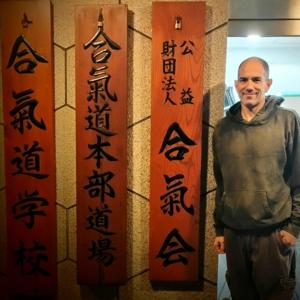
Miles Kessler Sensei teaches out of the Integral Dojo in Tel Aviv, Israel, and this conversation finds him literally in the crucible of war himself, as he speaks expecting sirens warning him to head to the nearest bomb shelter.
(To learn more about Miles Sensei’s incredible background, check out his first appearance. Link
It’s in this real-world context that his profound philosophy—Aikido not as a path of peace, but a path of conflict, with peace as the byproduct of good conflict done well—is called to action.
Miles Sensei’s most powerful application of Aikido off the mat is his frank discussion of trauma. He describes how trauma—whether personal, generational, or societal—causes us to retreat and polarize, locking us into patterns that perpetuate the past.
The ultimate work of the spiritual warrior is to purify this inherited and active trauma, allowing us to hold conflict in a way that becomes the catalyst for evolutionary development.
Miles Sensei challenges us to move beyond the easy binaries of “us versus them,” arguing that true spiritual progress requires us to wrestle with the moral dilemmas of the present moment. When nothing is reliable, the path of practice is the only constant.
He also reminds us that we are not doomed, that there may still be some adults in the room willing to meet the present conflict with a broader, deeper perspective, ready to move humanity forward with a practical, uncompromising spiritual framework for modern existence.