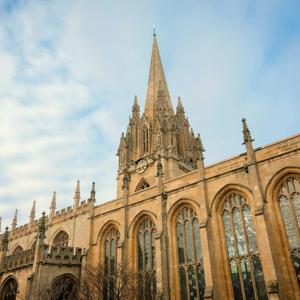
Weekly Podcasts

Weekly Podcasts

By University Church of St Mary, OxfordReligion & Spirituality
Download on the App Store

All Weekly Podcasts episodes

  • ‘This day you will be with me in paradise’
    ‘Christ’s Seven Last Words’ is a production of the University Church in Oxford, featuring Professor Graham Ward, Regius Professor of Divinity, which will be released each evening throughout Holy Week.
    In this second episode, Professor Graham Ward reflects on the words, ‘This day you will be with me in paradise’.
    Music sung by the University Church Choir.
    Sound design by Ana-Maria Niculcea
    Like the Prodigal Son among the swineherd, all inheritance spent, we are recalled to ourselves by the thief on the Cross and Christ’s words to him: “This day you will be with me in paradise.” We know something about what we are, though far less about what we will be, and we don’t know what paradise is. We have echoes of a mythic garden in Eden or the city coming down from heaven. We have dreamt ancient dreams and every laid-out and well-tended garden, woodland silence, sunset sea and frosted mountain leaves traces of a delightful beauty. But each culture imagines what is paradisial differently, or reads into the Biblical accounts familiar, though idealised, scenes. It is the transit from one realm and situation to another that speaks from the Cross. The transit from the physical and mental agony of being crucified to some place of eternal delights in which violence and violation cease. We are caught in the very moment of transition, not just between the present and the future, but an axial moment in created time and the eternal. But there is something also about judgement here: the criminal who, on his own account, deserved his punishment and Christ, the just one, the one alone who is without sin. There is a new justice manifest here; a divine justice revealed in the very face of both human injustice (against Christ) and the justified punishment of the thief. And who knows what led the thief to steal? Sin is exposed, even acknowledged and forgiveness comes through an intercession between Christ as Son and the divine Father. We have no understanding of what is involved in that exchange between Father and Son such that eternal forgiveness is possible. The forgiveness is and will always remain a mystery in which the first word from the Cross echoes: “they know not what they do.” For all the decisiveness of human practices of justice and the meeting out of punishment, there is a profound ignorance and only one who can be truly said to be innocent. So many unknowns about our human condition are staged here in the final moments on the Cross: the truth about where we are going and what we have done, the righteousness or unrighteousness of all our acts, singly and collectively. What is certain is the love that forgives and our eternal presence with Christ. Christ with us is paradise. It’s as if one day, beyond our deaths, we will awake, open our eyes and have to ask “what was that all about?” We are not the ultimate controllers of our destiny, or the destiny of anybody else either. “This day you will be with me in paradise” – and then we will understand. We will know even as we are known.
    9 min
  • Father, forgive them; for they know not what they do.
    ‘Christ’s Seven Last Words’ is a production of the University Church in Oxford, featuring Professor Graham Ward, Regius Professor of Divinity, which will be released each evening throughout Holy Week.
    In this first episode, Professor Graham Ward reflects on the words, ‘Father, forgive them; for they know not what they do’.
    Music sung by the University Church Choir.
    Sound design by Ana-Maria Niculcea
    The first of the seven last words: “Father, forgive them; for they know not what they do.”
    1. There were many people at the foot of the Cross: believers, non-believers, and functionaries carrying out the execution. Christ speaks from His elevated position to the world below Him, his family, his friends and those who have come to taunt. He is never more exposed as strung up on that cross, and neither is the gospel. And yet, even in this event, most particularly in this event, His work as the Mediator between creation and the Creator is dramatically and painfully revealed. This is who He is: the one who mediates. This is what the gospel is: salvation in and through that mediation that now, as if in some moment of tortured rest, arrives at the final stages of its completion. The inner rhythm of His intercession, to us, to God, to us again and back to God is revealed. It wraps the world in a call and response in which all things are submitted to their final, divinised consummation. But the coronation is by thorns. The Word itself is crucified, and we are left with meditating on this last day in which Christ’s suffering and exaltation are inseparable.
    I like to think I’m one of the disciples. I like to think I would be among the women at the foot of the cross. We all do. But I am not. I am exposed in Christ’s exposure, and what are revealed is not the endless repetition of little misdemeanours, but the scars I still bear of my deepest betrayals. And always these are betrayals of love; wounds I inflicted that were not loving and that did not keep faith. We know them, the deep ones, because they are unforgettable. We live with certain levels of selfishness and certain levels of compromise, but our human frailty, its pettiness and even banality, is not what I am talking about. I’m talking about those occasions in which I acted, in which I perpetrated, something I cannot forgive myself for doing. We try to rewrite the story, we might even have the opportunity of saying sorry, but the shame does not go away. It won’t go away. On the cross, Christ speaks the first of his seven words: “Father, forgive them; for they know not what they do.” But the things of which I speak were not done in ignorance and forgiveness is not a disinfecting wipe that cleans them away. Forgiving is not forgetting. The wounds will remain, remembered, even when forgiveness by Christ has been received. Just as the wounds on Christ’s body from the crucifixion are not erased with His resurrection. Forgiveness enables us to live with and through them, that we might understand what salvation is and isn’t. If it is a restoring to wholeness, then it is not our human understanding of wholeness. Being healthy, young, fit and well-proportioned is a human projection of wholeness. On the cross, Christ mediates for us a salvation in God that transfigures our human views of mental and physical perfection. We come to the cross bearing what we are, and the wounds are part of that. Through them we too are exalted. In some way. We will never have the security and consolation of closure. But redemption works with that and through that. The cross is the ultimate mediation between creation and our Creator.
    10 min
  • Intercollegiate Service 2021
    The practice of delivering University Sermons dates back to the earliest days of the University. Each year eminent men and women from many different traditions are invited by the Vice-Chancellor to deliver sermons ‘before the University’. The University’s motto from Psalm 27, Dominus illuminatio mea (The Lord is my light), captures something of its purpose: an occasion for the illumination of the mind in the context of prayer. Today, these sermons occur at the University Church and in College Chapels across the University. Every year during Hilary Term, an Intercollegiate Service takes place at the University Church as members of different Colleges gather together at St Mary’s for a University Sermon. This year, we are unable to gather, but we are very grateful that the Revd Dr Sam Wells, the Vicar of St Martin-in-the-Fields, has recorded his University Sermon, which is presented here as a podcast with recordings from many different Colleges of the University.
    Introit Vaughan-Williams, The Souls of the Righteous, The Queen’s College
    Welcome The Revd Julia Baldwin, Chaplain Brasenose College
    Collect The Revd Susannah Reide, Precentor University Church
    Hymn There’s a wideness in God's mercy (t. Corvedale), University Church Choir
    Reading 1 Cor 15.12-19 read by Aaron James, Christ Church
    Anthem Tallis, If ye love me, Brasenose College
    Reading Vassar Miller ‘To Jesus on Easter’ read by Constance Everett-Pite Corpus Christi College
    Reading John 14.1-6, read by The Revd Sarah Farrow, Chaplain Mansfield College
    Sermon The Revd Dr Sam Wells, Vicar of St Martin-in-the-Fields
    Anthem Aaron King, Lux Aeterna, Hertford College
    Prayers Chase Mizzell Harris Manchester College
    Anthem Shepherd, The Lord’s Prayer, Magdalen College
    Blessing The Revd Dr William Lamb, Vicar University Church
    Voluntary Bach’s Fantasia in G (BWV 572), played by Alastair Stone Pembroke College
    The anthem ’Lux aeterna’ was composed by Aaron King in memory of Rafa Baptista, member of Hertford College Chapel Choir, who died in April 2017.
    Producer: Ana-Maria Niculcea, Communications, Learning and Outreach Officer

    47 min
  • The Baptism of Christ
    Welcome to the University Church of St Mary the Virgin, Oxford. We are delighted that you have joined us today for our service of Holy Eucharist. The Revd Susannah Reide is presiding and the Revd Dr William Lamb is preaching.
    1 hr 3 min
  • 6. What’s in an ending
    Meditations on Mark
    Mark’s gospel is almost certainly the earliest of the canonical gospels. It was once regarded as the simplest and most straightforward account of the ministry of Jesus. With its breathless pace, ‘And then Jesus said… and then he went….and immediately….’ Mark presents a series of events in quick succession. The order appears to be almost random, and yet on closer inspection, it becomes apparent that this is a work of considerable literary sophistication.
    The interpretation of Mark has become the source of fascination to commentators: for some, Mark’s focus is Christological, exploring the identity of Jesus Christ; for others, it is eschatological, emphasising the imminence of Jesus’ proclamation that 'the Kingdom of God is at hand'; some scholars emphasise the pastoral or missionary accent of the text, while others focus on the way in which the text has been shaped by the politics and social issues of its day. In these podcasts, Will Lamb provides an overview of contemporary scholarship while paying close attention to the exegesis of Mark’s text. These meditations are designed to enrich our reading of Mark as we explore the gospel in the course of the liturgical year.
    6. What’s in an ending? (Mark 16.1-8)
    In this sixth and final episode, we are invited to meditate on Mark’s mysterious ending.
    12 min
  • 5. The Place Called Golgotha
    Meditations on Mark
    Mark’s gospel is almost certainly the earliest of the canonical gospels. It was once regarded as the simplest and most straightforward account of the ministry of Jesus. With its breathless pace, ‘And then Jesus said… and then he went….and immediately….’ Mark presents a series of events in quick succession. The order appears to be almost random, and yet on closer inspection, it becomes apparent that this is a work of considerable literary sophistication.
    The interpretation of Mark has become the source of fascination to commentators: for some, Mark’s focus is Christological, exploring the identity of Jesus Christ; for others, it is eschatological, emphasising the imminence of Jesus’ proclamation that 'the Kingdom of God is at hand'; some scholars emphasise the pastoral or missionary accent of the text, while others focus on the way in which the text has been shaped by the politics and social issues of its day. In these podcasts, Will Lamb provides an overview of contemporary scholarship while paying close attention to the exegesis of Mark’s text. These meditations are designed to enrich our reading of Mark as we explore the gospel in the course of the liturgical year.
    5. The place called Golgotha (Mark 15.22-39)
    In the fifth episode, we reflect on Mark’s account of the passion of Christ.
    15 min
  • 4. A Costly Discipleship
    Meditations on Mark
    Mark’s gospel is almost certainly the earliest of the canonical gospels. It was once regarded as the simplest and most straightforward account of the ministry of Jesus. With its breathless pace, ‘And then Jesus said… and then he went….and immediately….’ Mark presents a series of events in quick succession. The order appears to be almost random, and yet on closer inspection, it becomes apparent that this is a work of considerable literary sophistication.
    The interpretation of Mark has become the source of fascination to commentators: for some, Mark’s focus is Christological, exploring the identity of Jesus Christ; for others, it is eschatological, emphasising the imminence of Jesus’ proclamation that 'the Kingdom of God is at hand'; some scholars emphasise the pastoral or missionary accent of the text, while others focus on the way in which the text has been shaped by the politics and social issues of its day. In these podcasts, Will Lamb provides an overview of contemporary scholarship while paying close attention to the exegesis of Mark’s text. These meditations are designed to enrich our reading of Mark as we explore the gospel in the course of the liturgical year.
    4. A Costly Discipleship (Mark 10.32-45)
    In the fourth episode, we turn from Galilee to face Jerusalem. Jesus predicts his passion three times, and challenges his followers to think about the cost of discipleship.
    15 min
  • 3. The Mystery of the Kingdom (Mark 4.10-20)
    Meditations on Mark
    Mark’s gospel is almost certainly the earliest of the canonical gospels. It was once regarded as the simplest and most straightforward account of the ministry of Jesus. With its breathless pace, ‘And then Jesus said… and then he went….and immediately….’ Mark presents a series of events in quick succession. The order appears to be almost random, and yet on closer inspection, it becomes apparent that this is a work of considerable literary sophistication.
    The interpretation of Mark has become the source of fascination to commentators: for some, Mark’s focus is Christological, exploring the identity of Jesus Christ; for others, it is eschatological, emphasising the imminence of Jesus’ proclamation that 'the Kingdom of God is at hand'; some scholars emphasise the pastoral or missionary accent of the text, while others focus on the way in which the text has been shaped by the politics and social issues of its day. In these podcasts, Will Lamb provides an overview of contemporary scholarship while paying close attention to the exegesis of Mark’s text. These meditations are designed to enrich our reading of Mark as we explore the gospel in the course of the liturgical year.
    3. The Mystery of the Kingdom (Mark 4.10-20)
    In the third episode, we examine the tension between concealment and revelation in the gospel, and the way in which Mark uses parables in order to help us to see the extraordinary beyond the ordinary.
    15 min
  • 2. Binding the Strong Man (Mark 3.20-35)
    Meditations on Mark
    Mark’s gospel is almost certainly the earliest of the canonical gospels. It was once regarded as the simplest and most straightforward account of the ministry of Jesus. With its breathless pace, ‘And then Jesus said… and then he went….and immediately….’ Mark presents a series of events in quick succession. The order appears to be almost random, and yet on closer inspection, it becomes apparent that this is a work of considerable literary sophistication.
    The interpretation of Mark has become the source of fascination to commentators: for some, Mark’s focus is Christological, exploring the identity of Jesus Christ; for others, it is eschatological, emphasising the imminence of Jesus’ proclamation that 'the Kingdom of God is at hand'; some scholars emphasise the pastoral or missionary accent of the text, while others focus on the way in which the text has been shaped by the politics and social issues of its day. In these podcasts, Will Lamb provides an overview of contemporary scholarship while paying close attention to the exegesis of Mark’s text. These meditations are designed to enrich our reading of Mark as we explore the gospel in the course of the liturgical year.
    2. Binding the Strong Man (Mark 3.20-35)
    In the second episode, we consider the apocalyptic imagery of the gospel, as well as the conflict and controversy which attends Mark’s first few chapters.
    13 min
  • 1. The Beginning of the Gospel (Mark 1.1-8)
    Meditations on Mark
    Mark’s gospel is almost certainly the earliest of the canonical gospels. It was once regarded as the simplest and most straightforward account of the ministry of Jesus. With its breathless pace, ‘And then Jesus said… and then he went….and immediately….’ Mark presents a series of events in quick succession. The order appears to be almost random, and yet on closer inspection, it becomes apparent that this is a work of considerable literary sophistication.
    The interpretation of Mark has become the source of fascination to commentators: for some, Mark’s focus is Christological, exploring the identity of Jesus Christ; for others, it is eschatological, emphasising the imminence of Jesus’ proclamation that 'the Kingdom of God is at hand'; some scholars emphasise the pastoral or missionary accent of the text, while others focus on the way in which the text has been shaped by the politics and social issues of its day. In these podcasts, Will Lamb provides an overview of contemporary scholarship while paying close attention to the exegesis of Mark’s text. These meditations are designed to enrich our reading of Mark as we explore the gospel in the course of the liturgical year.
    1. The Beginning of the Gospel (Mark 1.1-8)
    In the first episode, we explore the language and imagery of Mark’s Prologue and the way in which Mark introduces his challenging and unsettling story.
    18 min