John 4:7-14 (Common English Bible)
A Samaritan woman came to the well to draw water.
Jesus said to her, “Give me some water to drink.”
His disciples had gone into the city to buy him some food.
The Samaritan woman asked, “Why do you, a Jewish man, ask for something to drink from me, a Samaritan woman?” (Jews and Samaritans didn’t associate with each other.)
Jesus responded, “If you recognized God’s gift and who is saying to you, ‘Give me some water to drink,’ you would be asking him and he would give you living water.”
The woman said to him, “Sir, you don’t have a bucket and the well is deep. Where would you get this living water? You aren’t greater than our father Jacob, are you? He gave this well to us, and he drank from it himself, as did his sons and his livestock.”
Jesus answered, “Everyone who drinks this water will be thirsty again, but whoever drinks from the water that I will give will never be thirsty again. The water that I give will become in those who drink it a spring of water that bubbles up into eternal life.”
____
A Samaritan woman comes to a well to draw water. Jesus asks her for a drink.
“Give me a drink.” There is so much more in these four words (actually, three words in Greek) than you might think.
If you ask Google, How many Samaritans are there in the world in 2020? The answer you will get is 818. The author Gerald Russell in his book, Heirs to Forgotten Kingdoms, states that all the Samaritans in the world are found in two places, a small village atop Mount Gerizim in the West Bank and on a street in the Holon suburb of Tel Aviv.
In Jesus’ day, there were about 1/2 million Samaritans. They were found in Samaria, that region between Judea to the south and Galilee in the North.
The Jews and the Samaritans had a fraught history for 700 years and in Jesus’ day, the animosity was intense.
In 9 AD, some Samaritans had snuck into the temple in Jerusalem at the beginning of Passover and scattered human bones throughout the sacred shrine making it unclean for the celebration.
Later in the century, as a Galilean pilgrim traveled through Samaria on his way to the holy city of Jerusalem, he was murdered by Samaritan terrorists.
Jewish Zealots reacted to the murder by massacring innocent Samaritans and burning down their villages.
Because of events like these, which happened far too often, Samaritans were banned from Judea and Jews intentionally stayed out of Samaria. Jewish travelers heading from Judea to Galilee and vice versa would detour around Samaria by way of the Jordan River adding 2 or 3 days to their journey.
Well, except Jesus...
He decides, on a trip from Galilee to Jerusalem to trek through Samaria.
As he and his disciples travel near Shechem, in the shadow of Mount Gerizim, Jesus takes a break by a well while the others mosey into town looking for falafels and fruit.
While the disciples are away, a woman comes to the well. While she is drawing water for herself, Jesus looks at her and asks, δις μοι πειν “Give me a drink.”
The woman’s responds, surprised, shocked, “Why do you, a Jew, ask me, a Samaritan, for a drink?”
And then the writer adds a parenthetical note- Jews and Samaritans didn’t associate with each other.
That’s quite an understatement. The Jews and the Samaritans had considered each other enemies for a seven centuries.
It’s kinda weird because, in actuality, both Samaritans and Jews held a common belief in a monotheistic deity by the name of Yahweh. They had almost identical religious practices that came from a Torah given to Moses by God, but they had very different interpretations of history, and that history created real problems.
Here’s the way the Samaritans saw it:
Way back when the Northern Kingdom, Israel was conquered by the Assyrians, a few Israelites were deported to destinations throughout the Assyrian Empire, but most remained in Israel and were faithful to their God.
They were the Samaritans, proud descendants from Joseph.
They accepted a Torah given to them by God through Moses.
They believed Mount Gerizim was God’s dwelling place, they revered it, worshiped upon it, and built a temple on it.
As the Samaritans interpreted history,
Adam was created from the dirt of Mount Gerizim,
it was on Mount Gerizim that Noah’s Ark came to rest,
it was on Mount Gerizim where Abraham attempted to sacrifice Isaac,
it was on Mount Gerizim that Moses received the commandments (the tenth of which was a declaration that Mount Gerizim was God’s holy place,).
The Samaritans believed that the Jewish temple in Jerusalem was an unholy innovation by King David, who they discounted as a interloper.
On the other hand, according to the prevalent Jewish thought, the Samaritans were people who the Assyrians shipped into Israel after massive number of Israelites were deported. These foreigners intermarried with the remaining Israelites and what resulted was a misguided people with a blasphemous religion.
Mt Gerizim was not a holy place at all, but the home of an illegitimate temple used by a heretical religious cult.
According to the Talmud, the Jews were open to reconciliation with the Samaritans,... if they would deny Mount Gerizim and confess Jerusalem as the throne of God. But As long as they kept Gerizim as their holy place there could be no relationship between Jews and Samaritans.
To make matters worse, throughout history the Samaritans had fought on the opposite side of most of the wars involving the Jews. The Jewish/Samaritan chasm widened greatly when Alexander the Great, after sacking Jerusalem rebuilt the temple at Gerizim for the Samaritans.
Add to this history the ongoing violence against each other, and you had two groups who were constantly at odds.
The common thought to a first century Jew or a first century Samaritan would be “I would rather go thirsty, I would rather die of thirst, then ask for a drink from that so and so” The idea of speaking to one of them, let alone asking for a favor, was anathema.
But that’s what Jesus does.
And because that is what Jesus does, a door opens.
It is difficult to overstate the impact of Jesus’ three words, δις μοι πειν.
True story.
In Ireland, there is a church with a hole cut in the door. That hole has been there since 1492, when two families, the Butlers -and the Fitzgeralds were embroiled in a feud.
At one point, the feud became a violent battle, and the Butlers, found themselves barricaded in St. Patrick’s Church.
The Fitzgeralds, sensing that things were out of control asked the Butlers to come out and make peace.
The Butlers sensed a trap, and refused to come out.
So, the head of the Fitzgeralds, Gerald Fitzgerald cut a hole in the door. He then stuck his hand through the hole in a attempt to shake hands with the leaders of the Butlers.
When the Butlers saw the unprotected hand come through the hole, and recognized that Gerald Fitzgerald was risking serious injury if the Butlers so desired, realized that the Fitzgeralds’ hope for reconciliation was real.
The Butlers came out, the families shook hands and worked to resolve their differences. This story is the origin of a popular Irish expression “to chance your arm.”
When Jesus asks “give me a drink,” he is sticking his hand through the hole in the door.
And the woman, for her part, opens the door. As Jesus asks for water, he is saying to the woman,
I see you,
I acknowledge you,
I accept you as you are,
I value you as a human being,
and I am thirsty.
“But why would you talk to me?” She responds, extending the conversation.
“Why not, he responds,” and then Jesus offers her water of a different sort- “living water that satisfies deeply.”
And from there the conversation takes off.
And eventually leads to the question that was the biggest possible question between them, the big question between Jews and Samaritans- bigger than gender, bigger than ethnicity, bigger than morality- where do we encounter God?
She asks the question- a pretty courageous question for a Samaritan to ask a Jew. Mount Gerizim or Jerusalem? knowing that as a faithful Jew he will certainly insist on Jerusalem and denounce Gerizim.
Jesus’ answer is shocking- “I don’t care. It’s not about where, or about how, it’s about who.”
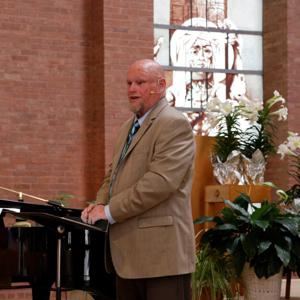
I love the Sanctuary of the Beatitudes. I am drawn to this space with it oculus and its windows and its simplicity. I love the wood and the brick and the crack in the back.
But, truth is, over the years, I have worshiped in lots of places.
I have worshiped
in grand cathedrals,
in historic old churches on 150 year old pews,
in storefronts on plastic lawn chairs,
in crowded living rooms,
under tent tops with sawdust on the floor,
in baseball stadiums,
in sweat lodges.
I have worshiped
in arenas,
in bars,
in synagogues,
in Buddhist temples,
on sacred mountains.
I have worshiped on trails,
on a bicycle,
in a car,
on a train.
I have worshiped
on the edge of the Grand Canyon,
on e the backside of Mt. Rushmore,
on the Mall in Washington,
at the Sea of Galilee and
in the caves of Masada.
And I can tell you, honestly, that God has not been more present at any of these places over any others, because worship is not about where. God is where we choose to encounter God. When we choose to worship, regardless of the locale, God is present.
I am reminded that as we worship today some are in person in the Sanctuary, others are sitting at their kitchen table, or on their couch, or under the covers in bed. No one place of worship is better in the eyes of God. It is the fact that God is worshiped that matters. So, bless you for joining us from wherever you are today.
Later, after Jesus’s death and resurrection, he gives instructions to his followers as to where they should go to share his Good News. Quote, “be my witnesses in Jerusalem, in all Judea and Samaria, and to the end of the earth.” Samaria, I am thinking that his disciples were a bit surprised to hear Jesus include Samaria in named places. Few of Jesus’ followers would have guessed that these looked-down upon outcasts would have front row seats at the incoming Kingdom. And History confirms for us that Samaritans were an integral part of the earliest church!
When Jesus asks a woman, “give me a drink,” he is inviting all of us who have felt alienated by dominant religious or societal expressions to feel welcome, to feel noticed, to feel accepted, to feel whole, to feel loved and to join the conversation about grace and mercy.
Amen.
____
Pastoral Prayer
O God of Forlorn Hope
Of a hope that is hanging on by the fingernails
Off a precipice
We bring our longing to you,
that you would reinflate what seems to be
losing air with each act of violence,
each physical discomfort, each ending.
For you are a full bodied, fully breathed, fully realized hope. You are with us. You do not leave us hanging all alone.
Fill your people with your love, to be poured out for all people; neighbor, estranged family, beloveds, stranger, enemies, ourselves.
Fill your people with your love and remind us that we are all your people.
We pray for our national leaders this week as they strive to create again a government of, by and for the people.
May they remember that they are there to serve, that they are there to guide policies that are for all of us.
That they are there to steward the land, the soil, the air, the creation that you have so generously and creatively given to us all. Move within the chambers in government, and within the hearts of the people of rural areas, villages, small towns and cities.
May we see one another as neighbor, worth caring for.
Broaden our scope of vision, that we may see your light that shines into the darkness.
Your light that illuminates all ills.
Your light that penetrates that which we try to hide.
Your light that has come to save. All of us. Each one of us.
Continue to teach us with your wisdom,
How to care well.
How to reach out in prayer.
How to make a connection through cards and notes and calls.
How to bring your light to the people of this community of faith, that we may bring your light to all in our ever broadening welcome.
You are more to us than a Savior for some distant day.
You save us today.
For this we are grateful.
In Christ’s name. Amen.



 View all episodes
