
Sign up to save your podcasts
Or


What would the greatest writer in the English language think of a world where people have stopped using words?
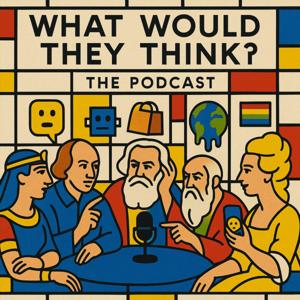
What Would They Think? is a fully AI-generated podcast that pairs history's greatest minds with the strangest corners of modern life. Each episode, one long-dead thinker walks straight into the 21st century and we ask: what would they actually make of it?
This episode: Shakespeare meets emojis. The man who gave us more words than anyone in the history of the language — who coined "lonely," "bedroom," "eyeball," and roughly 1,700 others — confronts a communication system built entirely on pictures. A 16th-century playwright who wrote for the groundlings and the court in the same breath meets a culture that expresses grief, desire, irony, and lunch in a single yellow circle.
It's a more honest collision than it seems. Shakespeare wrote for performance, not the page. He understood that meaning lives in gesture, in timing, in the gap between what's said and what's meant. Emojis operate in exactly that space. Whether he'd see them as a natural evolution of the thing he loved — or as proof that civilization has finally given up — turns out to be a genuinely open question.
The production will grow. The format will evolve. We're building this in public, with AI, and we're committed to the journey.
Dead philosophers. Modern problems. Fully AI.
What Would They Think?
 View all episodes
 By Jonathan Millard
What would the greatest writer in the English language think of a world where people have stopped using words?
What Would They Think? is a fully AI-generated podcast that pairs history's greatest minds with the strangest corners of modern life. Each episode, one long-dead thinker walks straight into the 21st century and we ask: what would they actually make of it?
This episode: Shakespeare meets emojis. The man who gave us more words than anyone in the history of the language — who coined "lonely," "bedroom," "eyeball," and roughly 1,700 others — confronts a communication system built entirely on pictures. A 16th-century playwright who wrote for the groundlings and the court in the same breath meets a culture that expresses grief, desire, irony, and lunch in a single yellow circle.
It's a more honest collision than it seems. Shakespeare wrote for performance, not the page. He understood that meaning lives in gesture, in timing, in the gap between what's said and what's meant. Emojis operate in exactly that space. Whether he'd see them as a natural evolution of the thing he loved — or as proof that civilization has finally given up — turns out to be a genuinely open question.
The production will grow. The format will evolve. We're building this in public, with AI, and we're committed to the journey.
Dead philosophers. Modern problems. Fully AI.
What Would They Think?