
Sign up to save your podcasts
Or


Retrieved from ScubaGuru - Expert Advice & Best Practices for Scuba Diving Professionals
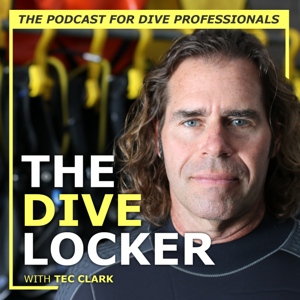
Welcome to The Dive Locker podcast, the podcast for dive professionals where we bring you the latest in diving industry resources that make you excellent at teaching techniques, risk management and dive business.
I’m your host Tec Clark and welcome
Why? Because frankly, there are some
We’re going to have experts on.
So what we want to do here is we want
You can listen to a 30 minute segment
But there will be segments that come
So let’s talk about why this show.
Underwater exploration is awesome, but we need to make it better. And how we do that is located in the way that we teach, the way that we conduct ourselves in business practices, the way that we handle risk. All of these things are going to be so important to how we flourish as an industry. And that starts with the frontline people. So what do I mean by frontline? Well, that’s going to be you, the dive pro, our retailers, our dive operators. And here’s something to think about. According to DEMA, recreational scuba diving and snorkeling contribute about $11 billion to the US Gross Domestic Product. Now that’s a big industry, but our frontline forces, those retailers and dive operators I have been talking about, you professionals rarely have any business training whatsoever. And so you hear that our sport comes from one that is kind of a grassroots and organically built industry where you have people that are so passionate about sharing the underwater world with others that they become a pro.
And they do that in a supervisory capacity like divemasters or an instructional capacity like instructors. And then what they rise up into saying, “hey, let’s look at doing this full time”. And so that might be as a full time independent instructor or hang a shingle and get a dive shop or a dive boat or a shop with a boat, a dive center. And so when we start to look at how these businesses grow, our frontline folks are the ones that are putting this all out there to the consumer. And as my friend Darcy Kieran says, having a dive center is like having six businesses in one. And if you think about it, it’s very true because we have to be able to serve the needs of diving and we have to do that in so many facets. And so how do we do that? Well is going to be one of the keys to the show.
We’re also going to talk about the
If we don’t police ourselves, then
So who am I the one that’s leading this as your host? Well, many of you know me from the diving industry. Many of you know me from the League of Extraordinary Divers Podcast and for those that I don’t know, I’m pleased to meet you. Tec is my nickname. Thomas E. Clark, Tec has nothing to do with technical diving or technology or anything like that. It’s just my nickname. And I began diving here in Lauderdale by the Sea at the age of 12. Then I went on to get my PADI open water and advanced open water certifications and promptly went to the University of Florida. And in my sophomore year I had to drop a golf class. There was a table, a drop-add table. And there were some instructors there and they said, “hey, are you to diver?
I said, “yes, I am”. They said, “what level of diver are you?” I said, “I’m an advanced diver”, and they said, “all right, well we’ve got a course that’s called assistant instructor. It’s your next level up. Why don’t you take it and it’s two credit hours.” So sure enough, I joined up, took the class and I joined the University of Florida Academic Diving Program and that semester I learned all there was about academic diving and being an assistant instructor. Loved it and promptly went onto my instructor training course. I became a NAUI instructor, a YMCA instructor, a CMAS instructor, and a PADI instructor all at the University of Florida Academic Diving Program. And that was 1988, a long time ago. And so I was able to teach in auditoriums. I spoke at YMCA conventions, NAUI events, I began writing for Currents – that’s the YMCA’s publication and Sources. NAUI’s publication. And that really got me to a point where we started to realize as young men and women at the University of Florida that we were doing some special things and we really were passionate about teaching.
Well, my mom got cancer and I decided
And so I did that for a couple of
I was also able to be a part of the RSTC the Recreational Scuba Training Council. That is the organization that’s a secretary of ANSI. You’ve heard of ANSI before, American National Standards Institute. That’s, you know, you see an ANSI sticker on a bike helmet, right? That’s because there are standards in these type of recreational pursuits. And so the RSTC is who creates the minimum standards in our diving industry. So I was able to serve alongside of SSI, PADI, IDEA, and PDIC. It was a fantastic, fantastic way to see the industry from kind of one of the highest levels of gathering together and creating industry standards. At that same time, I got into freediving. Now I always had been a freediver. But at this time it was really neat because we were with CMAS not only at University of Florida, but also YMCA. The YMCA Scuba program was a sanctioning body for CMAS here in the United States.
And with that, CMAS was also doing records for freediving. So I became a freediving judge with CMAS. And my passion just exploded as I was being a judge for record competitions for people like Tanya Streeter and Mehgan Heaney-Grier and Alejandro Ravello and really great upcoming freedivers at the time that were setting national and world records. Well that led to creating the US Freediving Team. So Mehgan Heaney-Grier and I in 1996 created the first United States Freediving Team and it was great to see that team flourish, especially the women getting a Gold at the Pacific Cup of freediving in the early 2000’s. I also had a passion for safety and so teaming up with Divers Alert Network and becoming a trainer with them was really important to the mission of dive safety and educating others and higher level areas of rescue and risk management and first aid and treatment.
Well that passion rolled into me
At that same time, I also was able to launch a ministry in diving. Reef Ministries is a ministry that lookes at the underwater world as the handiwork of God. And so growing up I really had not much of a faith, but getting older and having a wife and kids and just looking at the blessings and the beauty of the underwater world. All of that together just really touched me. And yes, I had a conversion experience and just really resonated with my life as a Christian became something really, really big and important to me. So my faith rose and I decided to turn the gifts that God had given me and diving and kind of help others with that. So I was able to take out church groups and homeschoolers and really explore the underwater world as the handiwork of God. And that was with Reef Ministries and reefministries.com is still going well today.
And then I was able to join up with Nova Southeastern University. Now I took a small gig with them to teach some lessons on the side and all of a sudden the President of the University, Dr. George Hanbury, needed a refresher. So I gave him a refresher and at in his early seventies Dr. Hanbury, I put him through the paces and at the end of our refresher he said, “I learned more in my refresher with you than I learned in my beginning courses. What is that about?” I said, “it’s academic diving and that’s what I did for 10 years at the University of Florida Academic Diving Program. And by the way, Nova Southeastern University with their brilliant oceanographic center should also have an academic diving program too. He said, “write me a proposal.” And seven months later we launched the Nova Southeastern University Academic Diving Program. And that’s what I also do to this day.
Now I don’t say all of this to toot
So I’m going to invite many people that I’ve had the blessing and honor of working with through the years and being in, in different organizations with, and being on different committees with, and they are also going to be a part of this show. So that’s what this is all about. Best Practices. And by being an active listener yourself, you are part of The Dive Locker Nation. You will be a better dive pro. You’ll be better at teaching techniques, better at risk management and better at dive business. Now remember what I said earlier about how you can be involved? Well, this is where you can simply go to www.scubaguru.com and at scubaguru.com you will find the section for The Dive Locker podcast. When you get onto that page for the dive locker podcast, you’re going to see a microphone icon. Those microphones will be different topics. They could be things that are just about a tip or a technique on a certain area.
It could be on what you want to hear for future episodes. It could be about encouragement for the show or what we could do to improve. Just click on the microphones and start talking. You might be on the podcast! Again, that’s over at www.scubaguru.com The Dive Locker is what you’re looking for. So again, my friends, this is the inaugural episode. I am so excited that you’re here. I’m so excited that we’re launching. There’s more great things to come. This is just the preface of what it is and what the show is about. Next episodes, you’re going to hear all kinds of things that we’ve got lined up for you to be better as a dive pro. So again, I thank you for being here. I thank you for being a part of The Dive Locker Nation and I look forward to serving you every week. So thank you everybody and we’ll see you next time. Take good care and safe diving my friends.
Hi Tec, it’s Stephen Frink. I enjoyed the podcast we worked on together for your League of Extraordinary Divers project and now very much looking forward to The Dive Locker. Good luck.
Hi, this is Dan Orr of Dan Orr Consulting and I just wanted to say best of luck to Tec Clark and his new podcast, The Dive Locker. I have no doubt that it’ll be both enjoyable and extremely informative.
Tec, it’s Mermaid Linden from Mermaids in Motion. I just want to congratulate you on the new ScubaGuru podcast. I’m very much looking forward to listening to it and I think it’s going to be “mermific”. Cheers.
This is Grant Graves of Soggy Science and Pod Aquatics. I want to wish Tec an amazing and successful run with The Dive Locker. Good luck buddy.
Hey TC. It’s Kell from Rainbow Reef. Having been shoved into a lot of lockers as a school boy I’m a little nervous about the new podcast, but I know you’re going to kick butt! Break a leg brother.
Hey there. This is Michael Feld from Oceanblue Dive in New York City, wishing Tec Clark the best of luck with his new podcast.
Hey Tec, Ryan over at Born of Water and Spirit Apparel. I just wanted to say congratulations and good luck on the new podcast and I’m looking forward to listening to the new series.
Hey Tec, this Jack Snively at NAUI headquarters in Tampa, Florida. I was really excited when I heard about your new podcast for dive professionals. I have no doubt that you’re going to touch many lives for the better. Thanks buddy. Good luck.
Hey this is Rachel Cushman, your
Aloha. This is Keller Laros, the Manta Man of Kona, Hawaii, and I want to wish Tec Clark great luck with his new podcast, The Dive Locker. Be sure to check it out.
Thank you for joining me again. Do you want to leave a comment or suggestion for this podcast? Simply record yourself below!
If you enjoyed this episode, please share it using the social media buttons you see at the bottom of the post.
Also, please leave an honest review for The Dive Locker podcast on iTunes. Ratings and reviews are extremely helpful and greatly appreciated! And, don’t forget to subscribe to the show on iTunes , Google Play Music , or Stitcher to get automatic updates.
The post 001 Introduction to The Dive Locker Podcast appeared first on ScubaGuru.
 View all episodes
 By Tec Clark: Scuba Diving Educator, Speaker, Author

4.8
6969 ratings
Retrieved from ScubaGuru - Expert Advice & Best Practices for Scuba Diving Professionals
Welcome to The Dive Locker podcast, the podcast for dive professionals where we bring you the latest in diving industry resources that make you excellent at teaching techniques, risk management and dive business.
I’m your host Tec Clark and welcome
Why? Because frankly, there are some
We’re going to have experts on.
So what we want to do here is we want
You can listen to a 30 minute segment
But there will be segments that come
So let’s talk about why this show.
Underwater exploration is awesome, but we need to make it better. And how we do that is located in the way that we teach, the way that we conduct ourselves in business practices, the way that we handle risk. All of these things are going to be so important to how we flourish as an industry. And that starts with the frontline people. So what do I mean by frontline? Well, that’s going to be you, the dive pro, our retailers, our dive operators. And here’s something to think about. According to DEMA, recreational scuba diving and snorkeling contribute about $11 billion to the US Gross Domestic Product. Now that’s a big industry, but our frontline forces, those retailers and dive operators I have been talking about, you professionals rarely have any business training whatsoever. And so you hear that our sport comes from one that is kind of a grassroots and organically built industry where you have people that are so passionate about sharing the underwater world with others that they become a pro.
And they do that in a supervisory capacity like divemasters or an instructional capacity like instructors. And then what they rise up into saying, “hey, let’s look at doing this full time”. And so that might be as a full time independent instructor or hang a shingle and get a dive shop or a dive boat or a shop with a boat, a dive center. And so when we start to look at how these businesses grow, our frontline folks are the ones that are putting this all out there to the consumer. And as my friend Darcy Kieran says, having a dive center is like having six businesses in one. And if you think about it, it’s very true because we have to be able to serve the needs of diving and we have to do that in so many facets. And so how do we do that? Well is going to be one of the keys to the show.
We’re also going to talk about the
If we don’t police ourselves, then
So who am I the one that’s leading this as your host? Well, many of you know me from the diving industry. Many of you know me from the League of Extraordinary Divers Podcast and for those that I don’t know, I’m pleased to meet you. Tec is my nickname. Thomas E. Clark, Tec has nothing to do with technical diving or technology or anything like that. It’s just my nickname. And I began diving here in Lauderdale by the Sea at the age of 12. Then I went on to get my PADI open water and advanced open water certifications and promptly went to the University of Florida. And in my sophomore year I had to drop a golf class. There was a table, a drop-add table. And there were some instructors there and they said, “hey, are you to diver?
I said, “yes, I am”. They said, “what level of diver are you?” I said, “I’m an advanced diver”, and they said, “all right, well we’ve got a course that’s called assistant instructor. It’s your next level up. Why don’t you take it and it’s two credit hours.” So sure enough, I joined up, took the class and I joined the University of Florida Academic Diving Program and that semester I learned all there was about academic diving and being an assistant instructor. Loved it and promptly went onto my instructor training course. I became a NAUI instructor, a YMCA instructor, a CMAS instructor, and a PADI instructor all at the University of Florida Academic Diving Program. And that was 1988, a long time ago. And so I was able to teach in auditoriums. I spoke at YMCA conventions, NAUI events, I began writing for Currents – that’s the YMCA’s publication and Sources. NAUI’s publication. And that really got me to a point where we started to realize as young men and women at the University of Florida that we were doing some special things and we really were passionate about teaching.
Well, my mom got cancer and I decided
And so I did that for a couple of
I was also able to be a part of the RSTC the Recreational Scuba Training Council. That is the organization that’s a secretary of ANSI. You’ve heard of ANSI before, American National Standards Institute. That’s, you know, you see an ANSI sticker on a bike helmet, right? That’s because there are standards in these type of recreational pursuits. And so the RSTC is who creates the minimum standards in our diving industry. So I was able to serve alongside of SSI, PADI, IDEA, and PDIC. It was a fantastic, fantastic way to see the industry from kind of one of the highest levels of gathering together and creating industry standards. At that same time, I got into freediving. Now I always had been a freediver. But at this time it was really neat because we were with CMAS not only at University of Florida, but also YMCA. The YMCA Scuba program was a sanctioning body for CMAS here in the United States.
And with that, CMAS was also doing records for freediving. So I became a freediving judge with CMAS. And my passion just exploded as I was being a judge for record competitions for people like Tanya Streeter and Mehgan Heaney-Grier and Alejandro Ravello and really great upcoming freedivers at the time that were setting national and world records. Well that led to creating the US Freediving Team. So Mehgan Heaney-Grier and I in 1996 created the first United States Freediving Team and it was great to see that team flourish, especially the women getting a Gold at the Pacific Cup of freediving in the early 2000’s. I also had a passion for safety and so teaming up with Divers Alert Network and becoming a trainer with them was really important to the mission of dive safety and educating others and higher level areas of rescue and risk management and first aid and treatment.
Well that passion rolled into me
At that same time, I also was able to launch a ministry in diving. Reef Ministries is a ministry that lookes at the underwater world as the handiwork of God. And so growing up I really had not much of a faith, but getting older and having a wife and kids and just looking at the blessings and the beauty of the underwater world. All of that together just really touched me. And yes, I had a conversion experience and just really resonated with my life as a Christian became something really, really big and important to me. So my faith rose and I decided to turn the gifts that God had given me and diving and kind of help others with that. So I was able to take out church groups and homeschoolers and really explore the underwater world as the handiwork of God. And that was with Reef Ministries and reefministries.com is still going well today.
And then I was able to join up with Nova Southeastern University. Now I took a small gig with them to teach some lessons on the side and all of a sudden the President of the University, Dr. George Hanbury, needed a refresher. So I gave him a refresher and at in his early seventies Dr. Hanbury, I put him through the paces and at the end of our refresher he said, “I learned more in my refresher with you than I learned in my beginning courses. What is that about?” I said, “it’s academic diving and that’s what I did for 10 years at the University of Florida Academic Diving Program. And by the way, Nova Southeastern University with their brilliant oceanographic center should also have an academic diving program too. He said, “write me a proposal.” And seven months later we launched the Nova Southeastern University Academic Diving Program. And that’s what I also do to this day.
Now I don’t say all of this to toot
So I’m going to invite many people that I’ve had the blessing and honor of working with through the years and being in, in different organizations with, and being on different committees with, and they are also going to be a part of this show. So that’s what this is all about. Best Practices. And by being an active listener yourself, you are part of The Dive Locker Nation. You will be a better dive pro. You’ll be better at teaching techniques, better at risk management and better at dive business. Now remember what I said earlier about how you can be involved? Well, this is where you can simply go to www.scubaguru.com and at scubaguru.com you will find the section for The Dive Locker podcast. When you get onto that page for the dive locker podcast, you’re going to see a microphone icon. Those microphones will be different topics. They could be things that are just about a tip or a technique on a certain area.
It could be on what you want to hear for future episodes. It could be about encouragement for the show or what we could do to improve. Just click on the microphones and start talking. You might be on the podcast! Again, that’s over at www.scubaguru.com The Dive Locker is what you’re looking for. So again, my friends, this is the inaugural episode. I am so excited that you’re here. I’m so excited that we’re launching. There’s more great things to come. This is just the preface of what it is and what the show is about. Next episodes, you’re going to hear all kinds of things that we’ve got lined up for you to be better as a dive pro. So again, I thank you for being here. I thank you for being a part of The Dive Locker Nation and I look forward to serving you every week. So thank you everybody and we’ll see you next time. Take good care and safe diving my friends.
Hi Tec, it’s Stephen Frink. I enjoyed the podcast we worked on together for your League of Extraordinary Divers project and now very much looking forward to The Dive Locker. Good luck.
Hi, this is Dan Orr of Dan Orr Consulting and I just wanted to say best of luck to Tec Clark and his new podcast, The Dive Locker. I have no doubt that it’ll be both enjoyable and extremely informative.
Tec, it’s Mermaid Linden from Mermaids in Motion. I just want to congratulate you on the new ScubaGuru podcast. I’m very much looking forward to listening to it and I think it’s going to be “mermific”. Cheers.
This is Grant Graves of Soggy Science and Pod Aquatics. I want to wish Tec an amazing and successful run with The Dive Locker. Good luck buddy.
Hey TC. It’s Kell from Rainbow Reef. Having been shoved into a lot of lockers as a school boy I’m a little nervous about the new podcast, but I know you’re going to kick butt! Break a leg brother.
Hey there. This is Michael Feld from Oceanblue Dive in New York City, wishing Tec Clark the best of luck with his new podcast.
Hey Tec, Ryan over at Born of Water and Spirit Apparel. I just wanted to say congratulations and good luck on the new podcast and I’m looking forward to listening to the new series.
Hey Tec, this Jack Snively at NAUI headquarters in Tampa, Florida. I was really excited when I heard about your new podcast for dive professionals. I have no doubt that you’re going to touch many lives for the better. Thanks buddy. Good luck.
Hey this is Rachel Cushman, your
Aloha. This is Keller Laros, the Manta Man of Kona, Hawaii, and I want to wish Tec Clark great luck with his new podcast, The Dive Locker. Be sure to check it out.
Thank you for joining me again. Do you want to leave a comment or suggestion for this podcast? Simply record yourself below!
If you enjoyed this episode, please share it using the social media buttons you see at the bottom of the post.
Also, please leave an honest review for The Dive Locker podcast on iTunes. Ratings and reviews are extremely helpful and greatly appreciated! And, don’t forget to subscribe to the show on iTunes , Google Play Music , or Stitcher to get automatic updates.
The post 001 Introduction to The Dive Locker Podcast appeared first on ScubaGuru.
10 Listeners
258 Listeners
54 Listeners
51 Listeners