
Sign up to save your podcasts
Or

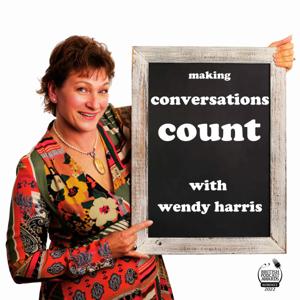

Making conversations about presentations count!
Delighted to introduce Lizzie Butler, owner of LB Communications, who met Wendy at a local online networking event and immediately hit it off.
They share how a bond of connection can happen without meeting purely because we trust our emotions.
The synergy of values draws people together and the basis of influencing others through conversation or communications calls to the right people, whether that is on a business or personal level.
Consider the language we use, body language, and how the recipient will receive your delivery and remember you.
Lizzie shares a deeply personal experience that affected her and the conversations she was having...
View Lizzie's events
Connect with Lizzie on LinkedIn
Visit Lizzie's website
Your host, Wendy Harris, runs a training business and has been Making Conversations Count for over 30 years. She has a best selling book on Amazon and loves nothing better than helping others find the right people to have the right conversations with. You can find out more on her website
INTERVIEW TRANSCRIPT
Making Conversations Count - Episode 16
Wendy Harris & Lizzie Butler
February 4th 2021
Timestamps
00:00:00: Introduction
00:02:01: Want to get goosebumps?
00:04:16: Close your eyes
00:06:50: Forget Zoom, use the telephone
00:09:36: Lizzie's pivotal moment
00:12:09: Don't deny your emotions?
00:14:07: You must rest
00:16:43: Neurolinguistics
00:19:29: Fear of presentations
00:20:08: Final thoughts
Wendy Harris: Welcome to Making Conversations Count, the podcast that brings you business leaders who are willing to share their pivotal moments that have created a turning point in their life and career. We're hoping that these stories really do resonate with our listeners and you enjoy listening to them.
Today, I have got Lizzie Butler in with me. Hello, Lizzie.
Lizzie Butler: Hello.
Wendy Harris: Please introduce yourself and tell everybody how we met.
Lizzie Butler: Okay, hi Wendy and hi listeners. I'm Lizzie Butler and I'm the owner and founder of LB Communications. Wendy and I first met on Jaz Greer's Business Connections. I think we had all of about five minutes because that's how it works. Then we went on to have another conversation which we set up, just us, didn't we?
Wendy Harris: We did.
Lizzie Butler: Although we never actually met in person, we just met via Zoom, the sort of platform for doing business at the moment, isn't it?
Wendy Harris: Yeah.
Lizzie Butler: It was funny, Wendy, because I was thinking about this the other day and thinking about making conversations count because communication of course is what I do. I help individuals and businesses to communicate better both formally and informally so they can get even better results than they're already getting.
I was thinking about and you and I and thinking about, "Isn't it funny how we've only had two conversations, one of them being five minutes".
Wendy Harris: Which was at about 100 miles an hour.
Lizzie Butler: Because you're on the clock; and one of them being 50 minutes.
Wendy Harris: Yeah.
Lizzie Butler: I was thinking, "We don't really know each other". I couldn't tell you what your favourite hobby is, or your favourite food and I don't think you would be able to tell me mine either.
Wendy Harris: Drink maybe, G&T, yeah.
Lizzie Butler: Yeah, we covered that one, absolutely. Yet I was thinking that if I knew somebody who was looking for your services, I would absolutely recommend you. Then I thought about that to myself and I thought, "That's a big step to recommend somebody who you don't really know on a personal level". That's a big step because of course, when you recommend someone and refer somebody, you're also putting your own reputation on the line as well, and yet I'd be more than happy to do that, even given that we've only had two conversations.
I thought, "Why is that?" Then I thought, "It's because, as human beings, we are emotional before anything else". We're emotional first, second and third and the cliché, "People buy from people" is absolutely true and I would like to add on, people buy from people they know, like and trust. I think with you and I, I certainly felt like we instantly connected, we instantly clicked, and that trust factor absolutely is there. That was two conversations.
Wendy Harris: I've got goosebumps, Lizzie. I've got goosebumps because this is just how unscripted these shows are, everybody. I agree with you emphatically though, Lizzie, that we laughed so much in that first five minutes because there's such a synergy in what we do in terms of helping people be themselves in their communication. You have a different route to market to mine, but essentially, we do the same thing.
So, we come across the same scenarios and I just knew straightaway that I needed to get to know you that little bit better and I think from that second conversation I was like, "Will you come on my podcast, please?" because I just think that there is a story to be told and to be shared and it is about making those conversations count.
Isn't it strange that we've not met, yet what you've said is that you would recommend me and likewise, so there is hope that we might not be physically connected but we are socially connected?
Lizzie Butler: Yeah, and also, I know for some people they can find it more difficult influencing over the telephone or online as opposed to face-to-face. My answer to that is, when I'm selling over the telephone, or should I say communicating over the telephone, I sometimes close my eyes, Wendy, because I don't need my eyes to listen.
Wendy Harris: Yes, that's true.
Lizzie Butler: Because when you listen and really, really also observe, then you're able to adapt your communication. Because I might be talking to a client, in fact, I will give you an example. It is a company who I'm working for and I was calling a number of clients and this particular one we had two conversations and it transpired that we could save that client in the region of about £4,000.
Wendy Harris: Not to be sniffed at then?
Lizzie Butler: No, not to be sniffed at, no. He asked me to put together a proposal which I did and sent that to him and then I followed up on the proposal. When he answered the phone, and it was an agreed time to call, I could hear in his voice that it wasn't a good time; even though we'd agreed that time, I could hear in his voice that it wasn't. His tone was much higher, his pace was much quicker suggesting to me that there were other things that he needed to work on at that time and that I wasn't going to be able to meet my desired outcome or success.
Wendy Harris: If you pressed it, yeah.
Lizzie Butler: You've got be able to do that. I have one phrase which is, "It's not me, it's all about you", and you have to know and understand your audience and what's important to them and where they're at, at that particular time. Because we know that when we communicate, we don't operate and exist in a vacuum and therefore I could say something to you, Wendy, that might have a negative effect. I might say something that I'm not aware of that you have a negative connotation with that particular word or phrase or whatever it may be. If I don't observe that, and if I don't hear that change in your voice or in your body language, then I'm going to keep going down that path which is going to make you feel negative towards me.
Wendy Harris: Yeah, of course.
Lizzie Butler: So, I've got to be able to stop that so that I can lead you emotionally to the place where I need you to be, so that you like and trust me. When we can get to that point, then I can begin to talk to you about whatever it is I want to talk to you about.
Wendy Harris: Yeah, it's powerful isn't it, the art of that. I did an article -- everybody's doing Zoom meetings, Zoom, Zoom, Zoom. Not only is it zapping everybody's energy but it's zapping your time, so your targets are not going to be met because you're not going to be as productive. My article was kind of along the lines of, "Do that first zoom. Get that first rapport built. Agree your next actions, but follow it up with a phone call". You really do have to concentrate on listening to what's happening and if you've got that rapport, you'll be able to tap in quickly to that personality.
Lizzie Butler: Yes, yes.
Wendy Harris: And you get so much time back because let's face it, you'll book out 15 minutes and you'll fill 15 minutes.
Lizzie Butler: Certainly, for some of the clients that I work with, their potential customers, not a chance would I have to meet them over Zoom; it's all the telephone. They have just got too much on their plate, so when I talk to them, I've got to be able to know how to manage my physical and emotional state so that I deliver the key message that I want them to receive and take away from them. I know that this is just a piece of the puzzle.
Wendy Harris: Yes, and it takes practice, it takes consistency, and you do need to get into the zone. If you're not going to be feeling it today, don't do it, it's not worth it.
Lizzie Butler: We have all done that, haven't we? When we have ignored our emotional state and then tried to get on the phone and communicate well.
Wendy Harris: Yes, go do something you hate. Take it out on something you hate. It never ceases to amaze me how people will press on, no matter whether it's a conversation or an action, when they should really just rein it back and do something else.
Lizzie Butler: Absolutely. I think the question that people should think about is, how do they want that person to think about you or feel about you when they put the phone down. So, for instance, the potential customer who I'd call with the money saving, I said to him, "I can hear this isn't a good time for you now, would it be better for us to reschedule this?" He said, "Oh Lizzie, that would be so much better for me, thank you. Thank you so much".
Wendy Harris: Yes, yeah.
Lizzie Butler: I'm on a different level then now, because then I'd built a little bit of empathy and trust and he knows that I can hear him and I mean really hear him, because a lot of people just talk. They think a conversation is about talking and, of course, it isn't.
Wendy Harris: No, it's not. Before we try and save the world from their bad sales calls, I'm going to bring it right back to what I got you here for, Lizzie, which is for you to share your pivotal moment with us. I know that you've been scratching your head and you've been thinking hard about this, so please tell us about your pivotal moment?
Lizzie Butler: This is something which was really pivotal for me three years ago, yet it's something that I continue to practice every single day and it's also something that I think everybody should think about. It was back in February 2017 and the conversation that changed my life is the one that I have with myself.
Wendy Harris: Interesting.
Lizzie Butler: For so many years, whilst I was successful, I wasn't quite as successful as I am now and that's because I changed the way I talk to myself, because conversations count and words matter; the words we say to ourselves matter. Prior to that, I was in fact very, very good at giving myself negative self-talk. I wouldn't expect many people to know or realise that, and that's because I gave them the version of me that was able to not show that.
When I learned how to talk to myself in a very positive way and I'm a numbers girl, and I'm a process girl; so if you have A is positive plus B is negative it means you're going to get some sort of negative reaction, but if you can make them both positive then you're going to get a positive reaction. What I learned to do was to change my internal communication to all positives, which means that I always get positive results.
That's what I help people to do now. So for instance, I'm working with, at the moment, two senior professionals who are going for incredibly senior promotions and I know they will both get this job, I know they will. They don't work together by the way; it's separate companies. The one thing that they feel that's holding them back, which isn't true by the way, is the self-talk.
They have limiting beliefs, beliefs that are holding them back and even though on paper, if they look at what they've achieved and they look up their skills and their attitude and how they're able to meet and exceed the criteria, they have limiting beliefs. "I don't deserve this". "Why me?" "I can't do this", or, "I can't get that", "Oh, that can't be right for me". "Oh, I don't know, it's easier not to go for it".
Wendy Harris: Going back to what you first said in terms of you not being as successful as you are now, what does that success look and feel like? Because people measure success in different ways and it doesn't necessarily have to be a salary, it could be a lifestyle or how you feel; tell me Lizzie's version?
Lizzie Butler: Okay, well the first thing is that I learned how to love myself again, because I'd fallen out of love with myself for many, many years. Something had happened in my life on a personal level, my grandma had died, and she was the most incredible lady.
Wendy Harris: They're the backbone to us, aren't they?
Lizzie Butler: Just wonderful, wonderful and when she died, I told myself, so this is my words, I told myself, meaning in my head, I told myself, "This is too painful, you need to get busy". Because I thought if I got busy then I wouldn't have to deal with it.
Wendy Harris: You just put it off.
Lizzie Butler: Yeah, because I couldn't grieve and I remember just feeling sort of, well nothing, because I couldn't allow myself to go there because it was going to be too painful and I didn't want to. So, I made myself incredibly busy to the point where I didn't rest anymore, to the point where I developed a fear of driving. I used to drive 600 miles a week, I couldn't drive on the motorway anymore. I used to feel as though the steering wheel was going to come off and the cars either side of me would crush me. I developed panic attacks; I developed an eating disorder. I developed all sorts of things.
Wendy Harris: So, those buried feelings were really desperate to try and get out.
Lizzie Butler: Absolutely, and in the end my brain shut me down and I had what I guess people would call now, I don't really like this word, a "breakdown". I mean, I didn't break; do you know what I mean?
Wendy Harris: No, you might have snapped a little.
Lizzie Butler: Yeah, it's same as the word "panic attack", the word "panic attack" is never going to make people feel good about themselves, is it? "Panic!" "Attack!" Do you know what I mean? They're not great words, are they?
Wendy Harris: No, no.
Lizzie Butler: So, I used to go for regular massage, because I used to do a lot of driving and I was a bit of a one-armed driver to be honest, so I used to have regular massage and I knew that she knew. Everybody else, the face was on, the filter was on, but I knew that she knew because I didn't tell anybody how I was feeling. I didn't tell my husband; I didn't tell anybody until the point where I couldn't keep it together anymore and my brain did shut me down. There were days when I couldn't even form a sentence.
Wendy Harris: That denial though, I can see myself back in a situation similarly when I lost my dad nearly 13 years ago, keep busy, busy, busy. Do it, sort it, and it wasn't until I was on a dog walk in the middle of nowhere and it just started to rain, and it was the summer. It shouldn't have rained, and I just got soaking wet and I was so furious with the weather and I broke down and the first person that I thought of was my dad. That was it; it was like the floodgates.
Lizzie Butler: Yeah.
Wendy Harris: It was about six years later.
Lizzie Butler: I think it's one of those things, it was only really sort of like the last 18 months. The time in between, it was a great time. I had two more children in that time, it was a great, great time. It was just the last 18 months, my body just couldn't...
 View all episodes
 By Wendy Harris
5
88 ratings
Making conversations about presentations count!
Delighted to introduce Lizzie Butler, owner of LB Communications, who met Wendy at a local online networking event and immediately hit it off.
They share how a bond of connection can happen without meeting purely because we trust our emotions.
The synergy of values draws people together and the basis of influencing others through conversation or communications calls to the right people, whether that is on a business or personal level.
Consider the language we use, body language, and how the recipient will receive your delivery and remember you.
Lizzie shares a deeply personal experience that affected her and the conversations she was having...
View Lizzie's events
Connect with Lizzie on LinkedIn
Visit Lizzie's website
Your host, Wendy Harris, runs a training business and has been Making Conversations Count for over 30 years. She has a best selling book on Amazon and loves nothing better than helping others find the right people to have the right conversations with. You can find out more on her website
INTERVIEW TRANSCRIPT
Making Conversations Count - Episode 16
Wendy Harris & Lizzie Butler
February 4th 2021
Timestamps
00:00:00: Introduction
00:02:01: Want to get goosebumps?
00:04:16: Close your eyes
00:06:50: Forget Zoom, use the telephone
00:09:36: Lizzie's pivotal moment
00:12:09: Don't deny your emotions?
00:14:07: You must rest
00:16:43: Neurolinguistics
00:19:29: Fear of presentations
00:20:08: Final thoughts
Wendy Harris: Welcome to Making Conversations Count, the podcast that brings you business leaders who are willing to share their pivotal moments that have created a turning point in their life and career. We're hoping that these stories really do resonate with our listeners and you enjoy listening to them.
Today, I have got Lizzie Butler in with me. Hello, Lizzie.
Lizzie Butler: Hello.
Wendy Harris: Please introduce yourself and tell everybody how we met.
Lizzie Butler: Okay, hi Wendy and hi listeners. I'm Lizzie Butler and I'm the owner and founder of LB Communications. Wendy and I first met on Jaz Greer's Business Connections. I think we had all of about five minutes because that's how it works. Then we went on to have another conversation which we set up, just us, didn't we?
Wendy Harris: We did.
Lizzie Butler: Although we never actually met in person, we just met via Zoom, the sort of platform for doing business at the moment, isn't it?
Wendy Harris: Yeah.
Lizzie Butler: It was funny, Wendy, because I was thinking about this the other day and thinking about making conversations count because communication of course is what I do. I help individuals and businesses to communicate better both formally and informally so they can get even better results than they're already getting.
I was thinking about and you and I and thinking about, "Isn't it funny how we've only had two conversations, one of them being five minutes".
Wendy Harris: Which was at about 100 miles an hour.
Lizzie Butler: Because you're on the clock; and one of them being 50 minutes.
Wendy Harris: Yeah.
Lizzie Butler: I was thinking, "We don't really know each other". I couldn't tell you what your favourite hobby is, or your favourite food and I don't think you would be able to tell me mine either.
Wendy Harris: Drink maybe, G&T, yeah.
Lizzie Butler: Yeah, we covered that one, absolutely. Yet I was thinking that if I knew somebody who was looking for your services, I would absolutely recommend you. Then I thought about that to myself and I thought, "That's a big step to recommend somebody who you don't really know on a personal level". That's a big step because of course, when you recommend someone and refer somebody, you're also putting your own reputation on the line as well, and yet I'd be more than happy to do that, even given that we've only had two conversations.
I thought, "Why is that?" Then I thought, "It's because, as human beings, we are emotional before anything else". We're emotional first, second and third and the cliché, "People buy from people" is absolutely true and I would like to add on, people buy from people they know, like and trust. I think with you and I, I certainly felt like we instantly connected, we instantly clicked, and that trust factor absolutely is there. That was two conversations.
Wendy Harris: I've got goosebumps, Lizzie. I've got goosebumps because this is just how unscripted these shows are, everybody. I agree with you emphatically though, Lizzie, that we laughed so much in that first five minutes because there's such a synergy in what we do in terms of helping people be themselves in their communication. You have a different route to market to mine, but essentially, we do the same thing.
So, we come across the same scenarios and I just knew straightaway that I needed to get to know you that little bit better and I think from that second conversation I was like, "Will you come on my podcast, please?" because I just think that there is a story to be told and to be shared and it is about making those conversations count.
Isn't it strange that we've not met, yet what you've said is that you would recommend me and likewise, so there is hope that we might not be physically connected but we are socially connected?
Lizzie Butler: Yeah, and also, I know for some people they can find it more difficult influencing over the telephone or online as opposed to face-to-face. My answer to that is, when I'm selling over the telephone, or should I say communicating over the telephone, I sometimes close my eyes, Wendy, because I don't need my eyes to listen.
Wendy Harris: Yes, that's true.
Lizzie Butler: Because when you listen and really, really also observe, then you're able to adapt your communication. Because I might be talking to a client, in fact, I will give you an example. It is a company who I'm working for and I was calling a number of clients and this particular one we had two conversations and it transpired that we could save that client in the region of about £4,000.
Wendy Harris: Not to be sniffed at then?
Lizzie Butler: No, not to be sniffed at, no. He asked me to put together a proposal which I did and sent that to him and then I followed up on the proposal. When he answered the phone, and it was an agreed time to call, I could hear in his voice that it wasn't a good time; even though we'd agreed that time, I could hear in his voice that it wasn't. His tone was much higher, his pace was much quicker suggesting to me that there were other things that he needed to work on at that time and that I wasn't going to be able to meet my desired outcome or success.
Wendy Harris: If you pressed it, yeah.
Lizzie Butler: You've got be able to do that. I have one phrase which is, "It's not me, it's all about you", and you have to know and understand your audience and what's important to them and where they're at, at that particular time. Because we know that when we communicate, we don't operate and exist in a vacuum and therefore I could say something to you, Wendy, that might have a negative effect. I might say something that I'm not aware of that you have a negative connotation with that particular word or phrase or whatever it may be. If I don't observe that, and if I don't hear that change in your voice or in your body language, then I'm going to keep going down that path which is going to make you feel negative towards me.
Wendy Harris: Yeah, of course.
Lizzie Butler: So, I've got to be able to stop that so that I can lead you emotionally to the place where I need you to be, so that you like and trust me. When we can get to that point, then I can begin to talk to you about whatever it is I want to talk to you about.
Wendy Harris: Yeah, it's powerful isn't it, the art of that. I did an article -- everybody's doing Zoom meetings, Zoom, Zoom, Zoom. Not only is it zapping everybody's energy but it's zapping your time, so your targets are not going to be met because you're not going to be as productive. My article was kind of along the lines of, "Do that first zoom. Get that first rapport built. Agree your next actions, but follow it up with a phone call". You really do have to concentrate on listening to what's happening and if you've got that rapport, you'll be able to tap in quickly to that personality.
Lizzie Butler: Yes, yes.
Wendy Harris: And you get so much time back because let's face it, you'll book out 15 minutes and you'll fill 15 minutes.
Lizzie Butler: Certainly, for some of the clients that I work with, their potential customers, not a chance would I have to meet them over Zoom; it's all the telephone. They have just got too much on their plate, so when I talk to them, I've got to be able to know how to manage my physical and emotional state so that I deliver the key message that I want them to receive and take away from them. I know that this is just a piece of the puzzle.
Wendy Harris: Yes, and it takes practice, it takes consistency, and you do need to get into the zone. If you're not going to be feeling it today, don't do it, it's not worth it.
Lizzie Butler: We have all done that, haven't we? When we have ignored our emotional state and then tried to get on the phone and communicate well.
Wendy Harris: Yes, go do something you hate. Take it out on something you hate. It never ceases to amaze me how people will press on, no matter whether it's a conversation or an action, when they should really just rein it back and do something else.
Lizzie Butler: Absolutely. I think the question that people should think about is, how do they want that person to think about you or feel about you when they put the phone down. So, for instance, the potential customer who I'd call with the money saving, I said to him, "I can hear this isn't a good time for you now, would it be better for us to reschedule this?" He said, "Oh Lizzie, that would be so much better for me, thank you. Thank you so much".
Wendy Harris: Yes, yeah.
Lizzie Butler: I'm on a different level then now, because then I'd built a little bit of empathy and trust and he knows that I can hear him and I mean really hear him, because a lot of people just talk. They think a conversation is about talking and, of course, it isn't.
Wendy Harris: No, it's not. Before we try and save the world from their bad sales calls, I'm going to bring it right back to what I got you here for, Lizzie, which is for you to share your pivotal moment with us. I know that you've been scratching your head and you've been thinking hard about this, so please tell us about your pivotal moment?
Lizzie Butler: This is something which was really pivotal for me three years ago, yet it's something that I continue to practice every single day and it's also something that I think everybody should think about. It was back in February 2017 and the conversation that changed my life is the one that I have with myself.
Wendy Harris: Interesting.
Lizzie Butler: For so many years, whilst I was successful, I wasn't quite as successful as I am now and that's because I changed the way I talk to myself, because conversations count and words matter; the words we say to ourselves matter. Prior to that, I was in fact very, very good at giving myself negative self-talk. I wouldn't expect many people to know or realise that, and that's because I gave them the version of me that was able to not show that.
When I learned how to talk to myself in a very positive way and I'm a numbers girl, and I'm a process girl; so if you have A is positive plus B is negative it means you're going to get some sort of negative reaction, but if you can make them both positive then you're going to get a positive reaction. What I learned to do was to change my internal communication to all positives, which means that I always get positive results.
That's what I help people to do now. So for instance, I'm working with, at the moment, two senior professionals who are going for incredibly senior promotions and I know they will both get this job, I know they will. They don't work together by the way; it's separate companies. The one thing that they feel that's holding them back, which isn't true by the way, is the self-talk.
They have limiting beliefs, beliefs that are holding them back and even though on paper, if they look at what they've achieved and they look up their skills and their attitude and how they're able to meet and exceed the criteria, they have limiting beliefs. "I don't deserve this". "Why me?" "I can't do this", or, "I can't get that", "Oh, that can't be right for me". "Oh, I don't know, it's easier not to go for it".
Wendy Harris: Going back to what you first said in terms of you not being as successful as you are now, what does that success look and feel like? Because people measure success in different ways and it doesn't necessarily have to be a salary, it could be a lifestyle or how you feel; tell me Lizzie's version?
Lizzie Butler: Okay, well the first thing is that I learned how to love myself again, because I'd fallen out of love with myself for many, many years. Something had happened in my life on a personal level, my grandma had died, and she was the most incredible lady.
Wendy Harris: They're the backbone to us, aren't they?
Lizzie Butler: Just wonderful, wonderful and when she died, I told myself, so this is my words, I told myself, meaning in my head, I told myself, "This is too painful, you need to get busy". Because I thought if I got busy then I wouldn't have to deal with it.
Wendy Harris: You just put it off.
Lizzie Butler: Yeah, because I couldn't grieve and I remember just feeling sort of, well nothing, because I couldn't allow myself to go there because it was going to be too painful and I didn't want to. So, I made myself incredibly busy to the point where I didn't rest anymore, to the point where I developed a fear of driving. I used to drive 600 miles a week, I couldn't drive on the motorway anymore. I used to feel as though the steering wheel was going to come off and the cars either side of me would crush me. I developed panic attacks; I developed an eating disorder. I developed all sorts of things.
Wendy Harris: So, those buried feelings were really desperate to try and get out.
Lizzie Butler: Absolutely, and in the end my brain shut me down and I had what I guess people would call now, I don't really like this word, a "breakdown". I mean, I didn't break; do you know what I mean?
Wendy Harris: No, you might have snapped a little.
Lizzie Butler: Yeah, it's same as the word "panic attack", the word "panic attack" is never going to make people feel good about themselves, is it? "Panic!" "Attack!" Do you know what I mean? They're not great words, are they?
Wendy Harris: No, no.
Lizzie Butler: So, I used to go for regular massage, because I used to do a lot of driving and I was a bit of a one-armed driver to be honest, so I used to have regular massage and I knew that she knew. Everybody else, the face was on, the filter was on, but I knew that she knew because I didn't tell anybody how I was feeling. I didn't tell my husband; I didn't tell anybody until the point where I couldn't keep it together anymore and my brain did shut me down. There were days when I couldn't even form a sentence.
Wendy Harris: That denial though, I can see myself back in a situation similarly when I lost my dad nearly 13 years ago, keep busy, busy, busy. Do it, sort it, and it wasn't until I was on a dog walk in the middle of nowhere and it just started to rain, and it was the summer. It shouldn't have rained, and I just got soaking wet and I was so furious with the weather and I broke down and the first person that I thought of was my dad. That was it; it was like the floodgates.
Lizzie Butler: Yeah.
Wendy Harris: It was about six years later.
Lizzie Butler: I think it's one of those things, it was only really sort of like the last 18 months. The time in between, it was a great time. I had two more children in that time, it was a great, great time. It was just the last 18 months, my body just couldn't...
1 Listeners

1 Listeners

0 Listeners
84 Listeners

0 Listeners
2 Listeners
51 Listeners