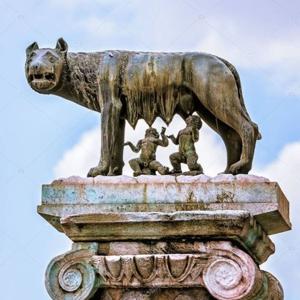
Romulus and Remus.
In the best known form of the legend, Romulus and Remus are the grandsons of Numitor, the king of Alba Longa. After Numitor is deposed by his brother Amulius and his daughter Rhea Silvia is forced to become a Vestal virgin, she becomes pregnant – allegedly raped by the war god Mars – and delivers the two illegitimate brothers. Amulius orders that the children be left to die on the slopes of the Palatine or in the Tiber River, but they are suckled by a she-wolf at the Lupercal cave and then discovered by the shepherd Faustulus and taken in by him and his wife Acca Larentia. (Livy combines Larentia and the she-wolf, considering them most likely to have referred to a prostitute, also known in Latin slang as a lupa or she-wolf.) Faustulus eventually reveals the brothers' true origins, and they depose or murder Amulius and restore Numitor to his throne. They then leave or are sent to establish a new city at the location where they had been rescued.
The twins then come into conflict during the foundation of the city, leading to the murder of Remus. The dispute is variously said to have been over the naming of the new city, over the interpretation of auguries, whether to place it on the Palatine or Aventine Hill, or concerned with Remus's disrespect of the new town's ritual furrow or wall. Some accounts say Romulus slays his brother with his own hand, others that Remus and sometimes Faustulus are killed in a general melee. Wiseman and some others attribute the aspects of fratricide to the 4th-century BC Conflict of the Orders, when Rome's lower-class plebeians began to resist excesses by the upper-class patricians.
Romulus, after ritualistically ploughing the generally square course of the city's future boundary, erects its first walls and declares the settlement an asylum for exiles, criminals, and runaway slaves. The city becomes larger but also acquires a mostly male population. When Romulus' attempts to secure the women of neighbouring settlements by diplomacy fail, he uses the religious celebration of Consualia to abduct the women of the Sabines. According to Livy, when the Sabines rally an army to take their women back, the women force the two groups to make peace and install the Sabine king Titus Tatius as comonarch with Romulus.
The story has been theorised by some modern scholars to reflect anti-Roman propaganda from the late fourth century BC, but more likely reflects an indigenous Roman tradition, given the Capitoline Wolf which likely dates to the sixth century BC. Regardless, by the third century, it was widely accepted by Romans and put onto some of Rome's first silver coins in 269 BC. In his 1995 Beginnings of Rome, Tim Cornell argues that the myths of Romulus and Remus are "popular expressions of some universal human need or experience" rather than borrowings from the Greek east or Mesopotamia, inasmuch as the story of virgin birth, intercession by animals and humble stepparents, with triumphant return expelling an evil leader are common mythological elements across Eurasia and even into the Americas.
Aeneas.
The tradition of Romulus was also combined with a legend telling of Aeneas coming from Troy and travelling to Italy. This tradition emerges from the Iliad's prophecy that Aeneas's descendants would one day return and rule Troy once more. Greeks by 550 BC had begun to speculate, given the lack of any clear descendants of Aeneas, that the figure had established a dynasty outside the proper Greek world. The first attempts to tie this story to Rome were in the works of two Greek historians at the end of the fifth century BC, Hellanicus of Lesbos and Damastes of Sigeum, likely only mentioning off hand the possibility of a Roman connection; a more assured connection only emerged at the end of the fourth century BC when Rome started having formal dealings with the Greek world.
The ancient Roman annalists, historians, and antiquarians faced an issue tying Aeneas to Romulus, as they believed that Romulus lived centuries after the Trojan War, which was dated at the time c. 1100 BC. For this, they fabricated a story of Aeneas's son founding the city of Alba Longa and establishing a dynasty there, which eventually produced Romulus.
In Livy's first book he recounts how Aeneas, a demigod of the Trojan royal Anchises and the goddess Venus, leaves Troy after its destruction during the Trojan War and sailed to the western Mediterranean. He brings his son – Ascanius – and a group of companions. Landing in Italy, he forms an alliance with a local magnate called Latinus and marries his daughter Lavinia, joining the two into a new group called the Latini; they then found a new city, called Lavinium. After a series of wars against the Rutuli and Caere, the Latins conquer the Alban Hills and its environs. His son Ascanius then founds the legendary city of Alba Longa, which became the dominant city in the region. The later descendants of the royal lineage of Alba Longa eventually produce Romulus and Remus, setting up the events of their mythological story.
Dionysius of Halicarnassus similarly attempted to show a Greek connection, giving a similar story for Aeneas, but also a previous series of migrations. He describes migrations of Arcadians into southern Italy some time in the 18th century BC, migrations into Umbria by Greeks from Thessaly, and the foundation of a settlement on the Palatine Hill by Evander (originally hailing also from Arcadia) and Hercules, whose labour with the cattle of Geryon was placed in the Forum Boarium by the Romans.
The introduction of Aeneas follows a trend across Italy towards Hellenising their own early mythologies by rationalising myths and legends of the Greek Heroic Age into a pseudo-historical tradition of prehistoric times; this was in part due to Greek historians' eagerness to construct narratives purporting that the Italians were actually descended from Greeks and their heroes. These narratives were accepted by non-Greek people's due Greek historiography's prestige and claims to systematic validity.
Archaeological evidence shows that worship of Aeneas had been established at Lavinium by the sixth century BC. Similarly, a cult to Hercules had been established at the Ara Maxima in Rome during the archaic period. By the early fifth century BC, these stories had become entrenched in Roman historical beliefs. These cults, along with the early – in literary terms – account of Cato the Elder, show how Italians and Romans took these Greek histories seriously and as reliable evidence by later annalists, even though they were speculations of little value. Much of the syncretism, however, may simply reflect Roman desires to give themselves a prestigious backstory: claim of Trojan descent proved politically advantageous with the Greeks by justifying both claims of common heritage and ancestral enmity.
Other myths.
There was no single mythic tradition of Rome's founding. By the time of the Pyrrhic War (280–275 BC), there were some sixty different myths for Rome's foundation that circulated in the Greek world. Most of them attributed the city to an eponymous founder, usually "Rhomos" or "Rhome" rather than Romulus. One story told how Romos, a son of Odysseus and Circe, was the one who founded Rome. Martin P. Nilsson speculates that this older story was becoming a bit embarrassing as Rome became more powerful and tensions with the Greeks grew. Being descendants of the Greeks was no longer preferable, so the Romans settled on the Trojan foundation myth instead. Nilsson further speculates that the name of Romos was changed by some Romans to the native name Romulus, but the same name Romos (later changed to the native Remus) was never forgotten by many of the people, so both these names were used to represent the founders of the city.
Another story, attributed to Hellanicus of Lesbos by Dionysius of Halicarnassus, says that Rome was founded by a woman named Rhome, one of the followers of Aeneas, after landing in Italy and burning their ships. That by the middle of the fifth century Aeneas was also allegedly the founder of two or three other cities across Italy was no object. These myths also differed as to whether their eponymous matriarch Roma was born in Troy or Italy – i.e. before or after Aeneas's journey – or otherwise if their Romus was a direct or collateral descendant of Aeneas.
Myths of the early third century also differed greatly in the claimed genealogy of Romulus or the founder, if an intermediate actor was posited. One tale posited that a Romus, son of Zeus, founded the city. Callias posited that Romulus was descended from Latinus and a woman called Roma who was the daughter of Aeneas and a homonymous mother. Other authors depicted Romulus and Romus, as a son of Aeneas, founding not only Rome but also Capua. Authors also wrote their home regions into the story. Polybius, who hailed from Arcadia, for example, gave Rome not a Trojan colonial origin but rather an Arcadian one.
Wikipedia: Text is available under the Creative Commons Attribution-ShareAlike 4.0 License.
This episode includes AI-generated content.



 View all episodes
