Before it became the template more than a hundred countries would copy, Yellowstone was two million acres almost no one in Washington had ever seen. When Congress voted to protect it in 1872, most lawmakers were deciding the fate of a place they knew only through paintings and photographs an expedition had hauled back the summer before. It was, as Collin O'Mara puts it, Instagram before Instagram.
O'Mara, president and CEO of the National Wildlife Federation, joins hosts Margaret Talev and Ghael Fobes to explain how the world's first national park nearly became another Niagara Falls, roadside tollbooths and all, and how a handful of landscape images convinced a skeptical government to keep it public. He talks about why conservation was for so long one of the few things both parties agreed on, from the Great American Outdoors Act to the fights moving through Congress right now, and he makes the case for his own favorite spot on the map: Delaware Bay, where a shorebird the size of a fist flies from the bottom of South America to the Arctic and stops to gorge on horseshoe crab eggs on the way.
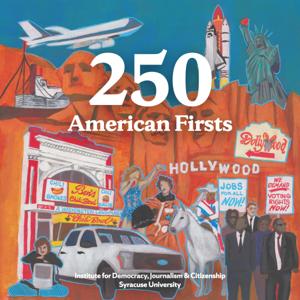
Part of 250 American Firsts, a Syracuse University podcast marking America's 250th anniversary by tracing the people and places behind the nation's pioneering moments.
This episode was produced by the Institute for Democracy, Journalism, and Citizenship in Washington, D.C. with the generous support of the Hearst Foundations.
Album artwork created by Abbey Locker, edited by Ingrid Cleveland
Special thanks to the National Wildlife Federation; to the National Park Service for the footage; and to the Smithsonian for the early photographs and paintings of the parks by William Henry Jackson and Thomas Moran.
Special thank you to Emma Hudson, Ellie Wilson, Susan Nash, and the rest of the IDJC for their support.
Show Notes and Links
National Wildlife Federation
Thomas Moran collection (Smithsonian American Art Museum)
"The Painting That Inspired a National Park," Smithsonian lesson plan (The American Experience in the Classroom)
William Henry Jackson and his Yellowstone photographs
Learn more about Syracuse University’s Institute for Democracy, Journalism & Citizenship
Subscribe to our newsletter, The Squeeze