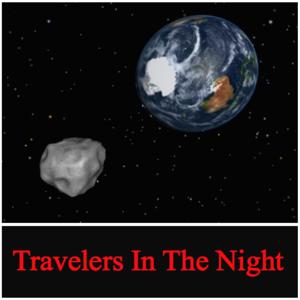
On it's gravitational leash, Earth's pet space rock, 2016 HO3, accompanies us at a distance of between 38 and 100 times the Moon's distance from Earth as we both travel about the Sun. As this tiny asteroid orbits the Sun it spends about half of it's time inside the Earth's orbit where it moves faster and passes ahead of us and the other half of it's yearly path outside of our orbit which causes it to lag behind our home planet. Since it's discovery little has been known about Earth's pet space rock leaving some to speculate that perhaps it is an old rocket booster or other piece of space junk. To answer this question, Dr. Vishnu Reddy of the University of Arizona's Lunar and Planetary Laboratory headed up a team of astronomers who used the University of Arizona's Large Binocular Telescope and the Discovery Channel's Telescope to determine some of it's properties. This team of researchers found that 2016 HO3 is indeed a natural object about 100 to 300 feet in diameter, rotates about once every 28 minutes, and is made of material similar to meteorites which have landed on Earth. Our pet space rock, 2016 HO3, has apparently been in it's present relationship to Earth for a hundred years and is likely to remain so for hundreds of years to come. Even though 2016 HO3 is not gravitationally bound to the Earth, the combination of the Sun's and Earth's gravitational pulls keeps it relatively near making it easy to reach and thus is an ideal candidate for visits by human or robotic spacecraft.



 View all episodes