
Sign up to save your podcasts
Or

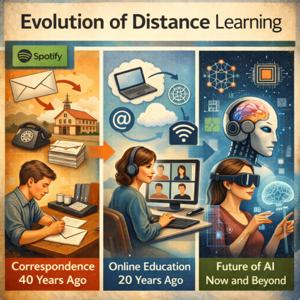


This episode presents a collection of chronological anecdotes and professional reflections from 1991 written by Morten Flate Paulsen. The text weaves together significant global events, such as the dissolution of the Soviet Union and the Gulf War, with the author’s personal experiences living in the United States as a Norwegian expatriate. A major focus is placed on the evolution of distance education, specifically the founding of the European Distance Education Network (EDEN) and the growth of the DEOS online symposium. Paulsen highlights his role in editing early electronic newsletters and attending international conferences that shaped the future of computer-mediated communication. Ultimately, the source serves as a historical record of how technological advancements in learning coincided with a rapidly changing political landscape.
This episode recounts the pivotal events of 1990 through the lens of a Norwegian scholar transitioning into the burgeoning field of online distance education. Set against a backdrop of global political shifts and the birth of the World Wide Web, the narrative tracks the author’s move to Penn State University to pursue doctoral studies under the mentorship of Michael G. Moore. It details the practical challenges of international relocation, such as mastering a new language and navigating cultural differences, while highlighting the technological milestones of the era, including early notebook computers and modems. The author describes the creation of DEOS, one of the first digital academic journals, and recounts influential interactions at global conferences in Canada and Venezuela. Ultimately, the source serves as a personal and professional memoir of a transformative year that shaped the future of flexible learning through computer-mediated communication.
In this episode, Morten Flate Paulsen chronicles the pivotal educational innovations of 1989, specifically focusing on the development of the EKKO computer-conferencing system. The episode highlights early experiments in virtual classrooms, such as role-playing forums, remote programming, and the use of multiple-choice databases for distance learners. Beyond technical achievements, Paulsen reflects on his personal life, including family losses and the inspiration he drew from using technology to assist those with physical disabilities. He also details his professional contributions to influential academic works like Mindweave and his efforts to produce instructional TV programs featuring interviews with tech icons like Bill Gates. Ultimately, the source serves as a retrospective on how online education began to transcend international borders during a year of massive global political shifts.
This episode about 1988 focuses on a pivotal era for online education, chronicling Morten Flate Paulsen's transition from a student at Connect Ed to a pioneering instructor. His reflections highlight the early use of computer conferencing systems like EIES and EKKO to facilitate remote learning through a "virtual school" environment. The year was marked by significant global milestones, including the 14th ICDE World Conference in Oslo, which led to the establishment of a permanent international secretariat in Norway. Paulsen also explores the technological challenges of the time, such as using slow modems and navigating the skepticism of traditional educators regarding paced online courses. Through various international conferences and free course offerings, these records illustrate the foundational shift from correspondence-based learning to collaborative digital pedagogy. These anecdotes ultimately portray 1988 as a breakthrough year that bridged medieval academic traditions with the modern computer age.
This episode documentes a pivotal year that merged significant family milestones with the emergence of online education. The episode details Morten Flate Paulsen's professional travels to meet global pioneers in computer-mediated communication and his successful implementation of Norway’s first online distance learning courses. These technical achievements are woven together with the birth of his son, Stian, and the solemn loss of his father, Jon, to ALS. Paulsen reflects on the transition of "virtual schools" from conceptual dreams to functional realities, providing a historical look at early software like EKKO. Ultimately, the narrative serves as a personal and professional memoir that captures the evolving landscape of digital learning and family legacy.
This episode chronicles the pivotal year of 1986, highlighting Morten Flate Paulsen's role in creating EKKO, an early Learning Management System designed for distance education. Against a backdrop of historical events like the Chernobyl disaster and the assassination of Olof Palme, the author describes his efforts to transition traditional correspondence courses into the digital age. The episode also details Pausen's professional travels to ICT conferences in Stockholm and Budapest, as well as a visit to an IBM factory in Florida. Through these anecdotes, Paulsen reflects on the cultural relationship between Norway and Sweden and the initial institutional resistance to online communication. Ultimately, the text illustrates how personal experiences and technological curiosity fueled a paradigm shift in global education.
In these personal reflections, Morten Flate Paulsen chronicles a pivotal year defined by rapid technological growth and career development within the Norwegian education sector. The episode details his early professional milestones, such as founding a private consulting firm, publishing his first technical articles, and transitioning into academic teaching at the encouragement of mentors. Beyond his career, Paulsen captures the cultural spirit of 1985, mentioning significant sporting records, the rise of Norwegian pop music, and shifts in the national political landscape. A major theme is the emergence of digital connectivity, specifically how the arrival of modems and bulletin board systems sparked his lifelong interest in online learning. These anecdotes illustrate the intersection of personal life and the digital revolution, highlighting how early networking tools laid the foundation for modern distance education.
This episode features a collection of personal anecdotes and historical milestones from 1984, written by Morten Flate Paulsen to document a pivotal year in his online education life. The author reflects on the loss of his mother, Else, detailing her artistic nature, her family’s connection to Olympic athletes, and her traditional lifestyle in a pre-digital Norway. Alongside these family memories, the narrative highlights the evolution of the HÅG company and the professional expansion of episode also tracks the institution's complex history of mergers that eventually led to its integration into Campus Kristiania. Finally, the account situates these private experiences within a broader global context by listing major international events, such as the Sarajevo Olympics and significant political assassinations.
This episode discusses Morten Flate Paulsen's chronicles from the pivotal year of 1983, focusing on the birth of Norway’s first private ICT college, NKI Datahøgskolen. The episode illustrates the early challenges of technological entrepreneurship, from physical labor in factory renovations to navigating government loan denials and managing student protests. Beyond professional milestones, the author details the launch of youth summer schools dedicated to programming and the evolution of instructional tools like the BBC microcomputer. These educational developments are framed by significant historical events and the author’s personal life, including formative travels to Brazil and the start of a lifelong partnership. Ultimately, the narrative serves as a historical record of how enthusiastic pioneers laid the groundwork for modern online and technical education in Norway.
This episode discusses Morten Flate Paulsen's experiences from 1982 through his transition from military service to the field of online education. During the first half of 1982, he served as a naval instructor at SMK, where he experienced historical milestones like the Falklands War and a royal visit from King Olav. His professional path shifted significantly in September when he joined NKI Distance Education, a role that required him to spearhead computer technology initiatives. While working at NKI, he faced the challenge of teaching assembly programming to international engineers and experimented with the BBC microcomputer. These personal anecdotes ultimately illustrate the early integration of information technology into the Norwegian educational landscape.
From the publisher's feed