
Sign up to save your podcasts
Or

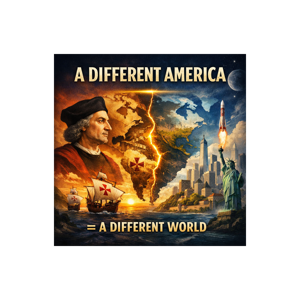


What if the global world we know today had been shaped not by Spanish and Portuguese empires, but by a Dutch Atlantic system built on trade, ports, and financial networks?
In this episode, we explore how a single change — Columbus sailing under northern European, proto-Dutch influence — could have transformed not just America, but the entire structure of global history. From South America to Africa, from Asia to Australia and New Zealand, we follow how a world driven more by commerce than by centralized empires might have emerged.
Instead of vast territorial colonies, this world grows through coastal strongholds, trading hubs, and commercial alliances. South America becomes a mosaic of port republics and regional federations. Africa is drawn earlier and deeper into global trade networks — with all the harsh consequences that brings. Asia remains a powerful partner in commerce rather than an early target of conquest. Australia and New Zealand develop as strategic nodes in a wider maritime system rather than purely national colonial projects.
At the center of it all stands a different kind of globalization: one driven less by imperial authority and more by capital, contracts, and connection. A world where the port matters more than the palace, and trade routes shape history as much as armies.
This episode is not just about an alternative past. It is about a different logic of the modern world — one that could have been more networked, more commercial, and more interconnected from the very beginning.
What if the modern world had grown not from Spanish empire and Anglo-American dominance, but from a Dutch Atlantic system built on ports, finance, trade, and commercial cities?
In this episode, we follow the long-term consequences of a world in which Columbus’s voyage leads not to Spanish America, but to Dutch America. From 1800 to 2026, we explore how modernity itself might have developed differently if the Atlantic had been shaped from the beginning by merchants, banks, insurance houses, joint-stock companies, and maritime networks rather than by centralized imperial crowns.
How would the collapse of colonial structures have unfolded in such a world? What kinds of new states and federations would have emerged in the Americas? Would there still have been a United States in the form we know? Could Amsterdam and the wider Dutch-Atlantic world have rivaled or even surpassed London as the heart of industrial and financial modernity?
This episode also follows the wider consequences for Europe, Africa, Asia, the world wars, the Cold War, and globalization. It asks what happens when the modern world is built less around one dominant empire and more around a web of commercial centers spread across both sides of the Atlantic.
This is not just a different map of history. It is a different logic of history: less royal, more financial; less ceremonial, more maritime; less centered on the crown, more centered on the city, the port, and the flow of capital.
What if America had been shaped not by the Spanish crown, but by the commercial world of the Netherlands?
In this episode, we explore an alternative Atlantic age in which Columbus’s voyage is financed under Dutch influence and the New World develops not first as a royal Catholic empire, but as a network of ports, companies, warehouses, contracts, and fortified trading centers. From 1500 to 1800, we follow how Dutch America might have grown from Caribbean footholds into a vast Atlantic system built on commerce, finance, maritime power, and urban ambition.
This is not a gentler history. Dutch America would still be marked by slavery, violence, exploitation, and the destruction of indigenous worlds. But it would be organized differently: less through crowns and viceroyalties, more through trade monopolies, commercial cities, and transoceanic networks.
How would the Caribbean change if it became the heart of a Dutch Atlantic order? What kind of mainland expansion would follow? How would religion, law, urban life, and colonial society develop under a more commercial model of empire? And what would happen to England, France, Spain, and Portugal if the modern Atlantic world began under Dutch primacy?
This episode explores a world in which modernity grows not first from Spanish silver and later British empire, but from ships, markets, ports, and profit.
What if the discovery of America had not belonged to Spain—but to the emerging commercial world of the Netherlands?
In this episode, we explore a bold alternative scenario in which both Portugal and Spain reject Christopher Columbus, and his voyage is ultimately financed by the merchant-driven environment of the Low Countries. Instead of a royal and religious project under the Spanish Crown, the New World becomes the foundation of a Dutch-style Atlantic system—built on trade, capital, ports, and contracts.
This shift would not simply change who “discovered” America. It would transform the entire logic of colonization. Rather than vast centralized empires ruled by kings and viceroys, we might see a network of commercial hubs, trading companies, maritime cities, and financial institutions shaping the early Atlantic world. The Caribbean and American coasts would emerge not as extensions of royal authority, but as dynamic centers of commerce, experimentation, and competition.
What would this mean for Europe? Spain would lose its path to global dominance. Portugal would double down on its eastern ambitions. France and England would be forced to react much earlier to a powerful northern rival. And the Netherlands—long before its historical Golden Age—might rise as the central force of a new Atlantic economy.
Beyond politics, the consequences would reach even deeper. The cultural and linguistic map of America could become far more diverse, shaped by trade and migration rather than uniform imperial rule. Religion might be less centralized. Urban life, contracts, and financial systems could define society more than aristocratic hierarchies. Even the foundations of modern capitalism might emerge earlier and in a different form.
This episode follows that transformation step by step—from late medieval Europe, through the first voyage, to the rise of a Dutch Atlantic world and its long-term consequences. Because if one decision had been different—if one “yes” had come from a port instead of a palace—the modern world might have been built not on empire, but on commerce.
What if the discovery of America had not launched a Spanish empire—but a Florentine global system?
In this episode, we expand the scope beyond the Atlantic and explore how a Florentine-led discovery of the New World would have reshaped the entire globe. If America had developed as a network of ports, financial hubs, and commercial republics rather than centralized colonial empires, the consequences would not have stopped at its shores. South America, Africa, Asia, Australia, and New Zealand would all have been drawn into a different kind of globalization—one driven less by crowns and conquest, and more by trade, contracts, and capital.
How would South America have evolved without Spanish dominance? Instead of vast viceroyalties, we might see a fragmented but dynamic continent of port cities, commercial republics, and regional federations, with stronger indigenous continuity and greater linguistic diversity.
What would Africa look like in a system shaped by Florentine commercial logic? Likely even more deeply integrated into Atlantic trade networks—yet at the cost of intensified exploitation, a highly organized slave system, and long-term economic dependency structured by finance and contracts.
In Asia, the encounter might begin less with conquest and more with commerce. Florentine-American networks could establish early trading footholds, alliances, and financial ties, creating a world where Asian powers remain strong but increasingly entangled in a global system of exchange and influence.
And what about Oceania? Australia and New Zealand might emerge not as extensions of a single empire, but as hybrid spaces—networks of ports, trading stations, and multicultural societies shaped by both European and Pacific connections, developing more slowly but with a broader cultural foundation.
This episode explores a world where globalization is not built primarily by empires, but by interconnected commercial civilizations. A world where power flows through cities, ports, and financial systems—and where the shape of modern history is defined not by one dominant center, but by a network of competing global nodes.
Because if the core changes, everything changes.
What if modern America had grown not from Spanish conquest and Anglo-American expansion, but from the legacy of Florence?
In this episode, we follow the long evolution of an alternative world in which Columbus’s voyage was financed by Florentine bankers and Renaissance elites. By 1800, Florentine America is no longer a distant colonial project, but a complex Atlantic civilization of port cities, commercial republics, urban elites, and Italophone culture. From there, the story moves into the modern age: independence movements, new states, industrialization, world wars, globalization, and the shape of the world in 2026.
How would an America shaped by Tuscan language, banking traditions, republican city culture, and Renaissance prestige have changed modernity itself? Would a true equivalent of the United States have emerged? Would the twentieth century still have belonged to an Anglo-American world? Or would a powerful Italophone America have stood at the center of global politics, trade, and culture instead?
This episode explores a different path into the modern age—one in which the New World carries the imprint not of Castile, but of Florence.
In this episode, we explore one of the most intriguing alternative-history scenarios of the Age of Discovery: what if Christopher Columbus had been financed not by Spain or Portugal, but by Florence—the city of bankers, merchants, Renaissance thinkers, and the Medici?
Instead of a New World shaped first by a conquering monarchy, America begins to develop under the influence of a commercial, urban, and financially driven republic. From 1500 to 1800, we follow how Florentine trading posts, port cities, banking networks, and Renaissance culture might have created a very different Atlantic world—one built less on crowns and feudal conquest, and more on contracts, capital, urban institutions, and mercantile power.
But this is not a gentler history. Florentine America would still face violence, disease, slavery, rivalry with Europe’s great powers, and growing internal tensions. The deeper question is whether such a world might have produced a different model of modernity itself: less monarchical, more urban; less imperial in the Castilian sense, more commercial and networked; and perhaps even an America shaped by the language and spirit of Renaissance Tuscany.
What if Christopher Columbus had not sailed for Spain, but for Florence—the city of bankers, merchants, Renaissance thinkers, and the Medici?
This episode explores one of the most intriguing alternatives in early modern history: a world in which Columbus is rejected by both Portugal and Spain, and his voyage is financed instead by Florence. Such a change would not only place a different flag on the horizon. It would transform the very logic of discovery. America would not begin as the project of a dynastic monarchy, but as the venture of a commercial republic driven by capital, prestige, urban power, and Renaissance ambition.
We follow Europe at the end of the fifteenth century, Columbus’s search for support, and the reasons why Florence might have said yes when others said no. From there, the story unfolds into a different Atlantic world—one shaped less by royal conquest and more by finance, networks, trade, and urban foundations.
What might a Florentine America have looked like? How would Europe have changed if Spain had missed its great opportunity? Could Italian, rather than Spanish, have become one of the defining languages of the New World? And how different might the modern world be if the Renaissance itself had crossed the ocean as a colonizing force?
This episode is not just about a different patron. It is about a different beginning for modern history.
What if the New World had not created empires… but a network?
In this episode, we leave America and follow its shadow across the rest of the globe. Because the discovery of the New World was never just about one continent—it was the spark that connected Europe, Africa, Asia, and eventually Oceania into a single system. And if that system had been shaped not by Iberian crowns, but by the Venetian Republic, then the entire logic of globalization would have changed.
Instead of vast territorial empires, the world begins to organize itself around ports, trade routes, contracts, and financial networks. America becomes not just a colony, but the beating heart of a commercial ocean—and that ocean reaches everywhere.
In South America, no unified “Latin world” emerges. Instead, the continent becomes a mosaic of port republics, coastal powers, and inland regions that develop more slowly. Cities dominate over territories. Trade dominates over administration. The result is dynamic—but unstable.
In Africa, the Atlantic system pulls even deeper. Coastal cities grow into cosmopolitan hubs linking continents, while the slave trade becomes even more systematized within a highly efficient commercial network. Africa is not just colonized—it is structurally woven into the global economy earlier and more intensely.
In Asia, the encounter is different. Instead of immediate conquest, merchant networks arrive first—alliances, trade posts, financial ties. But over time, dependency grows. Port cities flourish, interiors resist, and the balance between cooperation and control defines a new kind of global tension.
In Australia and New Zealand, colonization takes another path entirely. Not single-nation settler societies, but mixed, multicultural nodes emerge—bridges between Asia and America, shaped by trade rather than isolation.
By the nineteenth century, the world no longer revolves around a few great empires. And by the twentieth, there is no single dominant superpower to define the age. Instead, power is dispersed across multiple centers—Atlantic, European, Asian, and oceanic.
By 2026, this is a world that feels familiar… yet fundamentally different. Globalization exists—but not as the spread of one model. It is a web. Languages are diverse. Cultures are layered. Trade flows through many hands.
This episode asks a simple but profound question:
What if modernity had not been built by empires of land… but by empires of connection?
Because if Venice had opened America, the world might not belong to one center.
It might belong to the network.
What would the modern world look like if America had grown not from imperial crowns and a future superpower, but from the legacy of a maritime republic?
In this episode, we follow the long shadow of a Venetian New World from 1800 to 2026. By the nineteenth century, Venetian America is no longer just a colonial network of ports and trading stations—it is a living Atlantic civilization, rich, urban, commercially driven, and increasingly unwilling to remain tied to a distant metropolis in the Adriatic.
Then comes the great rupture. The Napoleonic era shatters the old Venetian order, and across the Americas new states begin to emerge—not as one vast continental giant, but as a mosaic of republics, federations, and port powers shaped by commerce, autonomy, and urban political culture. Instead of a United States in the form we know, the Western Hemisphere develops into a more fragmented but deeply interconnected world of maritime cities, trading elites, and competing Atlantic centers.
That changes everything. Europe no longer lives in the shadow of an Anglo-American colossus. The Mediterranean retains greater weight. Capitalism evolves less as the story of one dominant industrial giant and more as a network of financial and commercial hubs. The world wars unfold without a single decisive American power. The Cold War becomes more diffuse, more unstable, and more multipolar. And globalization in the twenty-first century spreads not as the expansion of one model, but as the rivalry of several.
By 2026, this is a world that is less American in the modern sense and more Atlantic-urban: a world of ports, republics, commercial networks, and multiple cultural centers. English still matters, but it does not dominate alone. The legacy of Venice survives not as empire, but as a way of organizing modernity itself.
This episode explores how one different patron for Columbus could have transformed not only America, but the entire shape of the modern world—creating not an American century, but a civilization of competing oceans, cities, and trade.
From the publisher's feed
What if a single decision changed the course of history?
The podcast A Different America explores alternative perspectives on key moments in history — especially the…
The series combines documentary-style analysis with carefully constructed alternative scenarios. It is grounded in real historical facts, political contexts, and the possibilities of the time, and then explores how Europe, the Americas, and global civilization might have developed differently.
This is not fiction without foundation. It is a thoughtful exploration of how little it might have taken for today’s world to be entirely different.
Because a different America means a different world.