A Good Science Read

A Good Science Read

By Oxford UniversityEducation
Download on the App Store

A Good Science Read episodes

  • A Good Science Read: Evolution - from Fossils to Finches
    Professor Paul Smith and Professor Frances Ashcroft discuss 'Wonderful Life' by Stephen Jay Gould and 'The Beak of the Finch' by Jonathan Weiner. Wonderful Life focuses on the weird and wonderful fossils found in the Burgess Shale in the Canadian Rockies – their discovery, what they tell us about evolution and their re-evaluation many years later. The Beak of the Finch is also about evolution but rather than fossils it is about evolution in action on a tiny volcanic island in the Galapagos. It describes the painstaking work of Peter and Rosemary Grant who studied Darwin’s famous finches for over 40 years and showed that evolution can take place in real time. Their story is interwoven with that of Darwin and his studies of the Galapagos finches.
    Professor Paul Smith is Director of the Oxford University Museum of Natural History, Professor of Natural History at the University of Oxford and a Fellow of Kellogg College Oxford. He is both a geologist and a palaeontologist whose research has focussed on the origin of vertebrates. He has worked extensively in the Arctic and in 2017 he was awarded the Polar medal for outstanding achievements in the field of polar research
    Websites
    https://oumnh.ox.ac.uk/people/paul-smith
    https://oumnh.ox.ac.uk/
    https://eeb.princeton.edu/people/b-rosemary-grant
    38 min
  • A Good Science Read: The Secret Life of the Cuckoo
    Professor Richard Boyd joins Professor Frances Ashcroft to discuss 'Cuckoo - Cheating by Nature' by Nick Davies. The cuckoo is a ruthless parasite that lays its egg in another bird’s nest, tricks them into accepting the egg as its own and entices them to feed its chick. This book is a riveting account of an extraordinary bird and it reads like a detective story. Nick Davies asks every question you can possibly imagine about how the female cuckoo and the cuckoo chick itself manage to deceive their host, and he describes the intricate experiments he and his colleagues have conducted to unravel the answers. He interweaves this with stories of naturalists from the past who have studied the cuckoo. He writes beautifully and his passion for the cuckoo and the natural world shines through.
    Richard Boyd, Emeritus Professor of Physiology at the University of Oxford and Emeritus Fellow of Brasenose College is a distinguished physiologist and an Honorary Fellow of the Physiological Society. He also happens to have a passion for birds.
    Website: https://www.zoo.cam.ac.uk/directory/nick-davies
    23 min
  • A Good Science Read: The importance of Mathematics and Engineering
    Professor Marcus du Sautoy joins Professor Frances Ashcroft to discuss 'A Mathematician’s Apology' by GH Hardy and 'Exactly: How Engineers Created the Modern World' by Simon Winchester. A Mathematician’s Apology is GH Hardy’s panegyric on pure mathematics in which he claims that pure maths is the pinnacle of the sciences and that it has an inherent beauty. Exactly tells the stories of the pioneering engineers who developed the precision tools and machinery that underpin the modern world. Along the way, the author addresses questions like why is precision important, how do we measure it, can we be too precise?
    Marcus du Sautoy is Simonyi Professor of the Public Understanding of Science at the University of Oxford and a Fellow of the Royal Society of London. A distinguished mathematician with a particular interest in symmetry and number theory, he is also the author of several popular science books about mathematics, including the critically acclaimed The Music of the Primes, and he has presented numerous TV programmes.
    Website: https://www.simonyi.ox.ac.uk/

    43 min
  • A Good Science Read: The Story of Penicillin
    Professor Matthew Freeman and Professor Frances Ashcroft discuss 'The Mould in Dr Florey's Coat' by Eric Lax This book tells the true story of the penicillin miracle – penicillin being the mould in Dr Florey’s coat. When most people are asked who discovered penicillin they invariably answer Alexander Fleming. But he was merely one of the people involved and arguably not even the most important. This book sets the record straight and tells the story of how it was 3 Oxford scientists, Howard Florey, Ernst Chain and Norman Heatley who isolated penicillin and turned it into a life-saving drug. It is a remarkable story, very well told, about a scientific breakthrough conducted on a shoestring budget in the middle of the second world war, that has benefitted all humanity.
    Matthew Freeman is Professor of Pathology at the University of Oxford and a Fellow of both Lincoln College Oxford and the Royal Society of London. He is also Head of the Dunn School of Pathology which plays a very special part in the story the book tells about the discovery of penicillin.
    Website: https://www.path.ox.ac.uk/research-group/matthew-freeman/
    40 min

About A Good Science Read

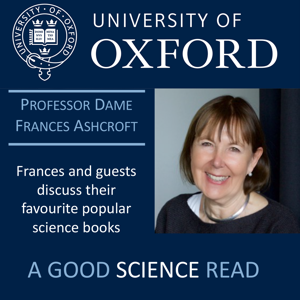
From the publisher's feed

Interested in science and the people behind the science? Looking for an informative, entertaining, thought-provoking and accessible read? Join Professor Dame Frances Ashcroft and her guests as they discuss their favourite popular science books, sharing their love of science, and the books they consider most enjoyable and that offer something to everyone. Episodes will be published fortnightly.