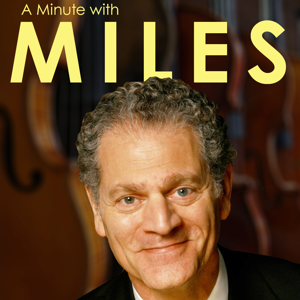
A Minute with Miles

A Minute with Miles

By Miles HoffmanMusic
Download on the App Store

A Minute with Miles episodes

  • Acoustics Part 1
    Acoustics is the science of sound. More specifically, it’s the branch of physics that deals with sound waves and their properties—how sound waves are generated, how they behave in various circumstances, how they interact.
    1 min
  • Fantasy
    Fantasy is the English translation of the Italian fantasia, a word that first appeared as a title for instrumental works in the 1500's. Since then, it’s a title that’s been used over and over: there have been fantasies for lute, guitar, harpsichord, viols, organ, piano, and orchestra; Renaissance fantasies, Baroque fantasies, Classical, Romantic, modern fantasies, and fantasies ranging from abstract exercises to extravagant variations on operatic arias.

    1 min
  • Mendelssohn, Child Prodigy
    Musical child prodigies have always fascinated the public. Far more rare than the child prodigy performer, though, is the child prodigy composer. The first name that comes to many people’s minds when they think of child composers is Mozart, and it’s true that Mozart started writing music at the age of four or five. But of all Mozart’s great pieces, very few were written before his twentieth birthday. Felix Mendelssohn , on the other hand, composed works when he was fifteen, sixteen, and
    1 min
  • Composers and Mental Illness
    It’s popular, in some circles, to find links between creative genius and mental illness. Among composers, Robert Schumann—who attempted suicide after years of inner torment—is usually Exhibit A, but there are others who are regularly mentioned, as well. My own view is that the so-called link is no link at all.
    1 min
  • Sonata
    The word sonata comes from the Italian sonare , an old form of suonare , which means “to sound,” or “to play,” as in “to play an instrument.” And indeed, a sonata is always an instrumental piece. During the Baroque period, the term was applied to pieces for one, or sometimes two solo instruments, with or without keyboard accompaniment, but since about 1750 the term has most often referred to pieces either for solo piano or for piano and one other instrument.
    1 min
  • Bach Cello Suites
    A word today about the solo cello suites of Johann Sebastian Bach. The melodies to which we’re most accustomed in the music of such composers as Haydn, Mozart, and Schubert, usually feature easily identifiable beginnings, middles, and ends.
    1 min
  • Antonio Vivaldi
    Antonio Vivaldi’s life story could easily be the subject of a novel. Vivaldi was born in Venice in 1678 and at the age of 25 he was ordained as a priest.
    1 min
  • How the Cello got its Name
    From the 1400's to the 1700's, the Italian word viola was the general term for any stringed instrument played with a bow. Viola da braccio , or “arm viola,” was the generic name for any member of what we now call the modern violin family. And even though it was always played between the legs, the instrument we now call the cello was first called the basso di viola da braccio , or “bass arm viola.” The word cello , believe it or not, comes from an Italian word meaning “little big viola.”
    1 min
  • Johann Friedrich Fasch
    Fame, they say, is fleeting. I recently came across a piece of music by a German composer named Johann Friedrich Fasch. Ever heard of him? I hadn’t.
    1 min
  • Mozart - What the Letters Show
    If you’ve seen the movie Amadeus, or the play it was based on, you may have gotten the impression that Wolfgang Amadeus Mozart was some sort of giggling idiot who just happened to be really good at writing music. Nothing, in fact, could be further from the truth.
    1 min

About A Minute with Miles

From the publisher's feed

Illuminating 60-second flights through the world of classical music with host and longtime NPR commentator Miles Hoffman. Produced by South Carolina Public Radio.You can enjoy an archive of these…