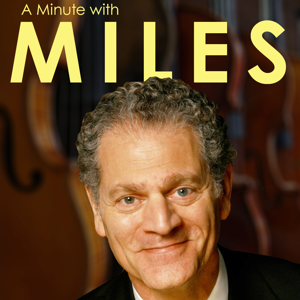
A Minute with Miles

A Minute with Miles

By Miles HoffmanMusic
Download on the App Store

A Minute with Miles episodes

  • Perfect Pitch, Beethoven, and the Chef
    We’re always fascinated by abilities that are far beyond the realm of our experiences, or even of our imaginations. Some people can hold their breath for 10 minutes, some can jump four feet off the ground, some can memorize the digits of pi out to thousands of places. And some musicians—actually many musicians, although I’m not one of them—can hear any note and tell you what that note is . It’s called having “perfect pitch.”
    1 min
  • Geniuses Ordinary and Magical
    The mathematician Mark Kac once tried to describe the extraordinary genius of the physicist Richard Feynman “There are two kinds of geniuses,” Kac wrote. “The ‘ordinary’ and the ‘magicians.’ An ordinary genius is a fellow that you and I would be just as good as, if we were only many times better. There is no mystery as to how his mind works. It is different with the magicians… the working of their minds is for all intents and purposes incomprehensible.”
    1 min
  • March 22nd - Bach's Passions
    A few more words today about Johann Sebastian Bach, whose birthday was yesterday. Bach wrote enormous quantities of profoundly moving sacred music. But the hallmark of Bach’s music, whether sacred or secular , is that it’s Always passionate .
    1 min
  • March 21st - Bach's Birthday
    Today is the birthday of Johann Sebastian Bach. The essayist Lewis Thomas, musing on the question of what signals earthlings ought to broadcast to outer space in case alien life forms were listening, wrote, “I would vote for Bach, all of Bach, streamed out into space over and over again. We would be bragging, of course, but it is surely excusable to put on the best possible face at the beginning of such an acquaintance. Any species capable of producing the music of Johann Sebastian Bach cannot
    1 min
  • Bellini and Melody
    Vincenzo Bellini—the composer of Norma, La Sonnambula, and I Puritani, to name a few of his best -known operas—is famous for the beauty of his melodies, but also for his ability to use melody to define character, express passion, and advance dramatic action. And he had nothing but disdain for what he called the “ridiculous rules” that some people thought composers should be obliged to follow when setting poetry to music.
    1 min
  • Style Fights - Silly, but Productive
    It occurs to me, when considering the history of music, that the endlessly recurring and often bitter fights over musical styles and trends have actually been quite productive, if only because they’ve acted as spurs for composers in supposedly opposing camps to produce their best work. And then, of course, it turns out that later generations usually have no trouble enjoying all the styles in question, and the old disputes, even though productive, just seem silly to them.
    1 min
  • Composers' Inspiration
    Mozart, they say, could compose music while he was playing billiards. Rossini wrote that he had once composed an overture while standing in the water fishing and listening to his fishing partner discuss Spanish finance. Prokofiev and other composers were known to carry notebooks with them so that they could jot down musical ideas that came to them on long walks, while Aaron Copland, when asked once how he found the inspiration for his music, said that the secret to inspiration was to sit down
    1 min
  • Rossini on Singers
    In The Barber of Seville and his many other operas, Gioacchino Rossini gave singers plenty of opportunities to show off their talents. But in a letter he wrote in 1851, Rossini made it clear that he didn’t have much patience for the cult of the great singer, or for singers whose pretensions got the better of them.
    1 min
  • Orchestra Metals
    Today, I thought we’d take a metallurgical tour of the orchestra. The bars, for example, of glockenspiels and celestas are made of steel. So are some of the strings of stringed instruments, and almost all strings are wound with very fine wire made of steel, silver, or aluminum. The bodies of timpani are made of copper, and brass instruments are made of… well, brass, which is an alloy of copper and zinc.

    1 min
  • Composers' Letter Writing
    Much of what we know about the great composers we’ve learned from their letters. It’s true that occasionally—and with some composers more than others—the music they’ve written seems somehow to reflect what was going on in their lives at the time. But more often than not the music gives no clue. It’s in their letters, much more than in their music, that we get a window into the composers’ private thoughts, and into the joys and struggles of their personal lives.
    1 min

About A Minute with Miles

From the publisher's feed

Illuminating 60-second flights through the world of classical music with host and longtime NPR commentator Miles Hoffman. Produced by South Carolina Public Radio.You can enjoy an archive of these…