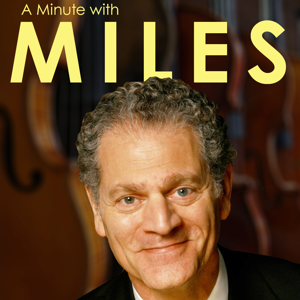
A Minute with Miles

A Minute with Miles

By Miles HoffmanMusic
Download on the App Store

A Minute with Miles episodes

  • Gabriel Faure
    Gabriel Fauré is often referred to as one of the greatest French composers of the late nineteenth and early twentieth centuries. But I wonder if that description goes far enough. It’s certainly true that his contributions to French music, especially in the areas of chamber music, piano music, and music for the voice -- are remarkable. But they’re remarkable because they’re wonderful music , not because they’re French.
    1 min
  • Mendelssohn and St. Matthew Passion
    J.S. Bach composed his St. Matthew Passion in 1727. But for the better part of a century after that, the piece essentially disappeared, unknown to all but a few specialists. One of those specialists was the composer Carl Friedrich Zelter, who was the music teacher of a boy named Felix Mendelssohn. Mendelssohn was only about fourteen when his grandmother gave him a copy of the full score of the St. Matthew Passion – a score she had borrowed from Zelter….
    1 min
  • Composer Friends and Colleagues
    I find it fascinating that many of the greatest composers of the 19 th century—composers such as Berlioz, Schumann, Chopin, Mendelssohn, Wagner, Brahms, Dvorák, and Tchaikovsky—knew one another, and in many cases had very friendly personal and musical relationships. Schumann, for example, wrote his piano quintet for his wife, Clara, a great piano virtuoso …and Clara played the first public performance of the piece.

    1 min
  • Opus Numbers - Schmieder, et al.
    In 1950 a musicologist named Wolfgang Schmieder published an enormous catalogue of J.S. Bach’s works, but Schmieder organized it by category, that is, by type of composition, not by date of composition. The catalogue is known in German as the Bach-Werke-Verzeichnis, or BWV, and that’s why you often see Bach’s works listed in programs with their BWV numbers.
    1 min
  • Concert Etiquette
    Concert etiquette. It’s really just a matter of common sense and good manners. If you think you may be at risk of a coughing or sneezing fit, sit on the end of a row, not in the middle. If you’re bringing a child to the concert and the child tends to fidget, sit in the back, not the front. Don’t take pictures or make videos if you’ve been asked not to or if you may be blocking somebody else’s view, and don’t use a flash even if you haven’t been asked not to.
    1 min
  • Traveling - the Glamour of Touring
    Do you find traveling glamorous? Sitting around in airports, waiting in lines, carrying luggage, eating in unfamiliar places, sleeping in unfamiliar beds? Well imagine doing that for about ten months a year, and imagine doing it alone, while having to prove, over and over again every single week, that you’re one of the best in the world at what you do.
    1 min
  • Paradox of Integrity
    Musicians, like actors, have to deal with something a drama teacher once called the “paradox of integrity.” On the one hand, you have to be completely “in character” when you’re performing—moved your self by the music in order to make it moving for others, and merged with the music, in a way… almost sub merged in it.
    1 min
  • Conflict
    I won’t mention any names, but many years ago there was a great string quartet that was famous for its members not getting along. People joked that it was a tragedy for this quartet if they showed up in a town that only had three hotels. I don’t know if we can blame this particular quartet, but one theory that took hold was that the best results for chamber music groups are produced by conflict, and the resolution of conflict.
    1 min
  • Pronunciation
    Classical music lovers tend to worry about correct pronunciation, so here are a few refreshers that I hope will be helpful. In America, people who play the flute call themselves flutists, not flautists, and we who play the viola, which looks like vie-ola, are called violists. Handel’s Messiah was written by Handel, not Hondle, and though you can say Haendel if you’re feeling German, Handel himself changed it to Handel, so I’d stick with that.
    1 min
  • Program Notes - George Bernard Shaw
    If you’re allergic to highly technical program notes for classical music concerts, you’re not alone. Most musicians I know find such notes boring and irrelevant, and most non-musicians find them useless, not to mention seriously off-putting. Well, it turns out it’s an old problem, as I discovered when I read a wonderful essay by George Bernard Shaw from 1896.
    1 min

About A Minute with Miles

From the publisher's feed

Illuminating 60-second flights through the world of classical music with host and longtime NPR commentator Miles Hoffman. Produced by South Carolina Public Radio.You can enjoy an archive of these…