Sign up to save your podcastsEmail addressPasswordRegisterOrContinue with GoogleAlready have an account? Log in here.
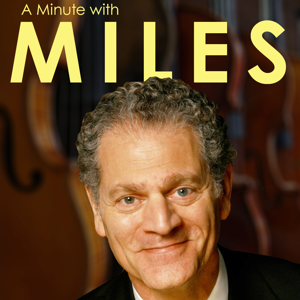
Illuminating 60-second flights through the world of classical music with host and longtime NPR commentator Miles Hoffman. Produced by South Carolina Public Radio.You can enjoy an archive of these segm... more
FAQs about A Minute with Miles:How many episodes does A Minute with Miles have?The podcast currently has 1,516 episodes available.
October 09, 2017Atonality vs DissonanceAtonality and dissonance are often linked in listeners’ minds, but they’re not the same thing. Dissonance, from the Latin words for “sounding” and “apart,” is the simultaneous sounding of two or more notes to produce a clashing, or unpleasant effect. Its opposite is consonance , a pleasing sound, a “sounding together .”...more1minPlay
September 29, 2017Music on a Desert IslandIt’s an old question: if you were going to be dropped off on a desert island and you could only take a few recorded pieces of music with you, what would they be? For me, the first piece on the list is easy: Mozart’s Marriage of Figaro ....more1minPlay
September 28, 2017NeuroscienceI’m grateful for advances in neuroscience, and for many reasons glad that every day we know more about how the brain works. But for all the studies of left brains, right brains, and neuron networks, some things will remain mysteries, and there’s no way around it....more1minPlay
September 27, 2017SpiccatoThe literal meaning of the Italian word spiccato is similar to that of staccato —“detached,” or “distinct.” In string playing, to play notes spiccato means to play them with a bouncing bow. With its stiff but flexible stick and tightened horsehair, the bow is like a long spring, so it wants to bounce. But spiccato involves a controlled bouncing. The bow comes off the string after each note, but the player has to find the balance between making the bow bounce and letting it bounce....more1minPlay
September 26, 2017Progress in MusicFor musicians and music teachers, the concept of Progress can be misleading. We can strive in our own ways to emulate the masters who’ve preceded us, but it’s a mistake to think there’s such a thing as being better than those masters....more1minPlay
September 25, 2017Progress in Science Vs. Progress in MusicIn fields such as science and technology, or in medicine, we’re used to achievements that represent Progress, progress that is obvious and indisputable. We do things better than we did before. But in the field of music, Progress has at times been a misleading concept....more1minPlay
September 22, 2017StringsThe strings of stringed instruments—violins, violas, cellos, basses, guitars, and harps—may be made of steel, nylon or other synthetics, or of gut. Often the steel, nylon, or gut serves as the core of the string, and around the core is a tight winding of very fine wire—wire of steel, aluminum, or silver....more1minPlay
September 21, 2017Aria Part 4The da capo aria, which I talked about yesterday, was a form that by 1750 had begun to lose its once enormous popularity. It was a form that was essentially killed by excess. The reign of the da capo aria coincided with the reign of the castrati as the stars of Italian opera....more1minPlay
September 20, 2017Aria Part 3For about a hundred years, roughly from 1650 to 1750, the principal type of aria in opera, and also in the oratorios and cantatas of such composers as Bach and Handel, was the da capo aria....more1minPlay
September 19, 2017Aria Part 2The aria - a musical form that’s a kind of song, but more elaborate and vocally demanding than the pieces we usually call songs. The development of opera in Italy in the 1600's is what brought the aria to glory....more1minPlay
FAQs about A Minute with Miles:How many episodes does A Minute with Miles have?The podcast currently has 1,516 episodes available.