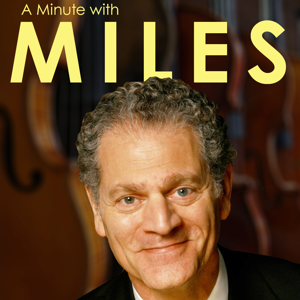
A Minute with Miles

A Minute with Miles

By Miles HoffmanMusic
Download on the App Store

A Minute with Miles episodes

  • Performers Vs. Creators
    There’s no question that good performers are necessary in order to bring musical compositions to life. I play the viola, and I’m always aware that when I’m playing a concert, the quality of my performance is of great importance in bringing the music to life for the people who are in that particular audience. So yes, in the limited sphere of my performances and my audiences, my role is critical, and if I play Mozart well, or Brahms, or Beethoven, I’m playing at least a small part in sustaining a

    1 min
  • Music That Lasts
    People often wonder, “Which pieces by contemporary composers will be familiar to classical music lovers fifty… a hundred… two hundred years from now”? Well, it’s not foolproof, but one pretty good indicator is that if a piece remains unloved after fifty years, or has entirely dropped out of sight, it’s not likely to be in the standard repertoire after a hundred years.
    1 min
  • Debussy on Bach
    Here are a few words that one great composer wrote about another—and I wonder if you can guess who was writing about whom. Ready? “Once again one finds almost the entire piece is pure musical arabesque…In reworking the arabesque he made it more flexible, more fluid, and despite the fact that [he] always imposed a rigorous discipline on beauty, he imbued it with a wealth of free fantasy so limitless that it still astonishes us…” “We can be sure that [he] scorned harmonic formulas. He preferred
    1 min
  • Debussy and Ravel - an Unlikely Friendship
    Claude Debussy and Maurice Ravel were roughly contemporaries, and as two of the greatest figures in late 19 th and early 20th century French music, they tend to be linked in people’s minds. But although they had similar training and came under many of the same influences, their musical styles and techniques were really quite different. And each admired the other’s talents, but that didn’t stop either one of them from criticizing what he saw as the other’s weaknesses.
    1 min
  • Timpani 2
    The timpani, or kettledrums were the original percussion instrument of the orchestra. The “kettle” of a kettledrum is called the “bowl,” and is made of copper or brass. The “head” of the drum, the surface that the player strikes, is a piece of Mylar plastic stretched over the rim of the bowl.
    1 min
  • Timpani 1
    The timpani, also called kettledrums, have been regular members of the orchestra since about 1700. Their history can be traced back to ancient times in the Middle East, but they first appeared in Europe in the 1400's—they were originally imported from Turkey for use in cavalry bands. Timpani are tuned drums—they play notes, not just booms.
    1 min
  • Maurice Ravel
    A famous music critic once referred to the French composer Maurice Ravel as “this most conscious, most naturally artificial of composers.” And in fact Ravel specifically said that he wasn’t seeking “profundity” in the music he wrote. He was merely seeking… perfection —some sort of technical perfection in composition, as he defined it, with “absolute beauty” as the guidepost and goal. But here’s the problem: I’m not sure we should completely believe him. Ravel once said, “In my opinion the joie
    1 min
  • A Quote from Claude Debussy
    Claude Debussy in 1903 wrote about the importance of giving his imagination free rein. Five years later Debussy expanded on the theme in a published interview. “You know,” he said, “People leave their homes to get away from themselves and from their surroundings. I confess that I live only in my surroundings and in myself. I can conceive of no greater pleasure than sitting in my chair at this desk and looking at the walls around me day by day and night after night..."
    1 min
  • February 22 - Washington's Birthday
    Today is the birthday of George Washington, so I thought I’d talk about… Alexander Reinagle. And in case this doesn’t seem like the most obvious choice to you, I’ll explain. Reinagle was a keyboard player and composer who was born in England in 1756 but who came to America in 17 86, landing first in New York and then moving to Philadelphia.
    1 min
  • Picturesque Titles - Debussy
    Robert Schumann called taking the titles of musical compositions too literally “clumsy.” Schumann’s friend Franz Liszt, on the other hand, coined the term “program music,” and said that when a piece has a program, or story, the musical ideas should clearly reflect the unfolding of the story—although that’s the same Franz Liszt who attached a “program” to his symphonic poem Les Préludes long after he had actually written the music.
    1 min

About A Minute with Miles

From the publisher's feed

Illuminating 60-second flights through the world of classical music with host and longtime NPR commentator Miles Hoffman. Produced by South Carolina Public Radio.You can enjoy an archive of these…