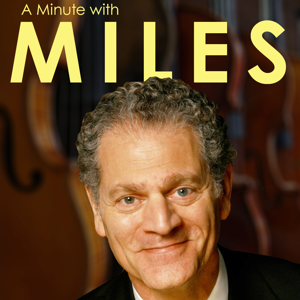
A Minute with Miles

A Minute with Miles

By Miles HoffmanMusic
Download on the App Store

A Minute with Miles episodes

  • Scherzo 1
    The word scherzo, which means “joke,” in Italian, had appeared in music as early as the 1600's, but it was Beethoven who gave the scherzo its modern character, and established a permanent place for it.
    1 min
  • Syncopation 2
    Syncopation disturbs the regular flow of rhythm and it shifts the emphasis in music from strong beats to weak beats, or to in-between beats. I’d like to stress, though, that syncopation is a general term: there’s no limit to the number or variety of possible syncopated rhythms or syncopated patterns, and no limit to the ways they may be used.
    1 min
  • Syncopation 1
    There’s an old joke about the husband who’s been out late drinking, and when his wife asks him where he’s been, he latches onto a word he saw on the cover of a book in the window of a music store, and he says that unfortunately he had come down with a case of… syncopation.
    1 min
  • Dvorak, Tchaikovsky, and Melody
    Already during their lifetimes, Antonin Dvorák and Peter Ilyich Tchaikovsky were among the most famous composers in the world. Their music is extremely sophisticated, the product of highly skilled composers, and their beautiful melodies have always been especially beloved.
    1 min
  • The Waltz
    When the dance known as the waltz first became popular in Europe in the late 1700's and early 1800's, it was considered by many observers to be the ultimate in lewdness and licentiousness, a corrupter of youth.
    1 min
  • The Clarinet
    The clarinet was the last of the principal woodwind instruments to join the orchestra. The modern clarinet evolved from earlier forms in the early 1700's—later than the modern oboe, bassoon, and flute—and it wasn’t until late in the century that orchestral composers included the clarinet in their scores with any regularity.
    1 min
  • The Development of the Piano
    The harpsichord, the keyboard workhorse of the Baroque period, is an instrument with a problem: varying the touch on the keys has absolutely no effect on volume or tone quality. Depress a key gently or pound on it, it doesn’t matter — the note will sound the same.
    1 min
  • Atonal Music
    Atonal music is music that isn’t written in a key, music that doesn’t follow the traditional rules of harmony. But although the term “atonal” tells us what a piece isn’t, it doesn’t tell us what it is. Many different styles and musical languages, whether harsh or lush, cool or intense, simple or complex can be described as atonal.
    1 min
  • Sonata
    The word sonata comes from the Italian sonare, an old form of suonare, which means “to sound,” or “to play,” as in “to play an instrument.” And indeed a sonata is always an instrumental piece—and since about 1750 the term has usually referred to pieces that are written either for solo piano or for piano and one other instrument.
    1 min
  • Atonality vs Dissonance
    Atonality and dissonance are often linked in listeners’ minds, but they’re not the same thing. Dissonance, from the Latin words for “sounding” and “apart,” is the simultaneous sounding of two or more notes to produce a clashing, or unpleasant effect. Its opposite is consonance, a pleasing sound, a “sounding together.”

    1 min

About A Minute with Miles

From the publisher's feed

Illuminating 60-second flights through the world of classical music with host and longtime NPR commentator Miles Hoffman. Produced by South Carolina Public Radio.You can enjoy an archive of these…