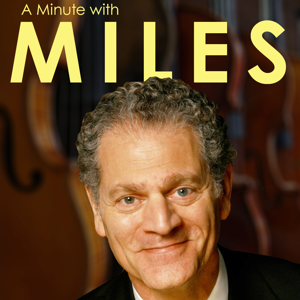
A Minute with Miles

A Minute with Miles

By Miles HoffmanMusic
Download on the App Store

A Minute with Miles episodes

  • Musical Borrowing
    For centuries, composers of classical music have been borrowing and adapting ideas and styles from popular music. Renaissance composers, for example, based Roman Catholic masses on popular tunes. Later composers made liberal use of folk tunes and folk styles of all kinds, and modern composers have borrowed freely from jazz and blues, among many other popular styles. But here’s what we sometimes forget: It’s always worked in the other direction, as well. The chords and harmonic progressions that
    1 min
  • Guitar History
    I’ve been reading about the guitar lately, and here’s what I’ve found: When it comes to the history of the guitar, the only thing that’s certain… is that nothing is certain. Did the early plucked ancestors of the modern guitar make their way to Europe from Asia and the Middle East? Possibly . There are tomb paintings from ancient Egypt, after all, and Hittite stone carvings from over three thousand years ago that show guitar-like instruments, not to mention an actual guitar-like instrument from
    1 min
  • Musical Arrangements
    To make an arrangement of a musical composition is to rewrite the composition for a new set of musical forces—to rewrite a wind quintet for string quartet, for example, or to transform a string quartet into a piano trio. In the process of arrangement, a piece may be altered in all sorts of ways, but the original composition always remains recognizable. And arranging is an art in itself—it can be done ingeniously and beautifully, helping us to hear a piece with fresh ears—and it can be done
    1 min
  • A Capella
    The term a capella is one of the more familiar Italian terms we run into in the music world. When applied to vocal music, a capella simply means “without instrumental accompaniment.” But you may find the derivation of the term interesting. The literal meaning of a capella in Italian is “as in the chapel,” or “in the style of the chapel.” And what has the chapel got to do with it? Well, it turns out that the term a capella was first used during the Renaissance, in the 1500s, to describe the
    1 min
  • Composers on Mozart
    Many composers over the years have tried to express in writing what the music of Mozart has meant to them—and to the world. Here are a couple of examples of Mozart appreciation from two 20 th -century composers who were also wonderful writers. First, from Aaron Copland: “Each time a Mozart work begins…we composers listen with a certain awe and wonder, not unmixed with despair. The wonder we share with everyone; the despair comes from the realization that only this one man at this one moment in
    1 min
  • Letters from Mahler
    In the letters of great composers, certain themes come up again and again, especially the composers’ struggles to get their works performed, and the desire—often frustrated—to have those works understood and appreciated. Here’s Gustav Mahler writing in 1906: “For the time being I must rest content with knowing that in a few places there are small circles of art-lovers for whom my work has some meaning, even perhaps some value. The first obstacle to its performance, no matter where, consists in
    1 min
  • Sergei Rachmaninoff
    Sergei Rachmaninoff was an example of one of the great “types” in the history of classical music: the virtuoso performer who was also an important composer. And indeed he was one of the greatest examples of this type, because both his performing and his composing activities were on the highest level. During his time, in fact, Rachmaninoff was considered by many to be nothing less than the greatest pianist in the world—and if you go to YouTube and check out some of the many Rachmaninoff
    1 min
  • Jean Sibelius
    Jean Sibelius was a fascinating man. He was born the year the American Civil War ended and he died in the year of Sputnik. He was a prolific composer—in addition to seven symphonies, many other orchestral works, choral music, music for the stage, and chamber music, he wrote more than a hundred songs—but over the last thirty years of his life he wrote virtually nothing. He was the greatest of Finnish composers, but he was a Swedish Finn: his first language was Swedish, and in fact he didn’t even
    1 min
  • Musicians' Injuries
    There’s very little that’s natural about the physical positions and movements that are required to play most musical instruments, and during the course of practicing and performing, awkward movements may be repeated literally thousands of times a day and millions of times a year, and unnatural positions may be maintained for untold numbers of hours. Muscle strain, tendinitis, nerve damage—all fall in the general category of “overuse” syndromes, and all are unfortunately extremely common among
    1 min
  • Performer Vs. Creator
    There’s no question that good performers are necessary in order to bring musical compositions to life. I play the viola, and I’m always aware that when I’m playing a concert, the quality of my performance is of great importance in bringing the music to life for the people who are in that particular audience. So yes, in the limited sphere of my performances and my audiences, my role is critical, and if I play Mozart well, or Brahms, or Beethoven, I’m playing at least a small part in sustaining a

    1 min

About A Minute with Miles

From the publisher's feed

Illuminating 60-second flights through the world of classical music with host and longtime NPR commentator Miles Hoffman. Produced by South Carolina Public Radio.You can enjoy an archive of these…