Sign up to save your podcastsEmail addressPasswordRegisterOrContinue with GoogleAlready have an account? Log in here.
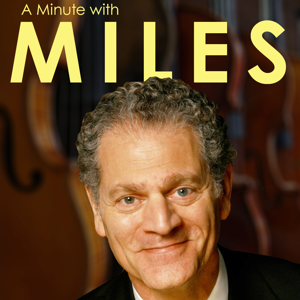
Illuminating 60-second flights through the world of classical music with host and longtime NPR commentator Miles Hoffman. Produced by South Carolina Public Radio.You can enjoy an archive of these segm... more
FAQs about A Minute with Miles:How many episodes does A Minute with Miles have?The podcast currently has 1,516 episodes available.
September 07, 2020StringsThe strings of stringed instruments—violins, violas, cellos, basses, guitars, and harps—may be made of steel, nylon or other synthetics, or of gut. Often the steel, nylon, or gut serves as the core of the string, and around the core is a tight winding of very fine wire—wire of steel, aluminum, or silver....more1minPlay
September 04, 2020Interesting Facts 5: RavelIt’s one of the hallmarks of great composers that they’re not limited by the practices of their times. Their imaginations are enriched, but not hemmed in, by the traditions they inherit, and they tend to push boundaries....more1minPlay
September 03, 2020Interesting Facts 4: BlochThe composer Ernest Bloch was born in Switzerland, and after spending time in America, he was thinking of returning to Europe. But a visit in 1922 to the Library of Congress, in Washington DC, convinced Bloch to stay in this country, and to take American citizenship. He was a famous composer, but Bloch was also one of this country’s most important educators, the founding director of the Cleveland Institute of Music and the first director of the San Francisco Conservatory of Music....more1minPlay
September 02, 2020Interesting Facts 3: Da PonteImagine, for a moment, Mozart walking down Broadway, in New York City. It’s not so easy. But Lorenzo da Ponte, who wrote the librettos for Mozart’s operas Don Giovanni, The Marriage of Figaro, and Così fan tutte, died a New Yorker. That’s right. It’s an amazing story, and here are the bare bones, telegraph style: Da Ponte was born in Venice; Jewish, but converted to Catholicism, and became a priest; kicked out of Venice when he had two children with his mistress; wound up in Vienna; ran out of...more1minPlay
September 01, 2020Interesting Facts 2: ProkofievSergey Prokofiev was a giant of 20 th -century composition. He wrote great symphonies, operas, ballets, concertos, piano sonatas, and chamber music pieces, not to mention Peter and the Wolf. Some things you may not know: Prokofiev visited America a number of times, and his concerts here were extremely successful. His opera The Love for Three Oranges was premiered in Chicago, and he met his first wife, the soprano Lina Llubera, in New York City. The Prokofiev's lived in Paris in the 1920's and 30...more1minPlay
August 31, 2020Interesting Facts 1: ChaussonThis week we’ll focus on interesting facts and stories about important musicians. The first interesting item about the French composer Ernest Chausson is his name. The word chausson, in French, means “slipper” – as in the slippers you wear on your feet. But a chausson aux pommes is an apple turnover. As a young man, Ernest Chausson studied law, and was admitted to the bar. But music was his great love, and instead of practicing law he enrolled at the Paris Conservatory, where he studied with...more1minPlay
August 28, 2020Progress in MusicFor musicians and music teachers, the concept of Progress can be misleading. We can strive in our own ways to emulate the masters who’ve preceded us, but it’s a mistake to think there’s such a thing as being better than those masters. For composers, mistaken concepts of progress can be downright dangerous. Human nature doesn’t change, and the reasons people listen to music don’t change. Whatever the thousand different feelings or ideas we experience in music, we seek meaning; we seek sounds that...more1minPlay
August 27, 2020Progress in Science Vs. Progress in MusicIn fields such as science and technology, or in medicine, we’re used to achievements that represent Progress, progress that is obvious and indisputable. We do things better than we did before. But in the field of music, Progress has at times been a misleading concept. Is there such a thing as being a better violinist than Jascha Heifetz, a better cellist than Mstislav Rostropovich, a better teacher than the great teachers of days gone by? I don’t think so. For me as a musician, and as a teacher...more1minPlay
August 26, 2020Deh Vieni alla FinestraNo piece of music is ever just “about” any one thing. In Mozart’s opera Don Giovanni, Don Giovanni stands beneath Donna Elvira’s window and sings the aria Deh vieni alla finestra, “Come to the window, O my treasure.” It’s a serenade, a love song, and a very beautiful one. But there’s one big problem: it’s a fake. Don Giovanni doesn’t love Donna Elvira, he’s just trying to seduce her. So what’s the aria really “about”? Well, it’s certainly still “about” love, but it’s also about lying. But the...more1minPlay
August 25, 2020The Flute, Part 2I mentioned yesterday that by the mid-1700's the modern flute, technically called the transverse flute, had to a great extent replaced the recorder. The replacement wasn’t complete, though: both Johann Sebastian Bach and George Frideric Handel had continued to write for both instruments. Then again, by the time of Haydn and Mozart, just a few decades later, most orchestras included a pair of flutes, and no recorders. It was in the 1830's and 40's that a German flutist and flute maker named...more1minPlay
FAQs about A Minute with Miles:How many episodes does A Minute with Miles have?The podcast currently has 1,516 episodes available.