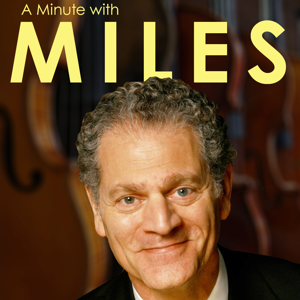
A Minute with Miles

A Minute with Miles

By Miles HoffmanMusic
Download on the App Store

A Minute with Miles episodes

  • Glass Armonica
    In May of 1761, Benjamin Franklin was in Cambridge, England, and he heard a man play a performance on musical glasses. They were crystal wine glasses filled with different levels of water, and when the performer rubbed the edges of the glasses, they produced different notes. Franklin was entranced by the sound, and he invented a mechanical version of the musical glasses that he called the glass armonica – that’s harmonica without the H. Franklin’s instrument consisted of a set of glass bowls
    1 min
  • Galilei
    Galileo, whose full name was Galileo Galilei, was one of the great figures in the history of science. What may surprise you is that Galileo’s father, Vincenzo Galilei, was one of the great figures in the history of Western music. The elder Galilei was a lutenist, singer, and composer, but most importantly he was a theorist. In a book called Dialogue of Ancient and Modern Music, published in 1581, he laid out the theory of what came to be known as monody, the style of music that features a solo

    1 min
  • Funny Things That Happen on Stage
    Musicians tend to tell lots of stories about funny things that have happened on stage during concerts. Often the stories are about disasters or near-disasters, and to be honest, they usually seem much funnier later on than the events themselves felt when they were actually happening. But one of the funniest stories I know isn’t about a disaster. It was told to me by the former second violinist of a very famous string quartet. The quartet had played a concert one night, had been up very late, and
    1 min
  • Figured Bass - Continuo
    In chamber music from the Baroque period, the written parts for keyboard instruments -- the harpsichord and the organ, for example – often consisted of merely a bass line, with numbers written under the notes. Such a bass line was called a “figured bass,” and the numbers, or figures, indicated which chords the keyboard player was expected to fill in above the bass, while at the same time improvising melodies [or countermelodies] to go along with what the other instruments were playing. The
    1 min
  • Percussion Instruments: Flavor and Color
    In some ways composers are like chefs – they’re always looking for interesting or even exotic flavors. Or like painters, experimenting with compelling colors and color combinations. And percussion instruments, whether alone or in combination, have always been very useful ingredients for adding flavor and color to orchestral compositions. Contemporary composers have been especially enthusiastic in their use of percussion instruments, sometimes calling for whole stages full of instruments that are
    1 min
  • The Harpsichord and Progress
    By the late 1700s, the piano had replaced the harpsichord as the primary keyboard instrument for solo compositions, concertos, and chamber music. Lovers of Baroque music may not like to hear this, but for most musicians of the time—of the late 1700s, that is—this replacement represented progress . And the reason it represented progress was that the piano offered possibilities for sound production, and sound variation , that the harpsichord couldn’t match. When you press the keys on a harpsichord
    1 min
  • Albeniz, Granados, and Falla
    When it comes to Spanish composers of the late 19 th and early 20 th centuries, the three most important names are certainly Isaac Albeniz, Enrique Granados, and Manuel de Falla – all composers who brilliantly integrated Spanish folk influences into the Western classical tradition. All three were great pianists, and Albeniz and Granados in particular had important careers as solo performers. Both those men, in fact, continued the long tradition of the composer/virtuosos who enriched the solo
    1 min
  • Why is Bach Better?
    Some years back colleague and I were listening to a Bach violin concerto on the radio. After a while my colleague said, “You know, there are a thousand Baroque violin concertos. Why is it that this one is just…better?” Johann Sebastian Bach wrote sonatas, concertos, suites, preludes and fugues, overtures, oratorios, and cantatas—music in all the major forms of the Baroque era, with the exception of opera. But Bach himself didn’t invent any of the forms he used. He used the forms he inherited ,
    1 min
  • Debussy the Pianist
    Many great composers have also been great pianists, genu-in virtuosos who in addition to composing led successful careers as performers. One gifted composer/pianist who did NOT have a big performing career was Claude Debussy. He did often perform his own works, but he tended to get nervous, and he didn’t enjoy playing in public. And yet by all accounts Debussy was a wonderful pianist, especially noted for his remarkable “touch” at the keyboard. “How could one forget his suppleness, the caress of
    1 min
  • Franz Liszt, Pt. 2
    Yesterday I mentioned that it was Franz Liszt who invented the solo piano recital, and that the frenzied reactions of Liszt’s audiences became known as “Lisztomania,” or “Liszt fever.” But I don’t want you have the impression that Liszt’s recitals were all virtuoso flash and little substance. Liszt had an enormous repertoire—he certainly played his own showpieces, but he also played pieces by all the great composers of the day and by those he called the “classics,” including many works of Bach,
    1 min

About A Minute with Miles

From the publisher's feed

Illuminating 60-second flights through the world of classical music with host and longtime NPR commentator Miles Hoffman. Produced by South Carolina Public Radio.You can enjoy an archive of these…