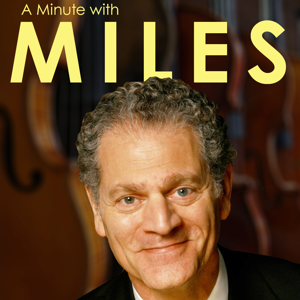
A Minute with Miles

A Minute with Miles

By Miles HoffmanMusic
Download on the App Store

A Minute with Miles episodes

  • Listening to Music
    Different people listen to music in different ways and for different reasons. And the same people listen to music in different ways and for different reasons, depending on when they’re listening. Some people have music on in their homes during meals, some while they’re relaxing, some in the background while they’re working, and some all the time. And some people absolutely can’t work if there’s music on in the background, and only want to hear music when they can pay close attention, whether it
    1 min
  • Good Music Lasts
    These days, with convenient hindsight we take it for granted that good music lasts, that pieces that are well known now will remain well known for years -- perhaps even for centuries to come. But I often wonder what was in the minds of the great composers of centuries past whose music we still love. Composers such as Bach, Mozart, and Beethoven knew very well how good they were, and where they stood compared to other composers. They were too good not to have known. And they certainly studied the
    1 min
  • Joanna Mauer: Wisdom vs. Age
    That snippet of Bach that you always hear at the beginning of A Minute with Miles is played by violinist Joanna Maurer. Joanna plays in the Metropolitan Opera Orchestra, and for almost twenty years she’s been my colleague in the American Chamber Players. She’s a remarkable musician, and for all these years I’ve been inspired both by her beautiful violin playing and by what I might call her musical wisdom: her interpretive insights and her mastery of the craft of chamber music. And like all her
    1 min
  • IPA
    Professional opera singers often have to sing in languages with which they’re completely unfamiliar. And yet they’re expected to pronounce all the words correctly. How do they do it? Well, they certainly can, and do, work with coaches who are native speakers, but most often they start by studying the foreign words with something called the International Phonetic Alphabet, or IPA, for short. The IPA was invented in the late 1880s by a group of English and French language teachers, or
    1 min
  • Interpretation vs. the Music Itself
    I attended a concert recently that featured a performance of the Schubert Fantasy in F Minor for piano four-hands. The Schubert Fantasy is a piece I’ve known and loved for decades, and I’d been looking forward to the performance. As it turned out, though, I didn’t enjoy the performance, or the music, because I didn’t like the interpretation. I simply couldn’t free myself from my conception of how the music should go, not to mention how it shouldn’t go. Afterward I shared my thoughts with another
    1 min
  • "Classical Music"
    Somehow it remains a struggle to define the term “classical music.” Some people call it “concert music,” which seems a little too broad, or “art music,” a little too exclusive, or “serious music,” which is an insult to every other kind of music. It’s often easier to say what classical music is not : it’s not any one of the countless different styles of music that fall in the general category of “pop” music. Recently, though, I heard a definition that I like: “text-based music.” The presence of a
    1 min
  • Brass Quintet
    A “brass quintet” consists of two trumpets, French horn, trombone, and tuba. I attended a concert by a brass quintet the other day, and I was struck by a big difference, visually , between a brass quintet concert and, say, a string quartet concert. When you watch a string quartet, you see lots of movement – arms, hands, fingers, instruments. But at a brass quintet concert the only thing you see moving much at all is the slide of the trombone. And the reason is that most of what brass players do

    1 min
  • Bad Chairs
    Imagine you’re a professional basketball player, about to take a foul shot. You’ve practiced this thousands of times, and you know exactly how you need to set your feet and orient your body in order to get the best results. But then you notice that the floor is uneven, or slippery, or has a big depression right at the foul line, or has a board sticking up under your foot. It’s going to be much harder to make the shot. Well, this doesn’t actually happen on professional basketball courts. But
    1 min
  • Why Should Somebody Else...
    Why should somebody else— anybody else, whether it’s a program annotator or a radio announcer—tell me that a piece of music is “sad,” or happy, or light, or charming, or profound, when no two people ever have precisely the same reaction to the same piece? One person’s “sad” may be another’s “noble,” and one person’s intense and penetrating may be another’s pretentious and annoying. The other day I read a program note in which a Schumann piano work was described as a charming salon piece, the
    1 min
  • What to Say After a Concert, v. 2.0
    A while back I spent a minute offering a few suggestions of what to say after a concert when the concert was really pretty bad, but the performer is someone you know and you have to say something . In the unfortunate event that you’ve already used up your store of useful phrases, I thought I’d suggest a few more. The easiest thing to say is a always a simple “Bravo.” But of course it’s a little too easy – and whenever someone has only said “bravo” to me after one of my concerts I’ve always been
    1 min

About A Minute with Miles

From the publisher's feed

Illuminating 60-second flights through the world of classical music with host and longtime NPR commentator Miles Hoffman. Produced by South Carolina Public Radio.You can enjoy an archive of these…