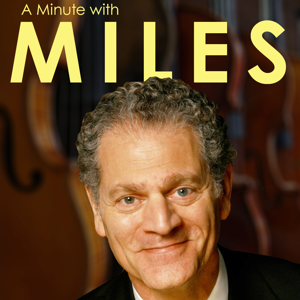
A Minute with Miles

A Minute with Miles

By Miles HoffmanMusic
Download on the App Store

A Minute with Miles episodes

  • Mozart Flute Quartets
    In a famous letter to his father, Mozart once wrote, “you know I become quite powerless whenever I am obliged to write for an instrument I cannot bear.” He was talking about the flute, and the occasion of the letter was a commission Mozart had received to write several flute concertos and quartets for flute and strings. In fairness to Mozart, neither the flutes nor the flutists of his day were terribly reliable, but it’s also possible that Mozart had just been procrastinating, and inventing an
    1 min
  • Robert Mann - Performer and Teacher
    Performers are always seeking the most effective and compelling ways to bring a composer’s musical ideas to life. I stress the plural, “ways,” because there’s never just one way. Some musicians sometimes forget this, unfortunately, but the best musicians, and the best teachers never do. When I was a graduate student, the string quartet I played in was working on a Bartók string quartet, and our faculty coach was Robert Mann, founder and first violinist of the Juilliard Quartet. Now, if ever

    1 min
  • Original Intent: Copland Story
    When musicians and music scholars prepare performances of works by dead composers, they often get stuck in arguments over determining what the composers’ “original intent” was. And while I certainly recognize the importance of scholarly accuracy and authenticity, and of staying true to the composers’ wishes, I think that sometimes musicians forget that dead composers were once alive. Back in 1980 a pianist I know was preparing a performance of the Copland Piano Concerto, a performance that Aaron
    1 min
  • Composers of Chamber Music
    Composers during the Baroque period wrote plenty of chamber music, especially trio sonatas, and sonatas for such high-voiced instruments as the violin and the flute. But the chamber music repertoire that today’s audiences are most familiar with probably begins with the piano trios and string quartets of Joseph Haydn. After Haydn, the floodgates opened. Mozart and Beethoven, for example, both composed enormous quantities of great chamber music in a variety of forms… and with the exception of
    1 min
  • Telemann
    You could write a book about the life of the German composer Georg Philipp Telemann– and as it turns out, Telemann himself wrote three – three separate autobiographies. One of the things he wrote about is the time he spent in Poland in his early twenties. He became familiar with Polish and Moravian folk music during this period—he wrote that he experienced it in “all its barbaric beauty”—and he also heard the music of Eastern European gypsies. But he didn’t just listen: he incorporated some of
    1 min
  • Rostropovich
    I had the enormous good fortune as a young man to get to work with the great cellist Mstislav Rostropovich. Rostropovich, or “Slava,” as everybody called him, was the music director of the National Symphony Orchestra when I played in that ensemble, and with all his other engagements he still somehow made time to give master classes just for members of the orchestra. I learned a tremendous amount from him, and to this day I don’t seem to be able to give a master class myself without quoting Slava
    1 min
  • Principles of Teaching
    In the world of instrumental and vocal teaching, most teachers approach their students with certain basic principles in mind. For me, one of those principles is that whether we’re dealing with individuals or with ensembles, there’s no separating technical goals from musical goals. I don’t believe, in other words, that it makes sense just to learn the notes first and then somehow to “plug in” the music later. Sure, there are certain fundamental techniques that all beginners have to master, but
    1 min
  • Changing Habits - Mark Twain
    One of the things I’ve learned as a string teacher is that good habits can often replace a student’s bad habits quickly, because the good habits make playing easier. But it was Mark Twain, strangely enough, who helped me to realize that the switch can only result from a very conscious and rational process on the student’s part, a process of understanding and acceptance. In his essay “Taming the Bicycle,” Twain wrote, “In order to keep my position, a good many things were required of me, and in
    1 min
  • Sports/Music Connections
    The efficient and graceful use of the body is crucial to both sports and musical performance. But there are certainly many mental parallels as well -- and the experiences of athletes can teach us quite a bit about what musicians do. Years ago I read an interview in the Washington Post with a professional baseball player named Charles Johnson. Johnson had hit a three-run homer to win a game, and this is what he said afterward: “I recognized a curveball right away, and told myself to stay on it. I
    1 min
  • The Colors of White
    In 2004 the Vatican Museum presented an exhibit called “The Colors of White.” What the exhibit showed, in a nutshell, is that our notion that the beauty of ancient Greek and Roman statues lies in their pure, white form is a relatively modern idea, with no basis in historical fact. Scientists working with electron microscopes discovered vestiges of all sorts of bright paint colors on ancient statues, colors that to modern eyes seem hideously garish, and the curators of the Vatican exhibit
    1 min

About A Minute with Miles

From the publisher's feed

Illuminating 60-second flights through the world of classical music with host and longtime NPR commentator Miles Hoffman. Produced by South Carolina Public Radio.You can enjoy an archive of these…