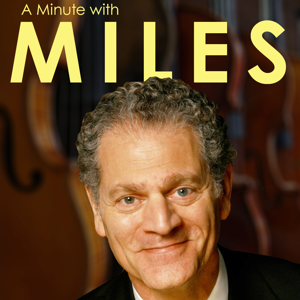
A Minute with Miles

A Minute with Miles

By Miles HoffmanMusic
Download on the App Store

A Minute with Miles episodes

  • Traveling and the Glamour of Touring
    Do you find traveling glamorous? Sitting around in airports, waiting in lines, carrying luggage, eating in unfamiliar places, sleeping in unfamiliar beds? Well imagine doing that for about ten months a year, and imagine doing it alone, while having to prove, over and over again every single week, that you’re one of the best in the world at what you do. And when you’ve imagined all that, and added in lots more hours spent alone practicing, you’ve imagined the glamorous life of a touring soloist.
    1 min
  • Bach - Better
    Some years back colleague and I were listening to a Bach violin concerto on the radio. After a while my colleague said, “You know, there are a thousand Baroque violin concertos. Why is it that this one is just…better?” Johann Sebastian Bach wrote sonatas, concertos, suites, preludes and fugues, overtures, oratorios, and cantatas—music in all the major forms of the Baroque era, with the exception of opera. But Bach himself didn’t invent any of the forms he used. He used the forms he inherited ,
    1 min
  • Debussy the Pianist
    Many great composers have also been great pianists, genu-in virtuosos who in addition to composing led successful careers as performers. One gifted composer/pianist who did NOT have a big performing career was Claude Debussy. He did often perform his own works, but he tended to get nervous, and he didn’t enjoy playing in public. And yet by all accounts Debussy was a wonderful pianist, especially noted for his remarkable “touch” at the keyboard. “How could one forget his suppleness, the caress of
    1 min
  • The Paradox of Integrity
    Musicians, like actors, have to deal with something a drama teacher once called the “paradox of integrity.” On the one hand, you have to be completely “in character” when you’re performing—moved your self by the music in order to make it moving for others, and merged with the music, in a way… almost sub merged in it. On the other hand, you have to remember where to put your fingers, and not to make the same mistake tonight you made at the rehearsal yesterday morning, and not to rush in the third
    1 min
  • Conflict
    I won’t mention any names, but many years ago there was a great string quartet that was famous for its members not getting along. People joked that it was a tragedy for this quartet if they showed up in a town that only had three hotels. I don’t know if we can blame this particular quartet, but one theory that took hold was that the best results for chamber music groups are produced by conflict, and the resolution of conflict. I would like to on record as saying that I think this theory is a
    1 min
  • Pronunication
    Classical music lovers tend to worry about correct pronunciation, so here are a few refreshers that I hope will be helpful. In America, people who play the flute call themselves flutists, not flautists, and we who play the viola, which looks like vie-ola, are called violists. Handel’s Messiah was written by Handel, not Hondle, and though you can say Haendel if you’re feeling German, Handel himself changed it to Handel, so I’d stick with that. Mozart is Mozart, not Moe-zart, but before we get too

    1 min
  • Franz Liszt, Pt. 2
    Yesterday I mentioned that it was Franz Liszt who invented the solo piano recital, and that the frenzied reactions of Liszt’s audiences became known as “Lisztomania,” or “Liszt fever.” But I don’t want you have the impression that Liszt’s recitals were all virtuoso flash and little substance. Liszt had an enormous repertoire—he certainly played his own showpieces, but he also played pieces by all the great composers of the day and by those he called the “classics,” including many works of Bach,
    1 min
  • Franz Liszt, Pt. 1
    In 1841 Franz Liszt played three concerts in Paris, and afterward he wrote, “My…solo recitals…are unrivalled concerts, such as I alone can give in Europe at the present moment… Without vanity or self-deception, I think I may say that an effect so striking, so complete, so irresistible had never before been produced by an instrumentalist in Paris.” Well, if it’s true it ain’t braggin’, and by all accounts it was true. The poet Heinrich Heine called the effect “Lisztomania.” Others called it
    1 min
  • Mozart's Optimism
    It’s hard to find a classical music lover who doesn’t love the music of Mozart. It’s when we try to describe why we love Mozart that things can get complicated. We’re describing something indisputably real—our love of Mozart—but unless we stick to strictly technical analyses, we have to use words that will necessarily be both subjective and metaphorical. My own words? I keep coming back to two: humanity and optimism. What I somehow hear in Mozart, whether in his operas or his instrumental works,
    1 min
  • Beethoven's Shadow
    For convenience sake, the 19 th century is usually known as the era of Romanticism in classical music. This is not necessarily wrong, but it certainly does lump a great number of composers of very different styles into one broad category. Another way to view the 19 th century is simply as the era of Beethoven. And that’s because after Beethoven, all composers were seen and evaluated in Beethoven’s light, or rather in his enormous shadow. Seen by the public, and seen by themselves. Imagine the
    1 min

About A Minute with Miles

From the publisher's feed

Illuminating 60-second flights through the world of classical music with host and longtime NPR commentator Miles Hoffman. Produced by South Carolina Public Radio.You can enjoy an archive of these…