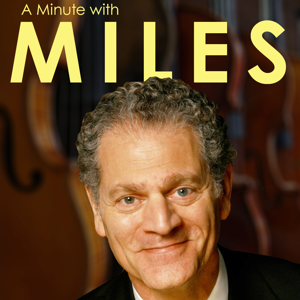
A Minute with Miles

A Minute with Miles

By Miles HoffmanMusic
Download on the App Store

A Minute with Miles episodes

  • Cool Leonard Bernstein
    If you’d like a remarkable example of the genius of Leonard Bernstein, I recommend that you listen – or listen again – to the song “Cool,” from West Side Story. Bernstein needed a song for the character Riff to sing to build up the tension before the gang fight between the Jets and the Sharks. If I told you his solution was to take Baroque counterpoint – a fugue, to be precise – the syncopated rhythms of jazz, and the atonal twelve-tone technique of Arnold Schoenberg… and to mix them all
    1 min
  • Better Ears
    Every musician will tell you that there are some musicians who just seem to have better ears than others do. We’re really talking about the brain, rather than the actual organ of hearing, but in any case from the same sounds others hear, some people are able to extract more information, and they’re able both to process and to store that information faster, more accurately, and more efficiently. Yesterday I talked about ear training courses for musicians, and rigorous training can certainly lead
    1 min
  • Don Giovani, Likeable Villain
    One of the reasons Mozart’s operas seem so profound to us is because they’re so true to life, and perhaps especially true to life’s complexities and contradictions. Take the character of Don Giovanni. He’s introduced to us having committed a sexual assault, which he follows by killing someone. But Mozart doesn’t make him a cartoon villain, and in fact he does the opposite: he makes him appealing—he gives him beautiful music to sing. But here’s what’s so fascinating – and such a stroke of genius
    1 min
  • Conducting: Changes Over the Centuries
    The tools and techniques of conducting have changed a great deal over the centuries. In the Middle Ages and Renaissance, the people who led musical performances, especially vocal performances, usually simply waved their hands in the air to indicate the shape and speed of melodies – although sometimes they also held a long wooden staff in one hand and marked beats with it. During the Baroque period and into the early Classical period, larger instrumental ensembles were usually led by a
    1 min
  • Composers' Lives, Part 2
    One of the common dangers of studying composers’ lives is finding out that some of the people whose music we love and admire turn out to have been very unadmirable human beings. Exhibit A in this category is usually Richard Wagner, an egomaniac and anti-semite, among other things, but a man who wrote lots of exquisitely beautiful music. What are we to make of such jarring disjunctions? Should we throw out the music with the maniac? I don’t have the answer. If your personal association with the
    1 min
  • Composers' Lives
    Here’s a question: Should we really care about the personal lives of the composers we admire? When we don’t know anything about their lives, we certainly don’t care. How many of us know a great deal about Monteverdi, or Palestrina? Or even Bach, or Beethoven? What we care about is the music. But still, we’re curious, especially about composers whose work has meant a great deal to us, work that has enriched our lives. Through their music they seem to have understood our very hearts and souls, and
    1 min
  • Ear Training
    Ears can be trained. Which is why every music school in the world offers ear-training courses. I suppose it should go without saying, but for musicians the ability to recognize fine distinctions among sounds is crucial. And what musicians are trained to do is to recognize very specific kinds of information in sounds, to recognize relationships and patterns and to be able to reproduce them. They do this through practice and memorization. The distance in pitch between any two notes, for example,
    1 min
  • Which Came First?
    So here’s the famous riddle: Which came first, the chicken... or the violin? Or the piano? Or the valved horn? By the mid-to-late-1500s the members of the modern violin family had been perfected, and by 1600 the Baroque era in music had begun, with an explosion of music for the violin. The piano was invented in 1700 and eventually mass-produced, and by 1775 the Classical era in music was in full swing, with an explosion of music for the piano. The ranges and possibilities for brass instruments
    1 min
  • Franz von Suppé
    Franz von Suppé could be the poster child for composers who were extremely prolific and very famous in their own time, but who, if they’re now remembered at all, are only remembered for two or three pieces. In Von Suppé’s case, one of those pieces goes like this: Butta yump, butta bump, butta yump, butta bump (etc.). Sound familiar? It’s from the overture to the operetta “Light Cavalry.” Living in Vienna in the mid-1800s, Von Suppé wrote some thirty operettas, as well as countless other works

    1 min
  • Vidula, Fidula
    Fiddle is an older word than violin – there were instruments called fiddles long before violins. Violino, which is Italian for “violin,” is the diminutive form of viola , which until the 1700s was the generic term for any bowed string instrument. The word viola itself came from the Old French viole , which came from the Provençal viula , which came from the Medieval Latin vidula . I used to think, as others did, that the word fiddle also came from vidula . Pronounce the V in vidula in the German
    1 min

About A Minute with Miles

From the publisher's feed

Illuminating 60-second flights through the world of classical music with host and longtime NPR commentator Miles Hoffman. Produced by South Carolina Public Radio.You can enjoy an archive of these…