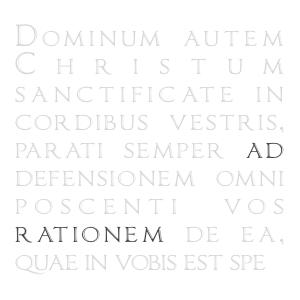
And with these words the Holy Father Pope John Paul II concludes his 26th catechesis on Man and Woman He Created Them a Theology of the Body. There are many salient points in this 26th catechesis. The Holy Father addresses concupiscence. This section is actually entitled “The Man of concupiscence”, which is a reference to all of us. Concupere – with desire, to take to oneself, a consequence of original sin. A consequence of the Fall.
Pope John Paul II presents in this catechesis the threefold concupiscence found in 1 John 2:16–17. The concupiscence of the flesh, concupiscence of the eyes and pride of life. Concupiscence of the flesh, refers to sins of the flesh, a tendency to sin with the flesh. Not just gluttony or drunkenness but even sexual sins are included. Concupiscence of the eyes, not to look at another with desire in the reductive way. We heard about that in the 25th catechesis, but even coveting our neighbors goods: our neighbors three story house, or foreign import car, or stellar education. Often before something is stolen it is desired with the eyes, coveted with the eyes. And then, pride of life, “Lord I thank you I am not like these others” we hear in the gospel (Luke 18:11). These are tendencies to sin. And they really cover just about everything.
Our Lord encourages us, exhorts us, as does His vicar on Earth Pope John Paul II, who gave us these conferences but now Benedict XVI encourages us not to be men and women, not to be human beings of concupiscence, but to be saints. Rejoicing in the good, rejoicing in the blessings of the other. Proper stewardship of ourselves, of our bodies, of our where-with-all, and of our eyes. The Holy Father does not use the expression ‘custody of the eyes’ but it is very much a part of the equation. It is one way how we combat concupiscence.
The tendency to sin is a consequence of Original Sin, of the Fall. And since this three-fold concupiscence is found in St. John’s first letter, Pope John Paul II addresses Johannine theology. That theology, the science of God, based on the writings of St. John. So you have the fourth Gospel, the three letters, and the book of Revelation. What was God trying to tell us through these inspired writings of this inspired author, the beloved disciple St. John. whose memory the Church celebrates each year on December 27th just after Christmas? “And the word became flesh and dwelt among us”(John 1:14) this is the high Johannine theology of Christ, the incarnate Word, the Word made flesh. “The Father and I are one” (John 10:30), Johannine Trinitarian theology. “My flesh is true food, My blood is true drink” (John 6:55), Eucharistic Johannine theology.
Our Holy Father Pope John Paul II in his footnotes cites so many of the different authors, the different sources, those who have written about what can be found in the writings attributed to St. John. So much has been written on Johannine theology. And the Holy Father makes his contribution here in this 2nd chapter of Man and Woman He Created Them a Theology of the Body. He does so in light of the Sermon on the Mount, however, which is Matthew 5:27–28, where the Lord is extending the Decalogue. Not only: not to commit adultery, but: not to look with desire, in the reductive sense, upon the other.
And our Holy Father Pope John Paul II asks the question, “Is it legitimate to transfer the typical contents of Johannine theology in 1 John 2:15–16, where we hear of the 3-fold concupiscence, to the terrain of the Sermon on the Mount (St. Matthew)?” That’s his question. And I think it is very important that we answer that question in the affirmative, “Yes of course it is legitimate.” And the Holy Father mentions as one reason why it is legitimate, why it is fine to juxtapose those two passage of Sacred Scripture because of the overall biblical context: 1 John is in the Scripture, and Matthew is in the Scripture.
[...]