
Sign up to save your podcasts
Or



Adhyatma Vidya Mandir
Video lecture link : https://www.youtube.com/playlist?list=PLvByNyt5x4-Aj-amr2__x6-DAvIk3EXFL
Subject: अपरोक्षानुभूतिः aparokṣānubhūtiḥ
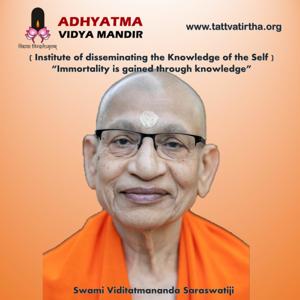
Speaker : Swami Viditatmananda Saraswatiji
Such treatises as aim at serving as introductions to a more advanced study of a system of philosophy, are generally known as प्रकरण ग्रन्था prakaraṇa granthā. Besides giving an outline of the system, each of them emphasizes some one or other of the main features. Aparokṣānubhūtiḥ is one such title manual, which, while presenting a brief description of Vedanta, deals specially with that aspect of it which relates to anubhūtiḥ realization of the highest truth. Such realization, unlike the knowledge of objects through sense-perception of inference, is an immediate and direct perception of one’s own Self, which is here indicated by the word aparokṣa.
November 14 2020 Satsang on Mumukshtvam
In this Satsanga, Pujya Swamiji sheds light on the subtle nature of Viveka, Vairagya, Shraddha, and Mumukshtvam. When can one say that one has done the ‘परीक्ष्य लोकान् parīkṣya lokān’? If this has not happened yet in a seeker’s life, what measures should one employ? Seekers will find here clarification on how the value of shraddha manifests in a seeker’s life through the maturity of values of shama, dama, uparati. The discussion of the relationship of bhakta and bhagwan, with an emphasis on saguna in bhakti and upasana, as a relationship of love and devotion for God is all very beautifully brought out here, as well what is possessiveness in the relationship of Sevak-Sevya, what should the sevak be cautious off, and how should one address the mind accordingly, all these subtleties presented here will be helpful to seekers to understand and implement the 4-fold values – Sādhana Catuṣṭaya Sampatti in their life.
Adhyatma Vidya Mandir
Video lecture link : https://www.youtube.com/playlist?list=PLvByNyt5x4-Aj-amr2__x6-DAvIk3EXFL
Subject: अपरोक्षानुभूतिः aparokṣānubhūtiḥ
Speaker : Swami Viditatmananda Saraswatiji
Such treatises as aim at serving as introductions to a more advanced study of a system of philosophy, are generally known as प्रकरण ग्रन्था prakaraṇa granthā. Besides giving an outline of the system, each of them emphasizes some one or other of the main features. Aparokṣānubhūtiḥ is one such title manual, which, while presenting a brief description of Vedanta, deals specially with that aspect of it which relates to anubhūtiḥ realization of the highest truth. Such realization, unlike the knowledge of objects through sense-perception of inference, is an immediate and direct perception of one’s own Self, which is here indicated by the word aparokṣa.
Adhyatma Vidya Mandir
https://www.tattvatirtha.org/vedantasara/
Subject: Vedāntasāra
Speaker : Swami Viditatmananda Saraswatiji
Vedāntasāra means essence of Vedānta and as the name suggests, this text provides an analysis of the basic principles of Vedānta as taught by the Upaniṣads. Vedānta can be summarized in one simple statement : tat tvamasi, which reveals the identity between tat, which stands for jīva or a limited conscious being. This means that one who takes onself as limited is in fact limitless. This knowledge releases one from all the complexes about oneself and resultant sorrow, both born of the ignorance of the basic reality of oneself. One owns up to one’s true nature that is limitless, wholeness, and unconditional happiness. One becomes jīvan-mukta, liberated in this life itself. One attains the ultimate goal of life; freedom and fulfillment.
This text as being exquisitely complete in its being an entirely comprehensive teaching of all the essentials of Vedānta that one need ever know; the teaching covers an incredible spectrum of topics and is, at the same time, both simple and profound. For this reason, the text will serve wonderfully well as a go-to-resource for easily looking up certain terms and references as well as finding more detailed explanations of familiar concepts and totally new ideas in a one-text-covers-all kind of way. If there is one text go over and over, it would be this one. And if there is one text that can teach something new each and every time, it would be this one. This may sound like cliché, but it contains an undeniable element of truth.
Hariḥ Om !
Ref: Preface of book by Jayshree Ramakrishnan
From the publisher's feed