
Sign up to save your podcasts
Or

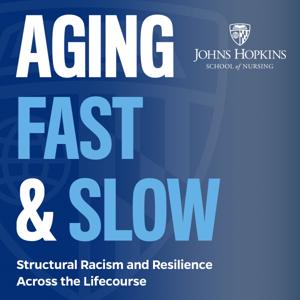


Drs. Sarah Szanton and Deidra Crews kick off Aging Fast & Slow Season 2 with guest Dr. Paris "AJ" Adkins-Jackson, Assistant Professor in the Departments of Epidemiology and Sociomedical Sciences at Columbia University Mailman School of Public Health. One big question for health researchers is how to measure structural racism in different places and systems. Dr. Adkins-Jackson is among the leading number of scientists working in this area. She joins us to discuss her research on the health impact of structural racism and to provide recommendations for how epidemiologists and other health researchers can measure structural racism, including approaches taken by other fields.
References:
1. Adkins-Jackson PB, Incollingo Rodriguez AC. Methodological approaches for studying structural racism and its biopsychosocial impact on health. Nursing Outlook. September 2022
2. Adkins-Jackson PB, Chantarat T, Bailey ZD, Ponce NA. Measuring Structural Racism: A Guide for Epidemiologists and Other Health Researchers. American Journal of Epidemiology. April 2022
3. Adkins-Jackson PB, Jackson-Preston PA, Hairston T. “The only way out”: How self-care is conceptualized by Black women. Ethnicity & Health. 2022
Season 2 Trailer. Aging Fast & Slow is returning. With this relaunch, we are moving beyond documenting inequities and moving to new measurement methods and solutions for achieving health equity and justice. Tune in as we interview cutting-edge scientists, policy experts, and innovators as we seek to understand structural discrimination, and resilience across the lifecourse and the impact on health inequities with aging.
Season1. Episode 5. Wrapping up Season 1, Dr. Lisa Cooper stresses the importance of trust as a key ingredient for the patient-physician relationship, community engagement, and crisis response.
Podcast References:
Continue the Conversation:
Episode 5 Transcript
Season 1. Episode 4. This episode of Aging Fast & Slow highlights how business collaborations drive systems change to achieve social impact. Guest Stephen Johnston describes how Aging2.0 accelerates innovation through its global community and collective intelligence platform to improve the lives of older adults.
Podcast References:
Continue the Conversation:
Aging Fast & Slow Episode 4 Transcript
Season1. Episode 3. Even amid the COVID-19 outbreak, chronic conditions don't take a break. In honor of National Kidney Month, we talk to Aging Fast & Slow’s own Dr. Deidra Crews, a nephrologist at Johns Hopkins. She tells us how kidney health inequities impact us all and how common they are. Dr. Crews also helps us understand what epidemiology and intervention research are, how they differ, and how she uses both in her work.
Podcast References:
Continue the Conversation:
Episode 3 Transcript
Season 1. Episode 2. Dr. Keith Whitfield, an expert in aging among African Americans and the Provost at Wayne State University, joins hosts Dr. Sarah Szanton and Dr. Deidra Crews for the second episode of Aging Fast & Slow. Together they discuss the impact of desegregation on cognition by looking at stress and longevity within and among African American families.
Podcast References:
Continue the Conversation:
Episode 2 Transcript
Season 1. Episode 1. Hosts Dr. Sarah Szanton and Dr. Deidra Crews kick off Aging Fast & Slow with guest Dr. Elissa Epel, professor of psychiatry at UCSF. Dr. Epel’s research seeks to understand the root of health disparities, and the role of chronic stress within aging. Together they unpack her recent work revealing how the impact of systemic oppression is transmitted intergenerationally.
Podcast References:
Continue the Conversation:
AgingFast & Slow Episode 1 Transcript
Some people age faster than others, but why? Our podcast hosts Dr. Sarah Szanton, a nurse practitioner with a research degree, and Dr. Deidra Crews, a nephrologist, will seek to answer this question. They will talk to scientists, policy experts, and innovators to better understand aging across the life course, and also differences in aging - due to societal structures, community factors, and even our own cells. Learn More: https://nursing.jhu.edu/agingfastandslow
From the publisher's feed
40 Listeners

5 Listeners
26 Listeners
4 Listeners
9 Listeners
45 Listeners
16 Listeners
2 Listeners
632 Listeners