
Sign up to save your podcasts
Or

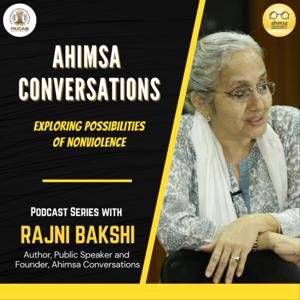


सुनें दुनियाभर के उन लोगों को जो अहिंसा से जुड़े अनुभवों को एक प्रयास और सामान्य इंसान की खोज के रूप में साझा कर रहे हैं। उन्हें इंसानों और कुदरत पर हो रही संरचनात्मक हिंसा की वजह से पड़ने वाले असर की व्याख्या करते हुए सुनें। जुड़िए हर सोमवार और शुक्रवार 'Ahimsa Conversations' में हमारी Host रजनी बख्शी के साथ।
Ahimsa Conversations is a platform for reflections on the possibility of nonviolence and the nature of violence.
Our candid discussions include voices of those whose experience in varied fields throws light on how nonviolence is actionable and effective, by ordinary people, firstly as a way of life and as a method of political action
Disturbed by the increasingly bitter polarization within American society, Nisha works to establish dialog and find common ground among those who may be firm opponents – in order to open pathways to justice and dignity for all. She has been at the heart of a successful bipartisan campaign for criminal justice reform legislation in the US Congress.
Ahimsa is a learnt practise. V. Geetha has learnt this from her work as a feminist activist and her study of the writings of B.R. Ambedkar and his vision of society in which there is justice for all. She describes how Periyar Ramasamy could be forceful in his struggle against caste injustice but he was also committed to nonviolence. While she has differences with Gandhi, Geetha explains in EP 9 how his insights on nonviolence are crucial.
Treating all of nature as a tradable resource, represents violence in its worst form. Bittu Sahgal, an environmentalist and conservationist, in EP 8, argues that it is only humans who create violence that is unrelated to the need for food or other physical sustenance. 'Jungle Raj', says Bittu, means honoring the flow of nature. He reflects on how it is the younger generation who can teach adults on how to undo this structural violence by forging bonds of cooperation and mutuality with each other and with nature
Every provocation to nonviolence, from violence, has to be responded to afresh. This is because Mahatma Gandhi has shown us the principle, not laid down a code.
In Ep 7 of Ahimsa Conversations, Gopal Gandhi, whose father was Mahatma Gandhi’s youngest son, describes how his three uncles reacted very differently to the assassination of Gandhi and what their responses teach us about both the impulse for violence and nonviolence.
“Ahimsa Parmo Dharma”, nonviolence is the primary virtue, is a principle that arose out of the horrendous violence of the Mahabharata.
Tune-in to Ep 6 of Ahimsa Conversations where Acharya Goswami, eminent Vaishnav scholar in the tradition of the Radharaman Temple in Vrindavan, narrates the historical and spiritual legacy of Shri Chaitanya Mahaprabhu, who equated Ahimsa with Seva (service), and links this to the legacy of Mahatma Gandhi.
A social and political activist, Faisal Khan has led the revival of Khudai Khidmatgar, the organization originally founded in 1929 by Khan Abdul Ghaffar Khan who was fondly known as ‘The Frontier Gandhi’.
In this conversation, Faisal describes why a community of over one lakh people have come together with the mission to unite hearts and counter hatred. Narrating experiences which manifest brotherhood, he expresses his faith in the energy and determination of young people to work for communal harmony.
Watch the full episode here - https://www.youtube.com/watch?v=7-ZkSf9Jzds
Medha Patkar, the Founder and leading activist of Narmada Bachao Andolan, explains how growing up in a family that was deeply engaged with the Socialist movement and its struggles for equality and dignity through nonviolent means, influenced and shaped her thinking.
Medha also describes how she found nonviolence to be the natural tendency of the people in the Narmada Valley and many other places where she has led struggles against the structural violence of the economic system.
Watch the full episode here - https://www.youtube.com/watch?v=fQU6So4-GwQ&t=131s
Having grown up amid the indignities and violence of Isreali occupation on the West Bank and raised by a politically active refugee family, Ali Abu Awwad became a member of Fatah and served two prison sentences for throwing stones and Molotov cocktails at the Israeli forces as a teenager. In this episode, Ali talks about a life changing moment which made him realise the power of a non-violent protest and shares with us his vision for Palestinian development, social change and an equitable solution to the conflict with Israel.
Watch the full episode here - https://www.youtube.com/watch?v=JPjZRzYSX3A&t=4s
From the publisher's feed