
Sign up to save your podcasts
Or



Lisa Dieker and Maggie Mosher sit down with Rohit Nichani, President and Chief Revenue Officer at Emergence AI, during the AI4 Conference to discuss the challenges of artificial intelligence and the importance of making AI safer and more reliable. Nichani shares findings from Emergence AI's research on autonomous AI agents, highlighting the risks of allowing AI to operate without proper safeguards and how mathematical verification can help build trust in AI systems.
The conversation also highlights free AI tools and resources available to educators, along with ways AI can reduce workloads, personalize student learning experiences, and support the future of education.
Resources:
Social Media:
Lisa Dieker and Maggie Mosher sit down with Jags Krishnamurthy, Chief Technology Officer of Object Edge, at the AI4 Conference to discuss how educators can connect students with industry projects to prepare them for future careers. Drawing from his experience teaching computer science at the University of San Francisco, Krishnamurthy shares how partnerships between schools and businesses give students hands-on opportunities to develop technical, collaboration, and problem-solving skills while working on projects for companies.
The conversation also highlights resources and strategies educators can use to build industry partnerships, customize projects for their classrooms with AI, and help students gain experience before entering the workforce.
Resources: https://www.objectedge.com/
Social Media:
Lisa Dieker and Maggie Mosher sit down with David Chun, a higher education technology executive and researcher at Columbia University, during the AI4 Conference to discuss how artificial intelligence is transforming higher education.
Chun shares how universities are moving beyond initial skepticism about AI to embracing its potential in teaching, learning, and research. The conversation dives into the importance of transparency in AI use, helping students develop critical thinking skills, guiding students on the responsible and ethical use of AI, and rethinking traditional assessments through collaboration with students and educators.
Looking ahead, Chun discusses how universities can prepare students for an AI-driven workforce and rethink the role of higher education over the next five years.
Resources: https://boodlebox.ai/
Social Media:
Lisa Dieker and Maggie Mosher attend the AI4 Conference to sit down with Kevin Cochrane, Chief Marketing Officer at Vultr, to discuss how the cloud computing platform helps educators and students build skills with artificial intelligence. Cochrane highlights Vultr’s free educational resources, AI-supported personalized learning paths, student credits for building projects based on their individual goals and experience, and global hackathons that provide hands-on opportunities to build AI applications with support from mentors.
The conversation dives into how these resources can make learning AI more accessible for students while encouraging them to move beyond generating content on social media to experimenting with AI, solving real-world problems, developing new skills, and preparing for the future.
Listen now and join the conversation.
Resources: https://www.vultr.com/
Social Media:
Lisa Dieker and Maggie Mosher sit down with David Blumenthal to talk about how AI can help make educational research easier and more accessible for educators. David shares the story behind Eddie, an AI powered tool built to help teachers quickly find research-based strategies and support for student learning and classroom challenges.
Together, they discuss the growing challenge of information overload, how AI can help educators save time and make informed decisions, and the importance of keeping teachers at the center of learning.
This episode offers a conversation about how tools like Eddie help educators spend less time searching for answers and more time supporting students.
Listen now and join the conversation.
Resources: https://www.eddieai.net/
Social Media:
Lisa Dieker and Maggie Mosher discuss how artificial intelligence can support teacher preparation and classroom creativity, from making syllabi more accessible through layered formats like videos and podcasts to designing “AI-proof” experiential assignments that encourage students to improve their skills in critical thinking, prompting, and problem-solving. During the episode, they introduce their new book, Empowered by AI: 10 Practical Approaches for Today’s Educators, describing it as a short, practical guide that helps educators quickly understand how AI can support their daily work without feeling overwhelmed.
Throughout the conversation, they share examples of how AI can assist with tasks such as preparing presentations, tailoring professional development for specific audiences, and helping teachers reflect on whether technology is meaningfully supporting student learning. Organized in a chapter-by-chapter format, the book offers actionable strategies on lesson planning, tutoring, AI-driven feedback, accessibility, gamification, and developing AI fluency.
By emphasizing process over specific tools, Lisa and Maggie position the book as a practical companion for educators who want to use AI responsibly, efficiently, and creatively, encouraging teachers to view AI not as a replacement for the human elements of teaching, but as an assistant that helps reclaim time, personalize learning, and strengthen instructional design while keeping educators at the center of the learning process.
Purchase here: Empowered by AI: 10 Practical Approaches for Today’s Educators
Social Media:
Lisa Dieker and Maggie Mosher highlight free resources and training opportunities where educators and professionals can learn more about artificial intelligence. They share a wide range of accessible resources, from micro-credentials and LinkedIn learning pathways to courses like Elements of AI and AI for Everyone. The conversation features platforms such as Google AI, Microsoft AI for Beginners, Coursera, and tool-specific training, emphasizing the importance of building knowledge in areas like prompting, generative AI, large language models, and responsible AI use. Throughout the episode, Lisa and Maggie encourage listeners to take advantage of free learning opportunities by starting with skills that immediately impact their work and approaching AI with curiosity and a commitment to continuous growth.
Resources:
Social Media:
Lisa Dieker and Maggie Mosher predict what the next five years of AI might look like in K–12 education. These predictions include how technology will shape classrooms, educators, and students. They discuss the rapid pace of innovation and the likelihood that AI will become a normalized tool used in schools every day. The conversation highlights both the opportunities and challenges ahead, including the need to prioritize mental health, set healthy boundaries with technology, and ensure AI reduces workload rather than adding stress.
The conversation also highlights how students are becoming more fluent with AI and how classrooms may rely on them as leaders in navigating new tools. They anticipate a shift toward more human-centered connections, even as AI becomes integrated in daily life. Throughout the episode, they encourage educators to stay curious, flexible, and grounded in relationships, emphasizing that while AI will evolve quickly, strong human connection and thoughtful implementation will remain at the heart of teaching and learning.
Resources:
Be My Eyes - https://www.bemyeyes.com/
Social Media:
X - https://x.com/KUFLITECenter
Facebook - https://www.facebook.com/people/Center-for-Flexible-Learning-through-Innovations-in-Technology-Education/61563791019174/
LinkedIn - https://www.linkedin.com/aai-flite-center
Lisa Dieker and Maggie Mosher discuss how artificial intelligence can act as a thought partner for educators as they navigate planning, problem solving, and everyday decisions. They explore ways AI can help with tasks like brainstorming lesson ideas, organizing materials, and creating classroom resources, while keeping the teacher’s expertise at the center. The episode includes examples of how educators can use AI to increase efficiency, personalize learning experiences for students, and reduce workload without sacrificing quality or creativity. Throughout the conversation, Lisa and Maggie remind listeners that AI works best when it supports human insight rather than replaces it, encouraging educators to approach AI with curiosity, optimism, and a focus on student learning.
Resources:
NotebookLM - https://notebooklm.google
Gemini - https://gemini.google.com
Social Media:
X - https://x.com/KUFLITECenter
Facebook - https://www.facebook.com/people/Center-for-Flexible-Learning-through-Innovations-in-Technology-Education/61563791019174/
LinkedIn - https://www.linkedin.com/aai-flite-center
Lisa Dieker and Maggie Mosher kick off season four by addressing common fears and misconceptions about artificial intelligence in education, beginning with the concern that AI will replace teachers. They emphasize that while AI can support tasks such as answering questions and organizing information, it can never replace the relationships, empathy, and human connection that make the classroom special for students. The episode also explores concerns about AI’s environmental impact, with insights on energy use and the role educators play in demonstrating responsible AI use through prompting practices. Throughout the conversation, Lisa and Maggie encourage educators to move beyond fear and view AI as a supportive tool that enhances teaching while keeping teachers at the center of learning.
Resources:
NotebookLM - https://notebooklm.google
Social Media:
X - https://x.com/KUFLITECenter
Facebook - https://www.facebook.com/people/Center-for-Flexible-Learning-through-Innovations-in-Technology-Education/61563791019174/
LinkedIn - https://www.linkedin.com/aai-flite-center
From the publisher's feed
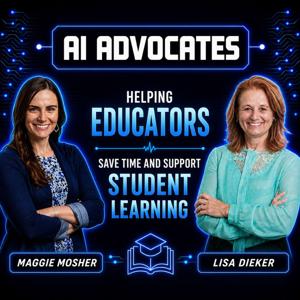
Welcome to AI Advocates, a podcast focused on helping educators integrate artificial intelligence into their classrooms to save time, support learning, and create more opportunities for…
In each episode, Lisa and Maggie break down different types of AI, including Narrow AI, Generative AI, and the growing field of Superintelligent AI. They share insights on how AI can support both educators and students while helping improve accessibility, equity, and learning outcomes in the classroom.
Whether you’re just starting to learn about AI or looking for ways to use it in your classroom, AI Advocates is your go-to resource for exploring what's possible in education. Tune in for short, bite-sized episodes packed with practical advice, thought-provoking discussions, and a few laughs along the way!