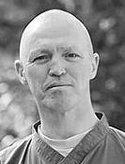
(Dharmagiri) The heart has tremendous potential for good or bad. We practice to clean up unfortunate effects that get established on it. Principles of respect, restraint and compassion are not only foundations for heart cultivation, but offerings to the world.
(Cittaviveka) In Dhamma practice we’re inclining citta towards itself, gathering in attention to recognize where the heart is engaged. Certain engagements will lead to liberation. The practice of recollection is one.
(Cittaviveka) A recollection of the qualities and effects of the teacher, Ajahn Chah. A teacher’s presence can bring forth a lot in people. They recognize the potential for strength that is there for all of us and help us develop pāramī.
(Cittaviveka) Something in us – citta – searches for release from suffering. It struggles to rise out of old patterns, which means one has to enter them. Sweeping meditation is a skillful means. It’s not just a physical exercise but an opportunity to clear kamma.
(Cittaviveka) We come to Dhamma practice hoping for calm and quiet, but that may be down the track a while. Begin instead with dialogue, listening to the inner chatter with patience and steadiness. As agitated and troubling states are lovingly met, the passion around them fades. We can experience the nibbāna element here and now.
(Cittaviveka) Unskillful saṇkhāras can be undone in the same way they are formed – through perception. Choose particular tones like friendliness and welcome. Introduce them into the body and ask how it feels. Skillful use of perception and attention can sooth and steady the body’s energy.
(Cittaviveka) Contact with the world causes citta to lose its sense of ground, space and rhythm. Use of body is recommended as a meditation theme. We practice to carefully meet contact impression, training intention and attention to be for one’s welfare.
(Cittaviveka) The unawakened worldly mind seeks to accumulate. It generates a sense of self from holding on. The Anattalakkhaṇa Sutta points to release and letting go. We practice standing back from phenomena, allowing things to move and shift without reacting to them. Just witnessing and awake – this is liberation.
(Cittaviveka) We are encouraged to understand saṇkhāra, the programs that take hold of us and result in unskillful states. It is possible to not act on these programs, release some of their pressure, and turn the citta towards skillful states.
(Cittaviveka) Citta is only touched by feeling and perception. Through not seeing this, not feeling and directly handling it, the whole realm of dukkha gets fabricated. Meet experience directly, with mindfulness and wisdom, and suffering eases up.
41 min
About Ajahn Sucitto's most recent Dharma talks (Insight Meditation Community of Berkeley)
From the publisher's feed
As a monk, I bring a strong commitment, along with the renunciate flavor, to the classic Buddhist teachings. I play with ideas, with humor and a current way of expressing the teachings, but I don't dilute them.
Sitting in a field of fifty to eighty people really starts my mind sparking. Since I don't prepare my talks ahead of time, I find myself listening to what I'm saying along with everyone else. This leaves a lot of room for the Dhamma to come up. Just having eighty people listening to me is enough to engage me, stimulate me, and create a nice flow of energy. The actual process of teaching evokes ideas that even I did not realize were being held somewhere in my mind.
Different teaching situations offer their own unique value. In retreat, you are able to build a cohesive and comprehensive body of the teachings. When people are not on retreat and come for one session, it opens a different window. They are more spontaneous and I'm given the chance to contact them in ways that are closer to their "daily-life mind." This brings up surprises and interesting opportunities for me to learn even more.
I'm continually struck by how important it is to establish a foundation of morality, commitment, and a sense of personal values for the Vipassana teachings to rest upon. Personal values have to be more than ideas. They have to actually work for us, to be genuinely felt in our lives. We can't bluff our way into insight. The investigative path is an intimate experience that empowers our individuality in a way that is not egocentric. Vipassana encourages transpersonal individuality rather than ego enhancement. It allow for a spacious authenticity to replace a defended personality.
I normally incorporate Qi Gong instruction in my retreats. They are not suitable as audio files but you can watch the nine videos here: https://tinyurl.com/Sucitto-qigong