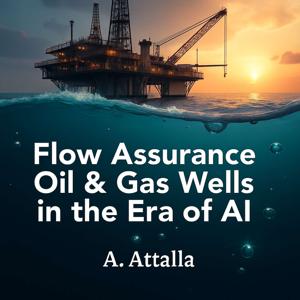
Artificial intelligence (AI) and machine learning are rapidly transforming the oil and gas industry, particularly in flow assurance and predictive maintenance. These technologies enable a shift from reactive to proactive management by analyzing vast streams of real-time and historical data to anticipate issues like hydrate and wax deposition, corrosion, and equipment failures before they occur. This approach reduces unplanned downtime, extends asset life, improves safety, and optimizes operational efficiency across both upstream and downstream activities.
A variety of advanced AI techniques—such as deep learning models (LSTM, GRU, CNNs), fuzzy logic systems, and anomaly detection algorithms—are deployed to tackle specific operational challenges. These models rely on robust data management, with sensors and IoT devices generating large volumes of data that require rigorous preprocessing and integration. Hybrid modeling, which combines data-driven AI with physics-based models, further enhances prediction accuracy and helps quantify uncertainty, especially when data is limited or noisy.
Despite their benefits, AI adoption faces significant challenges, including system integration, data quality, workforce skills, high implementation costs, and the need for model reliability and interpretability. AI is designed to augment human expertise, acting as a digital assistant that highlights critical anomalies for expert review. Looking ahead, tighter integration with digital twins and edge computing, broader adoption of cloud and big data, and a focus on safety and sustainability are expected to drive further innovation and efficiency in the industry.
Thank you for listing!
Ahmed Attalla
________________________________________________________
Note: You are also welcome to watch my videos on
https://vimeo.com/showcase/11506865
https://www.youtube.com/@azab14
Links :
linkedin.com/in/ahmed-attalla-19764614
facebook.com/aattalla1?mibextid=LQQJ4d