
Sign up to save your podcasts
Or



With the Tunguska impact having happened over 100 years ago, June 29/30 is Asteroid day. Here we focus mainly on asteroid relate topics and some great objects we can see in the sky over the summer months.
Mary and Julie discuss the discovery of Pluto's moon Charon, the summer solstice, then go on several side quests while discussing missions that have side quests.
Image by A. Dunn from https://commons.wikimedia.org/wiki/File:Summer_Solstice_Sunrise_over_Stonehenge_2005.jpg
Join our host Maheen Hemani and cohost Dr. Elaina Hyde for a high-energy x-ray investigation of galaxies and history. We discuss the recent news from Chandra, MeerKat, JWST and of course York University. Did you know that the fastest wind near a supermassive black hole ever found (as of yet) at ultraviolet wavelengths was by YorkU researchers?
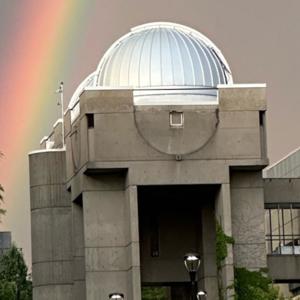
Tune into this weeks episode to learn about how to explore the summer skies, and hear about exciting space news in our galaxy and beyond!
Image: The Milky Way over the 16'' telescope at Killarney Provincial Park Observatory. Image credit: Anna Skrinnik and Sunna Withers
Rocky asteroids, planets and meteors make for dynamic objects. Tonight we talk about sky viewing for Mercury and Venus as well as asteroids and the recent Ontario meteorite. The host is Dr. Elaina Hyde and we are joined by special guest Mahesh Aravamudan, a RASC Toronto Center member and astronomy enthusiast to investigate.
Image Credit: The general shape of Psyche viewed from the south pole with an ellipsoidal overlay. Its major and intermediate axes with longitudes are labeled, and three major deviations from the ellipsoid, labeled Alpha, Bravo, and Charlie, are shown. By Michael K. Shepard et al. (see https://iopscience.iop.org/article/10.3847/PSJ/abfdba#psjabfdbaf9 for full list of authors).
Julie and Maheen explore the technology that makes scientific advancement possible. From using cinematography to record solar eclipses at the turn of the last century to AI use in future space missions and using fungi to grow food in regolith, thinking outside of the box has led to some pretty amazing stuff!
Episode photo: A view of the Aug. 21, 2017, total solar eclipse from Madras, Oregon. Credit: NASA/Gopalswamy
This week, we look at the night sky, some space and astronomy news, and, most importantly, celebrate some of the great mothers in the field!
Spectra and Light are important to all of Astronomy as we know it today. Join special guest Dr. Thomas Morris for a history and news adventure in spectroscopy with our host Dr. Elaina Hyde. What is light? What is it used for in Astronomy, and how can amateur astronomers help?
Image Credit: Fraunhofer made this copper etching in 1815, He coloured the spectra and lines as well as drew the spectral response curve above. A now standard view of spectra it was revolutionary at the time! Deutsches Museum Archv 43952
Here we talk about a few history topics and some planetary observations.
Mars Express Observations
https://www.esa.int/Science_Exploration/Space_Science/Mars_Express/Ash_creeps_across_Mars
Julie and Elaina discuss the illustrious careers of Max Planck and Ibn al-Haytham in This Week and Space and Astronomy History. In the news, dark volcanic ash is moving across the Martian surface, the Lyrid meteor shower peak is almost here, mineral dust is increasing cloud production in the Venusian atmosphere, and NASA has found interstellar glaciers that are definitely not glaciers, but are very cool nonetheless.
Image Credit: Elaina Hyde/AICO
From the publisher's feed