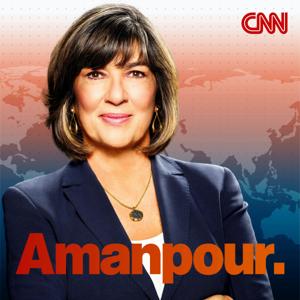
Amanpour

Amanpour

By CNN PodcastsNews
Download on the App Store
  • Favorites

    1,426

    Followers

  • Latest release

    Today

  • Typical duration

    56 min

    per episode

  • If it hooks

    44%

    finish an episode

Based on Podcast App listening data

All Amanpour episodes

  • Amanpour: Ali Shabani, Danylo Lubkivsky, Evan Osnos and Chris Hughes
    After Iran admitted accidentally shooting down a Ukrainian passenger plane, the regime finds itself under pressure from its own people and over the weekend, President Trump tweeted his support for the growing protests. To break this all down, Mohammad Ali Shabani, an Iran research at SOAS University of London, joins Christiane Amanpour in London. The doomed Flight 752 outbound from Iran was heading towards Kiev and eleven Ukrainian nationals lost their lives on board after it was shot down. Danylo Lubvisky was the Ukrainian Deputy Foreign Minister at the time of the MH17 disaster and he speaks from his experience of the fallout this will cause. This week, Beijing's top trade negotiator has touched down in DC with one aim; to bring an end to a bitter economic war between the two superpowers. Evan Osnos has written extensively on this subject for The New Yorker and he gives his analysis of the relations between the U.S. and China. Our Hari Sreenivasan sits down with Chris Hughes, co-founder of Facebook, to talk about his concerns that the tech giant is too powerful and may be a potential risk to liberal democracy. He is now leading the battle against corporate monopolies, a fight that could bring to face-to-face with the company he helped build.
    To learn more about how CNN protects listener privacy, visit cnn.com/privacy
    57 min
  • Amanpour: Michael Kergin, Richard Dalton, Barbara Slavin, Ervand Abrahamian and Daniel Fessler
    Speaking at a candlelit vigil in Toronto to mourn the victims of the Ukrainian plane crash which killed all 176 on board, including many Canadian and Iranian nationals, Canadian Prime Minister Justin Trudeau said that Canadians "deserve answers." To discuss this tragic human cost of this diplomatic drama, Christiane Amanpour speaks with Canada's former Ambassador to the U.S Michael Kergin. Richard Dalton, former British Ambassador to Iran, and Barbara Slavin, the Atlantic Council's top Iran expert, talk about the urgent need for diplomacy to ease tensions between the U.S. and Iran. Ervand Abrahamian, historian and Iranian-American author of "The Coup", digs down into the turbulent and complex relationship between the two nations that goes back decades. He sits down with our Walter Isaacson and looks back at the Iranian revolution and the hostage crisis of 1979. In a world filled with violence and polarization, Daniel Fessler, anthropologist and director of the UCLA Kindness Institute, explains the need for more kindness in the world.

    To learn more about how CNN protects listener privacy, visit cnn.com/privacy

    Learn more about your ad choices. Visit podcastchoices.com/adchoices

    58 min
  • Amanpour: Michael Kergin, Richard Dalton, Barbara Slavin, Ervand Abrahamian and Daniel Fessler
    Speaking at a candlelit vigil in Toronto to mourn the victims of the Ukrainian plane crash which killed all 176 on board, including many Canadian and Iranian nationals, Canadian Prime Minister Justin Trudeau said that Canadians "deserve answers." To discuss this tragic human cost of this diplomatic drama, Christiane Amanpour speaks with Canada's former Ambassador to the U.S Michael Kergin. Richard Dalton, former British Ambassador to Iran, and Barbara Slavin, the Atlantic Council's top Iran expert, talk about the urgent need for diplomacy to ease tensions between the U.S. and Iran. Ervand Abrahamian, historian and Iranian-American author of "The Coup", digs down into the turbulent and complex relationship between the two nations that goes back decades. He sits down with our Walter Isaacson and looks back at the Iranian revolution and the hostage crisis of 1979. In a world filled with violence and polarization, Daniel Fessler, anthropologist and director of the UCLA Kindness Institute, explains the need for more kindness in the world.
    To learn more about how CNN protects listener privacy, visit cnn.com/privacy
    57 min
  • Amanpour: Tim Kaine, Fred Pleitgen, Dickie Arbiter, Mark Landler and Cyrus Habib
    Democratic Senator Tim Kaine from Virginia joins Christiane Amanpour to discuss the ongoing political crisis between the U.S. and Iran, just as reports emerge that the Ukrainian Boeing plane that crashed killing 176 people, may have in fact been mistakenly shot down by Iran. He unpacks what action is occurring in Washington to limit any further military escalation. Fred Pleitgen, CNN Senior International Correspondent, gives the view from ground in Tehran. He explains the Iranian government's stance on these latest developments. Dickie Arbiter, former press secretary to Queen Elizabeth II, and Mark Landler, London bureau chief at The New York Times, give their perspective on the unprecedented news that Duchess of Sussex, Meghan Markle, and Prince Harry are stepping back as senior royals. They asses what has prompted this move and how it will work practically and financially. Our Hari Sreenivasan sits down with Cyrus Habib, Washington Lieutenant Governor, to talk about the demonization of Iranian-Americans.

    To learn more about how CNN protects listener privacy, visit cnn.com/privacy

    Learn more about your ad choices. Visit podcastchoices.com/adchoices

    58 min
  • Amanpour: Tim Kaine, Fred Pleitgen, Dickie Arbiter, Mark Landler and Cyrus Habib
    Democratic Senator Tim Kaine from Virginia joins Christiane Amanpour to discuss the ongoing political crisis between the U.S. and Iran, just as reports emerge that the Ukrainian Boeing plane that crashed killing 176 people, may have in fact been mistakenly shot down by Iran. He unpacks what action is occurring in Washington to limit any further military escalation. Fred Pleitgen, CNN Senior International Correspondent, gives the view from ground in Tehran. He explains the Iranian government's stance on these latest developments. Dickie Arbiter, former press secretary to Queen Elizabeth II, and Mark Landler, London bureau chief at The New York Times, give their perspective on the unprecedented news that Duchess of Sussex, Meghan Markle, and Prince Harry are stepping back as senior royals. They asses what has prompted this move and how it will work practically and financially. Our Hari Sreenivasan sits down with Cyrus Habib, Washington Lieutenant Governor, to talk about the demonization of Iranian-Americans.
    To learn more about how CNN protects listener privacy, visit cnn.com/privacy
    57 min
  • Amanpour: David Urban, Mohammad Marandi, Antony Blinken and Mina Al-Oraibi
    David Urban, corporate lobbyist and Trump's campaign strategist, joins Christiane Amanpour to give his analysis of the President's address to the nation after Iran's retaliatory airstrike on U.S. coalition air bases in Iraq. Mohammad Marandi, chair of American Studies at the University of Tehran, gives his view from Tehran; he assesses the proportionality of this strike as well as the rhetoric coming from the two leaders of the hostile nations. Antony Blinken, former U.S. Deputy National Security Adviser, discusses how President Trump has seemingly stepped back from further military confrontation whilst at the same time still fervently criticizing the Iran nuclear deal. Mina Al-Oraibi, editor-in-chief at The National, also weighs in about the impact this will have on the Persian Gulf states who are very dependent on America's military presence in the region. She unpacks Trump's desire for NATO to take on some of that burden.

    To learn more about how CNN protects listener privacy, visit cnn.com/privacy

    Learn more about your ad choices. Visit podcastchoices.com/adchoices

    58 min
  • Amanpour: David Urban, Mohammad Marandi, Antony Blinken and Mina Al-Oraibi
    David Urban, corporate lobbyist and Trump's campaign strategist, joins Christiane Amanpour to give his analysis of the President's address to the nation after Iran's retaliatory airstrike on U.S. coalition air bases in Iraq. Mohammad Marandi, chair of American Studies at the University of Tehran, gives his view from Tehran; he assesses the proportionality of this strike as well as the rhetoric coming from the two leaders of the hostile nations. Antony Blinken, former U.S. Deputy National Security Adviser, discusses how President Trump has seemingly stepped back from further military confrontation whilst at the same time still fervently criticizing the Iran nuclear deal. Mina Al-Oraibi, editor-in-chief at The National, also weighs in about the impact this will have on the Persian Gulf states who are very dependent on America's military presence in the region. She unpacks Trump's desire for NATO to take on some of that burden.
    To learn more about how CNN protects listener privacy, visit cnn.com/privacy
    57 min
  • Amanpour: Mark Esper, Massoumeh Ebtekar, Elissa Slotkin and Turki Al-Faisal
    Mark Esper, U.S. Defense Secretary, joins Christiane Amanpour to defend the decision to carry out a targeted killing of Iran's top military commander, Qasem Soleimani. He explains why he doesn't regret the decision as well as the "imminent threat" that justified such an extreme course of action. Massoumeh Ebtekar, the Iranian Vice President on Women and Family Affairs, gives her counter-viewpoint, arguing that the White House made a serious miscalculation. Elissa Slotkin, U.S. House Democrat for Michigan, weighs in on the debate by giving her expert analysis as a former CIA analyst who served 3 tours in Iraq. She explains the war power resolution that she has been tasked with drawing up, to block the president's path to war in the region. Turki Al-Faisal, former Saudi Ambassador to the U.S., discusses concern coming out of the Kingdom and the effort launched to deescalate tensions between the U.S. and Iran.

    To learn more about how CNN protects listener privacy, visit cnn.com/privacy

    Learn more about your ad choices. Visit podcastchoices.com/adchoices

    58 min
  • Amanpour: Mark Esper, Massoumeh Ebtekar, Elissa Slotkin and Turki Al-Faisal
    Mark Esper, U.S. Defense Secretary, joins Christiane Amanpour to defend the decision to carry out a targeted killing of Iran's top military commander, Qasem Soleimani. He explains why he doesn't regret the decision as well as the "imminent threat" that justified such an extreme course of action. Massoumeh Ebtekar, the Iranian Vice President on Women and Family Affairs, gives her counter-viewpoint, arguing that the White House made a serious miscalculation. Elissa Slotkin, U.S. House Democrat for Michigan, weighs in on the debate by giving her expert analysis as a former CIA analyst who served 3 tours in Iraq. She explains the war power resolution that she has been tasked with drawing up, to block the president's path to war in the region. Turki Al-Faisal, former Saudi Ambassador to the U.S., discusses concern coming out of the Kingdom and the effort launched to deescalate tensions between the U.S. and Iran.
    To learn more about how CNN protects listener privacy, visit cnn.com/privacy
    57 min
  • Amanpour: Mohammad Marandi, Chris Murphy, Ayad Allawi, Stephen Hadley and Tim Flannery
    Mohammad Marandi, chair of American studies at the University of Tehran, joins Christiane Amanpour to discuss the shocking targeted strike on one of Iran's top generals, Qasem Soleimani. He was killed in an U.S. airstrike whilst he was visiting Iraq and it has prompted both celebration and deep concern for how this will impact the already tense relations between the two nations. Democratic Senator Chris Murphy explains why this violates congressional rules and procedures and how the House plan to stop what they see as President Trump waging an undemocratic war in Iran. Ayad Allawi, the former Prime Minister of Iraq, reflects on the fact this controversial and deadly airstrike occurred on his country's soil. In response, Iraq voted to expel U.S. forces and President Trump is threatening sanctions if they make good on their word. Allawi digs down into what he sees are the next steps for the players involved. Stephen Hadley, former U.S. National Security Advisor, unpacks the strength of the evidence for Soleimani's killing. Lastly, Tim Flannery, the man at the helm of Climate Council Australia, talks passionately about the devastating fires that are consuming Australia killing millions of animals in its wake. He explains about the science and policy that is causing this crisis.

    To learn more about how CNN protects listener privacy, visit cnn.com/privacy

    Learn more about your ad choices. Visit podcastchoices.com/adchoices

    58 min