
Sign up to save your podcasts
Or

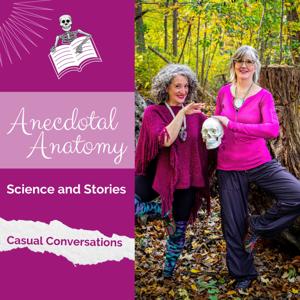


Once upon a time, in bucolic Bucks County, PA, two yoga educators put their hearts and minds together to tell the epic tales our bodies tell. Their mission was simple, to reveal the stories our bodies hold and tell in service of linking the individual to the collective.
It began with the idea of teaching anatomy by attributing character traits and storylines to our systems, bones, muscles, tendons, ligaments, and any other aspects of our gross anatomy. It was to learn the functions, movements, and systems of the body through storytelling. Interestingly enough, what actually unfolded started with the body, but rather than telling the stories that would increase scientific knowledge of the skeleton and other tangibles, what came up more often were the stories held and told from the body (using the Koshas/layers including: food body, energy and breath body, thoughts and emotions, wisdom, and bliss).
This final episode is not meant to imply the conversations are complete, only that the podcast conversations have come to a stopping point.
In this episode, Sherry & Theresa say farewell (Until next time) and offer their loyal listeners a couple of guided practices to punctuate this ending (and maybe glimpse bliss). They will also be available (FREE) in the Anecdotal Anatomy website store.
It was a deliberate choice to end on E88. The number itself is infinity, it is abundance and alignment. While the podcast is ending, Anecdotal Anatomy in Action is continuing with newfound momentum and joy.
If you enjoy this podcast, please stay tuned for information on our LIVE seasonal events! Please join The List so you can stay informed and in touch!
And now a personal note: We are incredibly grateful for every drop of support we have received during these pasta 88 weeks! When we think of you, we feel we know you, even though we cannot see you. Thank you!
Until next time...
Thank you to our amazing team! Please visit their links for more information! This has been a most excellent collaboration!
Our Amazing Team:
Judith George - Editor (video & audio)
Keith Kenny - Music
Cindy Fatsis - Photography
You know you’ve changed when what once made you mad now makes you laugh. (Tony Gaskins)
That sounds like wisdom. Perspective often yields to wisdom which is why we assume it comes with age. In this, our penultimate episode, we revisit Vijnanamayakosha - the wisdom sheath, which includes intellect and intuition. While this is not a new topic for discussion, but it is spoken about and explored in a different way.
The wisdom of experience is the best teacher. We can fill our cups with data-driven knowledge, but without the nuance of story and context, often we're left with dry dates and numbers. Minus any part, it may touch the intellect but will rarely stir the soul.
Wisdom shows up sometimes when we are trying to form the right response in the moment, knowing there is no one-size-fits-all. Wisdom in the skillful reading of any room. One person may need to hear something that would make another person roll her eyes. Reading the room is where wisdom and compassion meet.
Being present is a window into wisdom and intuition. The times when we're gazing through that window and still miss the mark, wisdom clears the way for resolution. Wisdom also asks, how can I best serve you? Or just guides deep listening.
While the Koshas (Vijnanamaya, the fourth of five) are depicted having a certain order, it can be illuminating to explore them in different ways. Observing your thoughts as a means to discover the origin story of back pain, for example. Or using breath practices to activate the parasympathetic nervous system as a way to work with discursive and anxious thoughts.
There are many subtle body anatomy maps to study and play with, including the koshas and chakras, among many.
Working with secondary awareness, also referred to as the awareness of awareness, gives us an in-the-moment opportunity to make the choice to interrupt an unproductive pattern. It is the wisdom of growth.
On the road to growth and self-discovery, we are often presented with a variety of teachings, lineages, and practices; wisdom allows us to discern what works best for us without getting lost in the din.
There are myriad practices available for exploration, something for everyone. We don’t always know why we end up where we are, but when it resonates, we know. Over time, we get to look back and understand the wisdom of the journey through the perspective of a wider lens.
Theresa shared a definition she recalled from her time on this path, “Wisdom is the ability to perceive the unintended consequences of both actions and inactions.” This provides for reality that not making a choice is making a choice. It’s not always what we choose to do, but what we choose not to do. It’s the choice that allows us to interrupt patterns AND there are consequences to both.
Wisdom is knowing what you don't know or even that you don't know.
Wisdom may arrive in the form of trust. When we have faith in the messages we receive and the circumstances we are in, we cultivate the ground for wisdom.
Sherry reads a story about a Zen Master (link below). It not only speaks to knowing when enough is enough, it reveals how we must empty our cups to receive teachings, that if we arrive full with what we know, our opinions, and stories, there won't be space for learning. That's wisdom.
NOTE: For those who felt left hanging after Sherry referenced Surya (Sun) and were wondering about its counterpart (which fizzled in the conversation) - Chandra (moon).
Sources and mentions from the show:
Zen Master Story with the Teacup
Just for Us – Alex Edelman
Yardley Eye Care
GISH(WHES)
***
Our Amazing Team:
Judith George - Editor (video & audio)
Keith Kenny - Music
Cindy Fatsis - Photography
This episode looks at play through the lens of Manomayakosha, the mental/emotional sheath (see Koshas, Season 1). Slipping into a playful mindset is beneficial in many ways.
Theresa and Sherry share stories of how play has shown up in their lives, from jobs to grandkids. They explore the value of play through storytelling, song, and poetry, and its capacity for healing. They also touch on the shadow side of play, including being overly competitive.
Ultimately, they agree that a playful mindset is essential for optimal growth, connection, and overall wellness.
***
Sources & Mentions from the Show:
***
Our Amazing Team:
Judith George - Editor (video & audio)
Keith Kenny - Music
Cindy Fatsis - Photography
Here we are at episode 85, only three more to follow before we wrap up these conversations.
We are sad to announce that the CAMP experience we lovingly curated was ultimately canceled (so please do not see this as an invitation to come to CAMP this summer, rather an invitation to see the magic in your life and add a dash of play to your daily doings).
These final show notes will reflect the casual nature of our conversations (no more time-stamped synopses).
At the time of recording, we were still moving fully forward with CAMP, sharing the M inspiration, including Mindfulness, Magic, and Movement, while examining them through the lens of Pranamayakosha (the energy sheath). In these practices we see the energy as riding the breath. There is immense power of breath in the creation and direction of energy.
Pranayama is the term for breathing practices in Yoga. Certain breath practices can influence the parasympathetic nervous system, promoting calm and restoration, while others can amp us up when necessary. Both are valuable and accessible through the breath.
It may seem counter-intuitive to have to learn to breathe, but since the breath is the one aspect of the autonomic nervous system that can also be directed on purpose, it holds a lot of power.
We talk about different practices including open-eyed mindfulness meditation, closing eyes for a different experience of accessing one's energetic body, and Theresa's Sit Spot practice among others.
There's so much packed into this episode, going back to our origin stories (some only accessed through old journals). We discussed the power of words and Theresa mentioned that the word Spelling has the word SPELL right there!
Sherry started to share a story about a spell she used when she met her husband. She shared one ritual (putting his name in a bowl of sugar) and how he called as soon as the match went out - what she forgot to mention was that she lit the match while speaking words given to her by a friend, a spell of sorts. The words ended, the match went out, her future husband called in that very moment!
We both walked down memory lane, to the best of our recollections.
In the end, we conclude with the potent reminder of of the gift of life and the abundance of magical energy around and within us.
Have a listen!
***
Mentions from the show:
Nadi Shodhana
Reverse Breathing
Mindfulness Meditation Instruction - eyes open
TED Talk - How I made friends with reality - Emily Levine
***
Our Amazing Team:
Judith George - Editor (video & audio)
Keith Kenny - Music
Cindy Fatsis - Photography
On today's episode, we announced that our final podcast will be E88. We still have a few more things to discuss in our weekly casual conversation, but we also feel it coming to its natural conclusion.
Anecdotal Anatomy (the podcast) will be now be Anecdotal Anatomy in Action (seasonal signature programs - mostly live, some virtual).
Our next program is CAMP (8/4 &5), a place for women to gather, play, practice, laugh, and generally just BE. We are using these final episodes to end as we began, using the Koshas as a model for looking at the various aspects and pillars of CAMP through the layers of our being. If you're local to Bucks County, PA and would like to join the fun, click any CAMP you see in these Show Notes.
This episode touches on the A in cAmp which stands for Awareness, Alignment, and Anecdotes, as seen through Anamayakosha (the Food Body).
In a nutshell, this conversation is about the awareness of the physical body, its alignment and the stories it holds and tells.
***
Here is a very brief breakdown, time-stamped summary:
***
Sources & Snippets from the Show:
Book: gluten-free girl: How I found the Food that Loves Me Back...and How You Can Too
John Sarno (Dr. Sarno is no longer here, but this is his process - along with testimonials)
Koshas - this is one of countless sources for study on the Koshas.
Greenland - no trees! Okay, there used to be some trees and now there are some shrubs. This is one of a number of articles on the subject.
Fox Walk - this is a sweet link. Go out and give it a good meander!
Hanuman
***
Our Amazing Team:
Judith George - Editor (video & audio)
Keith Kenny - Music
Cindy Fatsis - Photography
This week, Theresa & Sherry explore the transformational journey that happens when we connect through creativity, community and communication. This journey is different for each traveler.
Focusing on their on live programs and events, this episode is the first in the acronym breakdown of CAMP, an immersive adult camp coming up in August.
The C in CAMP is for Creativity, Community, Communication and, of course, Connection. This episode explores these various C-energies in the context of inner transformation.
The key moments in this episode are:
00:00:00 - Introduction
00:01:43 - Importance of Communication
00:04:41 - Pebbles on the Path
00:09:43 - The Seed of Transformation
00:12:38 - Building Community
00:14:59 - The Importance of Listening in Communication
00:16:12 - The Chakra System and Communication
00:17:56 - Awareness and Patterns in Communication
00:19:48 - Transformation and the Importance of Small Changes
00:21:53 - Finding Communities and Discovering What We Love
00:29:07 - Workshop with Julia Cameron and Sonia Choquette
00:31:27 - The Importance of Nurturing Creativity
00:33:37 - The Elements of Transformation
00:38:37 - The Power of Community and Reflection
00:41:49 - The Joy and Power of Play
00:45:11 - "Introduction: Everything We Talk About"
00:46:04 - "Reading Each Other and the Unseen Audience"
00:47:40 - "The Creative Process and Collaboration"
00:48:59 - "The Role of Communication, Community, and Creativity"
00:52:18 - "Gratitude and Playfulness in Transformation"
Episode Goodie Bag:
CAMP information and registration
Julia Cameron - The Artist's Way
Sonia Choquette - The Psychic Pathway
Our Amazing Team:
Judith George - Editor (video & audio)
Keith Kenny - Music
Cindy Fatsis - Photography
This episode on acknowledging and honoring our teachers was poetically recorded on Guru Purinima (a Hindu, Buddhist celebration of teachers - it honors the day the first guru was born - click link for more information).
This personal episode has the hosts reaching back for memories of primary and secondary teachers, as well as their own identification as teachers. Both agree that their students often show up as teachers. In the world of reflection, everything has the capacity of being a teacher, if we pay attention.
Timestamped summary of this episode:
00:00:00 - The Teacher-Student Dynamics
The hosts discuss the flip-flop of teacher and student roles and how learning can come from unexpected sources, such as animals.
00:03:24 - Lessons from Animals
The hosts talk about the lessons we can learn from animals and how observing them can provide valuable insights.
00:05:02 - The Once and Future King
The hosts discuss the book "The Once and Future King" and how it explores the concept of transformation and learning through different perspectives.
00:07:34 - Critical Thinking and Learning
The hosts share their experiences with education and how critical thinking and curiosity are important for true learning.
00:10:05 - Impact of Teachers
The hosts reflect on the impact of teachers on their learning journey and how teachers can either foster or hinder a student's progress.
00:15:12 - The Importance of Teaching and Absorbing Information
The hosts discuss the importance of teaching in fully absorbing and understanding information. They mention that there is data suggesting that we absorb different amounts of information through hearing, reading, and seeing. They also share their personal experiences of how teaching has helped them gain a clearer focus on yoga philosophy and other aspects of their practice.
00:16:14 - Seeing Classrooms as a Circle of Learning
The hosts talk about their perspective on classrooms and teaching. They view all classrooms as a circle and see themselves as arcs within that circle. They mention how Sean Corn's statement about having the capacity to communicate information in a way that people can best receive it resonated with them. They emphasize the importance of communication, humor, and personal anecdotes in teaching.
00:17:36 - Learning from Students
The hosts share an example of how they learned from a student during a yoga class. The student expressed reluctance to perform a cleansing breath because she felt it would be wasting her prana. This perspective made the hosts reconsider their teaching approach and they adjusted it to encourage mindfulness and directing the breath and energy towards someone who could benefit from it. They highlight the importance of listening to and learning from students.
00:20:27 - Transforming Teaching Approach
One of the hosts reflects on a teaching experience where none of the students did the assigned reading. Initially, they reacted with frustration and employed a punishment-like approach. However, they realized their mistake and transformed the situation into a positive teaching moment by having students teach
00:29:59 - Mr. Woodley's Intuition
The narrator reflects on their experience with Mr. Woodley, a coach who showed understanding and support during their nose job. Mr. Woodley recommended the narrator for Honors English and expressed belief in their potential.
00:31:13 - Mr. G and Existentialism
The narrator shares their experience in Honors English with Mr. G, who taught existentialism. Despite struggling academically, the narrator felt seen and understood by Mr. G, who gave them an A and acknowledged their unique contribution to the class.
00:33:56 - Mrs. Tobin and Creative Expression
The narrator recalls a challenging teacher, Mrs. Tobin, who criticized their creative doodles and discouraged their individuality. The narrator stood up for themselves, but it was clear that Mrs. Tobin was not a good fit as a mentor.
00:34:09 - Mimi, a Teacher and Thinker
The narrator highlights their student-turned-mentor relationship with Mimi, a brilliant thinker and fellow learner. They continue to inspire each other and engage in thought-provoking conversations, exploring different perspectives and embracing intellectual curiosity.
00:37:34 - The Generosity of Teaching
The narrator reflects on the role of a teacher and emphasizes the importance of being a learner oneself. They acknowledge the need for a two-way flow of information and the transformative power of teaching students to complete and finish tasks, beyond just following a curriculum.
00:43:47 - Embracing the Unknown
The hosts discuss how their experiences have taught them how to handle the unknown. They emphasize the importance of taking action and just "doing it" in order to learn and grow.
00:44:41 - Lessons from "To Sir, with Love"
The hosts mention the movie "To Sir, with Love" and discuss how the main character taught his students valuable lessons about healthy eating and self-respect. They highlight the power of teaching and the impact it can have on others.
00:46:32 - The Soft Learning of Massage
The hosts share a personal story about receiving a card from a massage student expressing gratitude and referencing the movie "To Sir, with Love." They discuss the importance of recognizing and owning one's strengths as a teacher.
00:49:04 - Honoring Teachers
The hosts explore different ways to honor teachers, including expressing gratitude and incorporating their teachings into daily life. They emphasize the role of awareness in recognizing and embracing the lessons taught by various teachers.
00:54:39 - The Resonance of Teachings
The hosts reflect on how certain teachings may not resonate immediately but can still have a lasting impact. They discuss the subtlety of resonance and how awareness plays a key role in recognizing and experiencing it.
00:59:09 - Learning to Feel
The speaker shares her experience of learning to feel and how challenging it was to move out of her head and into an embodied sense. She emphasizes the importance of being able to feel and land in the senses, particularly the sense of touch.
00:59:44 - Getting Out of Your Head
The speaker recounts a story about how she was able to get out of her head and into a more creative and receptive state while massaging someone. Despite initially feeling frustrated by the person singing, it ultimately helped her shift her focus and connect with her body.
01:00:35 - Curiosity and Resistance
The speaker reflects on how curiosity drives her to understand things she doesn't like or understand. She also recognizes that resistance is a valuable learning opportunity.
01:01:17 - Event Announcement
The hosts announce an upcoming event called "The Radiant Self: Illuminating the Koshas for Inner Transformation." They provide details about the date, time, and location, and express their excitement for the event. SEE BELOW & CLICK TO FIND OUT MORE AND TO REGISTER!
01:01:46 - Call to Action
The hosts encourage listeners to sign up for their newsletter and attend their upcoming events. They emphasize the importance of self-discovery and invite listeners to engage with them on their Facebook page or via email.
And then some (this is where you get a little bit more)...
If you're local, join us for RADIANT SELF - Illuminating the Koshas for Inner Transformation -- a mini retreat at Flower of Life Yoga in Morrisville, Pa - Saturday, 7.15.23 from 11:30am-3:30pm. Check out this link for more information and to sign up!
Tias Little - Yoga of the Subtle Body (book)
Meaningful Mentors - a love letter to amazing teachers - Sherry Sadoff Hanck on Substack
Once & Future King - T.H. White
CORRECTION: During her story about reading King Arthur fiction, Sherry referred to the “Cromwell” books when she meant, Bernard CORNWELL.
Our Amazing Team:
Judith George - Editor (video & audio)
Keith Kenny - Music
Cindy Fatsis - Photography
Aging is a gift, unique to each person's unfolding. This week, we talk about aging in an empowering way and without judgement. We talk about cultivating vitality rather than chasing youth.
Vitality feels like youth in the body's ability to be agile and strong, while operating from the aggregated wisdom of each era.
The key moments in this episode are:
***
Kick the Can excerpt and commentary (spoiler alert)
***
Our Amazing Team:
Judith George - Editor (video & audio)
Keith Kenny - Music
Cindy Fatsis - Photography
Join Anecdotal Anatomy for an episode that explores the art of magic and play. Discover the power of imagination, the benefits of a playful mindset, and the secrets of real magic, while ditching any notion of “magical thinking,” in service of something deeper.
The Importance of Play
Play doesn't just signify frolicking about without any tasks at hand, but it's a gateway that unlocks the sheer joy of being in the moment, being one with your surroundings, expressing the unexpressed, and just giving in to the child within.
The Benefits of Play
The liberating feeling of play has an ample range of benefits – it boosts creativity, resilience to stress, injects an excitement to live, and helps us appreciate beauty in the most underrated aspects of life. Believing play to be centric to wholistic wellness, Anecdotal Anatomy encourages its Keystone Community to integrate playful practices in every offer it puts forth. Theresa and Sherry eloquently explain how play not only assists in improving creativity and the sense of humor but also maintains a gentle balance between the mind and body.
When in a playful mindset, magic can be found anywhere and everywhere. Such instances of recognition remind us all of our inner vital sparkle. Play can have a big role in leading to self-transformation and a sense of deep gratitude. Who wouldn’t want to view life through a dynamic, playful kaleidoscope?
***
The key moments in this episode are:
***
Sources:
Peter Himmelman Official Website
Peter Himmelman Substack
***
Our Amazing Team:
Judith George - Editor (video & audio)
Keith Kenny - Music
Cindy Fatsis - Photography
This episode is the second in our two-part series on slowing down. Last week we talked about the ART of slowing down, today is more about the ANATOMY of slowing down (parasympathetic nervous system and vagus nerve).
We have dedicated this month to slowing down, including these two episodes, a free 90-minute DYE (Discover Your Excellence: The Art of Slowing Down) and a two-day retreat designed around slowing down, resetting, and re-storying. We do not declare that we have fully embodied this pace, but that we are in a daily practice to explore all the benefits that result from slowing down.
Instead of providing the time-stamped synopsis of the episode you will find some takeaways from the episode that were originally procured through ChatGPT. We expounded on these topics, using them as springboards, but wanted you to have the source material.
The vagus nerve plays a significant role in soothing and calming us by activating the parasympathetic nervous system, which is responsible for the body's relaxation response. Here are a few ways in which the vagus nerve contributes to soothing and relaxation:
Overall, the vagus nerve acts as a calming influence on the body by modulating various physiological functions. By engaging in activities that stimulate the vagus nerve, such as deep breathing, meditation, or social connection, we can enhance its soothing effects and promote a state of relaxation.
Slowing down and practicing relaxation techniques can have several benefits on our nervous system. While I don't have access to the internet to provide specific sources, I can certainly list 10 common benefits of slowing down that are often mentioned in scientific literature and popular health sources. Please note that these benefits are general and may vary from person to person:
While I cannot provide specific sources, you can find scientific studies and articles related to these benefits by searching on reputable medical and scientific databases such as PubMed, Google Scholar, or academic journals in the fields of psychology, neuroscience, and stress research.
10 ways the vagus nerve can put us into our parasympathetic nervous system
The vagus nerve plays a crucial role in activating the parasympathetic nervous system, also known as the "rest and digest" response. Here are ten ways in which the vagus nerve can help put us into our parasympathetic state:
It's important to note that while these techniques have been associated with vagal activation and parasympathetic response, individual responses may vary. It's always best to find what works best for you and consult with healthcare professionals or experts in specific techniques for personalized guidance.
Mentioned in the Show:
Wim Hof Method
Our Amazing Team:
Judith George - Editor (video & audio)
Keith Kenny - Music
Cindy Fatsis - Photography
From the publisher's feed